


11 Aug 10,000 करोड़ रुपये की CMAS योजना: भारत के कंटेनर निर्माण को बढ़ावा
✎ India’s Container Manufacturing Support Scheme (CMAS) seeks to reduce import dependency on containers by strengthening supply-chain resilience and trade competitiveness.
Subject Relevance — Where This Topic Fits
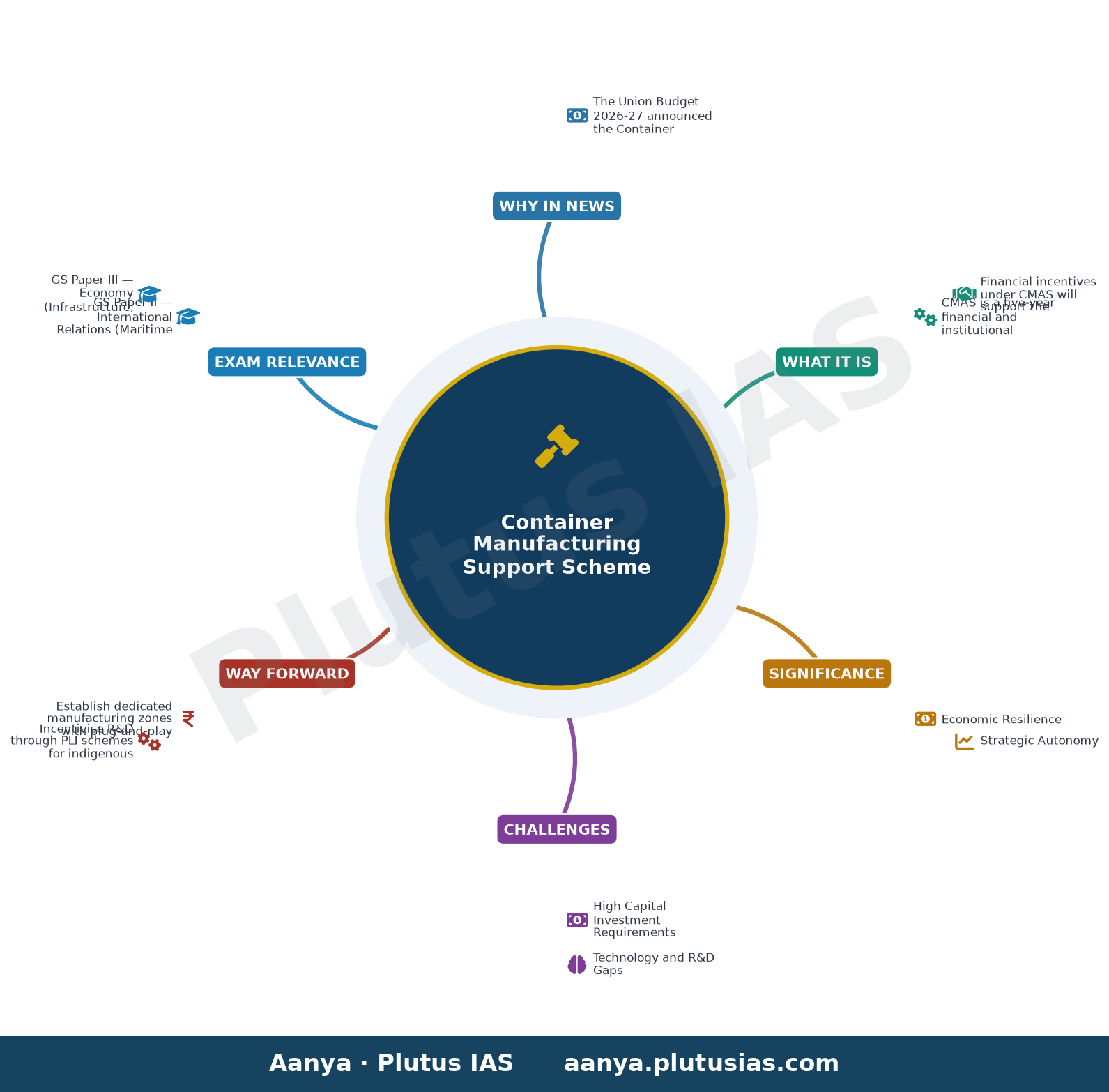
- GS Paper II — International Relations (Maritime Security, Global Supply Chains) | GS Paper III — Economy (Infrastructure, Industrial Policy, Logistics) | GS Paper III — Science and Technology (Indigenous Manufacturing, Standardisation)
- Prelims: Containerisation, TEU, ISO standards, Maritime Amrit Kaal Vision 2047, Make in India, Multi-modal Logistics, Freight-rate volatility, UNCTAD, EXIM trade
- Essay: India’s maritime logistics: From dependency to self-reliance in global trade, The role of infrastructure in India’s economic growth: A case study of the shipping sector
Quick Revision: India’s Container Manufacturing Support Scheme (CMAS) seeks to reduce import dependency on containers by strengthening supply-chain resilience and trade competitiveness.
Why is this in the news?
The Union Budget 2026-27 announced the Container Manufacturing Support Scheme (CMAS) with an outlay of ₹10,000 crore to address India’s heavy reliance on imported containers and reduce supply-chain vulnerabilities amid rising global trade disruptions and freight-rate volatility.
Background
- Global maritime trade is predominantly containerised, with UNCTAD reporting that approximately 80% of global merchandise trade by volume is transported via sea, and two-thirds of global trade value is carried in containers.
- Geopolitical tensions, supply-chain disruptions, and shifting shipping routes have exposed vulnerabilities in global logistics, increasing freight-rate volatility and operational risks for importers and exporters.
- India’s growing role in global manufacturing and trade has amplified demand for containerised cargo movement, yet the country remains heavily dependent on imported empty containers, importing nearly 2 million annually for repositioning and domestic demand.
- The scheme aligns with the Maritime Amrit Kaal Vision 2047, which aims to position India as a global maritime hub by enhancing port capacity, logistics efficiency, and indigenous manufacturing.
- CMAS complements the ‘Make in India’ initiative and the Multi-modal Logistics Parks (MMLP) scheme, which seeks to integrate rail, road, and port infrastructure for seamless cargo movement.
- The initiative is part of a broader strategy to reduce import dependency in critical logistics assets and strengthen India’s resilience in global supply chains amid de-globalisation trends.
What is the Container Manufacturing Support Scheme (CMAS)?
- CMAS is a five-year financial and institutional support scheme announced in Union Budget 2026-27 with a total outlay of ₹10,000 crore to develop a competitive domestic container manufacturing ecosystem.
- Financial incentives under CMAS will support the establishment of new manufacturing facilities and the expansion of existing units, with a focus on high-efficiency, ISO-compliant container production.
- The scheme targets the reduction of India’s reliance on imported containers, which currently stand at nearly 2 million units annually, thereby mitigating exposure to global freight-rate volatility and supply-chain disruptions.
- CMAS is designed to integrate with India’s broader maritime and logistics reforms, including port modernisation, digitalisation of shipping documentation, and the development of Multi-modal Logistics Parks (MMLPs).
- The initiative is expected to generate significant employment opportunities across the container manufacturing value chain, including in ancillary industries such as steel, welding, and logistics.
- By fostering domestic production, CMAS aims to enhance India’s trade competitiveness, reduce logistics costs, and strengthen the resilience of supply chains critical to the country’s economic growth.
- The scheme is aligned with the ‘Make in India’ initiative and the Maritime Amrit Kaal Vision 2047, which envisions India as a global maritime power by 2047.
Key Features
| Feature | Significance |
|---|---|
| Financial Outlay of ₹10,000 crore | Provides fiscal support for establishing new manufacturing units and scaling existing capacities in the container ecosystem. |
| Target Capacity of 7.5 lakh TEUs annually | Aims to reduce import dependency from ~20 lakh empty containers to near-self-sufficiency in container supply. |
| Focus on ISO-compliant containers | Ensures compatibility with global maritime logistics standards for seamless inter-modal transport. |
| Integration with Maritime Amrit Kaal Vision 2047 | Aligns with long-term policy goals for self-reliance in maritime infrastructure and trade facilitation. |
| Employment Generation Potential | Expected to create direct and indirect jobs across manufacturing, logistics, and ancillary industries. |
Why it Matters
Economic Resilience
- Reduces vulnerability to global freight-rate volatility and supply-chain disruptions by localising critical logistics assets.
- Enhances India’s trade competitiveness by lowering logistics costs through domestic container availability.
- Stimulates ancillary industries such as steel, engineering, and logistics services, fostering industrial growth.
Strategic Autonomy
- Strengthens India’s position in global maritime trade by reducing reliance on imported containers, particularly from China and Southeast Asia.
- Supports the ‘Make in India’ initiative by promoting indigenous manufacturing of high-value logistics infrastructure.
- Contributes to the ‘Maritime India Vision 2030’ and ‘Amrit Kaal Vision 2047’ by building a robust domestic maritime ecosystem.
Logistics Efficiency
- Improves turnaround time for EXIM cargo by ensuring timely availability of containers at ports and hinterland hubs.
- Facilitates seamless inter-modal transport (sea, rail, road) through standardised ISO containers, reducing trans-shipment delays.
- Enhances supply-chain predictability, which is critical for industries reliant on just-in-time inventory systems.
Employment and Skill Development
- Generates direct employment in container manufacturing, maintenance, and logistics operations.
- Indirectly supports jobs in steel, fabrication, and allied sectors, contributing to formal employment growth.
- Promotes skill development in precision engineering, welding, and quality control for high-tech manufacturing.
Challenges
1. High Capital Investment Requirements
- Container manufacturing is capital-intensive, requiring significant upfront investment in machinery, technology, and land.
- Banks and financial institutions may perceive the sector as high-risk due to long gestation periods and cyclical demand.
- Attracting private sector participation may necessitate government-backed credit guarantees or viability gap funding.
UPSC Link: Economic Survey: Capital Formation
2. Technology and R&D Gaps
- Domestic manufacturers may lack advanced technologies for producing high-grade, corrosion-resistant containers.
- Limited indigenous R&D in lightweight materials (e.g., aluminium, composites) for next-generation containers.
- Dependence on imported raw materials (e.g., high-tensile steel) could increase costs and affect competitiveness.
UPSC Link: Science & Tech: R&D in Manufacturing
3. Supply Chain and Logistics Bottlenecks
- Existing port infrastructure may not be optimally configured for efficient container handling and storage.
- Inadequate last-mile connectivity (rail/road) to hinterland logistics hubs could negate manufacturing gains.
- Regulatory delays in land acquisition and environmental clearances may hinder project execution.
UPSC Link: Logistics Efficiency: PM Gati Shakti
4. Global Competition and Market Dynamics
- Established global players (e.g., China, South Korea) dominate container manufacturing with economies of scale.
- Fluctuating global demand for containers may lead to oversupply or underutilisation of domestic capacity.
- Trade protectionism or anti-dumping duties in export markets could limit India’s container exports.
UPSC Link: International Trade: WTO Rules
5. Skilled Labour Shortages
- Shortage of trained welders, fabricators, and quality control technicians in the organised sector.
- Limited vocational training programmes tailored to container manufacturing and maritime logistics.
- Competition from other industries for skilled labour may drive up wage costs.
UPSC Link: Human Resource Development: Skill India
Challenges — UPSC Perspective
| Issue | Concern |
|---|---|
| Raw Material Dependence | High reliance on imported steel and alloys increases cost and supply risks. |
| Port Infrastructure Gaps | Inadequate handling capacity and storage facilities may delay container turnaround. |
| Regulatory Hurdles | Delays in environmental clearances and land acquisition for manufacturing units. |
| Global Price Volatility | Fluctuations in steel prices and freight rates impact profitability and pricing. |
| Technology Transfer Barriers | Limited access to proprietary manufacturing technologies from global leaders. |
| Export Market Penetration | Competition from low-cost producers in China and Southeast Asia. |
Way Forward
- Establish dedicated manufacturing zones with plug-and-play infrastructure for container producers, leveraging PM Gati Shakti corridors.
- Incentivise R&D through PLI schemes for indigenous development of lightweight, corrosion-resistant container materials.
- Strengthen port infrastructure via Sagarmala Programme to ensure seamless container handling and storage.
- Launch skill development initiatives in collaboration with MSDE and industry associations to address labour shortages.
- Facilitate technology transfer and joint ventures with global container manufacturers to bridge capability gaps.
- Develop a phased import substitution roadmap, starting with standard dry containers before advancing to specialised types.
- Promote container leasing and pooling mechanisms to optimise utilisation and reduce idle capacity.
- Integrate CMAS with trade facilitation measures under the National Logistics Policy to enhance end-to-end efficiency.
UPSC Value Addition
Keywords for Mains Answer-Writing
Container Manufacturing Support Scheme (CMAS) · Maritime India Vision 2047 · Make in India · UNCTAD maritime trade report · ISO shipping containers · TEUs (Twenty-foot Equivalent Units) · domestic container manufacturing capacity · logistics resilience · supply chain vulnerabilities · India’s EXIM trade · freight-rate volatility · multi-modal logistics · maritime infrastructure · global trade competitiveness · India’s maritime ambitions · public-private partnership in manufacturing
Concept Flow
Globalisation and containerisation of trade → Increased demand for standardised logistics assets → Supply-chain vulnerabilities due to geopolitical disruptions and freight volatility → Government recognition of need for domestic container manufacturing → Announcement of CMAS with ₹10,000 crore outlay → Target of 7.5 lakh TEUs annual capacity to reduce import dependency → Integration with Maritime Amrit Kaal Vision 2047 and Make in India → Enhanced trade competitiveness, employment generation, and strategic autonomy.
Prelims Practice Questions
Q1. Consider the following statements regarding the Container Manufacturing Support Scheme (CMAS):
1. The scheme is aimed at reducing India’s dependence on imported empty containers.
2. It seeks to establish a domestic container manufacturing capacity of 7.5 lakh TEUs annually.
3. The scheme is part of the Maritime India Vision 2047 and aligns with the ‘Make in India’ initiative.
4. The scheme provides financial support exclusively to public sector enterprises for container manufacturing.
How many of the above statements are correct?
- Only one
- Only two
- Only three
- All
Answer: Only three — Statements 1, 2, and 3 are correct as per the scheme’s objectives and alignment with national initiatives. Statement 4 is incorrect because the scheme supports both public and private sector entities.
Q2. Assertion (A): The Container Manufacturing Support Scheme (CMAS) is designed to mitigate the impact of freight-rate volatility on India’s trade.
Reason (R): Freight-rate volatility is a consequence of global supply chain disruptions and geopolitical tensions, which the scheme aims to address by enhancing domestic container manufacturing capacity.
In the context of the above two statements, which one of the following is correct?
- Both A and R are true, and R is the correct explanation of A
- Both A and R are true, but R is not the correct explanation of A
- A is true, but R is false
- A is false, but R is true
Answer: Both A and R are true, and R is the correct explanation of A — Both the assertion and reason are true, and the reason correctly explains the assertion. Freight-rate volatility is a known challenge in global maritime trade, and enhancing domestic container manufacturing capacity is a strategic response to reduce vulnerability.
Q3. Match the following initiatives with their respective objectives:
Column I (Initiative) | Column II (Objective)
—————————————————|—————————————————
A. Maritime India Vision 2047 | 1. Enhance domestic manufacturing of shipping containers
B. Make in India | 2. Strengthen India’s maritime infrastructure and global competitiveness
C. Container Manufacturing Support Scheme (CMAS) | 3. Promote domestic manufacturing across sectors
D. Multi-modal Logistics Policy | 4. Integrate road, rail, and maritime logistics for efficiency
Select the correct match:
- A-2, B-3, C-1, D-4
- A-1, B-2, C-3, D-4
- A-3, B-1, C-2, D-4
- A-4, B-3, C-1, D-2
Answer: A-2, B-3, C-1, D-4 — The correct matches are: A-2 (Maritime India Vision 2047 focuses on maritime infrastructure and competitiveness), B-3 (Make in India promotes domestic manufacturing across sectors), C-1 (CMAS aims to enhance domestic container manufacturing), and D-4 (Multi-modal Logistics Policy integrates logistics modes).
Mains Practice Question
✍ Critically examine the rationale behind the launch of the Container Manufacturing Support Scheme (CMAS) in the context of India’s evolving trade dynamics and global supply chain vulnerabilities. (15 Marks)
Approach: MODEL-ANSWER SKELETON:
1. **Contextual Background (3 points)**
– Global maritime trade dynamics: UNCTAD data on containerized cargo (80% by volume, 66% by value) and India’s rising EXIM trade.
– Supply chain vulnerabilities: Geopolitical tensions, freight-rate volatility, and disruptions in global logistics.
– India’s import dependence: Annual import of ~20 lakh empty containers, exposing it to global market fluctuations.
2. **Rationale for CMAS (4 points)**
– **Economic Resilience**: Reduce import dependency and enhance domestic manufacturing capacity (target: 7.5 lakh TEUs/year).
– **Trade Competitiveness**: Strengthen India’s position in global maritime trade by ensuring reliable container availability.
– **Employment Generation**: Boost job creation in manufacturing, logistics, and allied sectors.
– **Alignment with National Initiatives**: Complements ‘Make in India,’ Maritime India Vision 2047, and Multi-modal Logistics Policy.
3. **Challenges and Critiques (5 points)**
– **Technological and Capital Intensity**: High entry barriers in container manufacturing (steel, precision engineering, ISO standards compliance).
– **Market Competition**: Competition from established global manufacturers (e.g., China, South Korea) and price sensitivity.
– **Infrastructure Bottlenecks**: Need for robust port infrastructure, logistics connectivity, and skilled workforce.
– **Sustainability Concerns**: Environmental impact of steel-based container manufacturing and need for green alternatives.
– **Policy Implementation**: Ensuring effective disbursement of financial incentives and monitoring of outcomes.
4. **Conclusion (3 points)**
– CMAS is a strategic intervention to address structural vulnerabilities in India’s maritime trade.
– Success hinges on multi-stakeholder coordination (government, industry, and academia) and continuous policy refinement.
– Long-term benefits: Enhanced trade resilience, reduced logistics costs, and alignment with India’s ‘Atmanirbhar Bharat’ goals.
Source: PIB (Press Information Bureau)
Generated by AanyaAi for educational purpose.

- Gurugram’s groundwater extraction exceeds limit by 212%; HC seeks ban - October 4, 2026
- स्वतंत्रता सेनानी श्यामजी कृष्ण वर्मा की जन्म जयंती पर पीएम का श्रद्धांजलि - October 4, 2026
- KWML’s Feasibility Reports for Water Metro in 18 Cities: UPSC & PCS Insights - October 3, 2026

No Comments