


21 Mar National Quantum Mission: India’s Quantum Leap
This article covers “Daily Current Affairs” and the Topic of the National Quantum Mission: India’s Quantum Leap.
SYLLABUS MAPPING:
GS-3- Science and Technology- National Quantum Mission: India’s Quantum Leap
FOR PRELIMS
What is the National Quantum Mission (NQM), and why is it important for India?
FOR MAINS
What are the key challenges in implementing the National Quantum Mission?
Why in the news?
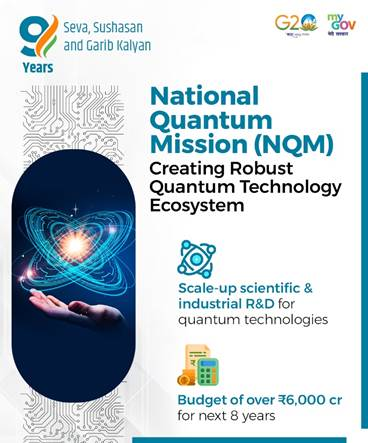
The National Quantum Mission (NQM) has been making headlines as a groundbreaking initiative by the Government of India to advance quantum technology research and development. Approved by the Union Cabinet on April 19, 2023, the mission is set to run from 2023–24 to 2030–31, with a substantial budget of ₹6,003.65 crore. This mission aims to position India as a global leader in quantum technologies, driving innovations in computing, communication, and cryptography. With the potential to revolutionize industries like healthcare, clean energy, cybersecurity, and climate research, the NQM is seen as a strategic step toward technological self-reliance and economic growth, making it a significant topic of discussion worldwide.
What is Quantum Computing?
Quantum computing is an advanced field of computing that leverages the principles of quantum mechanics to perform calculations much faster than classical computers. Unlike traditional computers, which use bits (0s and 1s) to process data, quantum computers use qubits (quantum bits), which can exist in multiple states at once due to superposition.
Key Principles of Quantum Computing:
1. Superposition: A qubit can be both 0 and 1 simultaneously, allowing quantum computers to process vast amounts of information in parallel.
2. Entanglement: Qubits can be strongly correlated, meaning a change in one qubit instantly affects another, regardless of distance. This property enables faster and more secure computations.
3. Quantum Interference: Quantum states can interfere with each other, helping optimize and refine computations.
Objectives of the National Quantum Mission
1. Quantum Computing Evolution: Develop intermediate-scale quantum computers with 20-50 physical qubits (3 years), 50-100 physical qubits (5 years), and 50-1000 physical qubits (8 years) across platforms like superconducting and photonic technologies to advance computational capabilities.
2. Satellite-Based Quantum Communication: Establish satellite-enabled quantum-secured communication between two ground stations over 2000 km within India and extend this technology for long-distance secure quantum communication with other countries.
3. Inter-City Quantum Key Distribution (QKD): Implement quantum-secured communication spanning 2000 km using trusted nodes and wavelength division multiplexing (WDM) on existing optical fibre infrastructure, enhancing secure data transmission.
4. Multi-Node Quantum Networks: Develop a multi-node quantum network incorporating quantum memories, entanglement swapping, and synchronized quantum repeaters at each node, enabling scalable and robust quantum communication (2-3 nodes).
5. Advanced Quantum Sensing & Clocks: Design highly sensitive quantum devices, including magnetometers with 1 femto-Tesla/sqrt(Hz) sensitivity in atomic systems and better than 1 pico-Tesla/sqrt(Hz) in Nitrogen-Vacancy centres, gravity sensors with better than 100 nano-meter/second² sensitivity, and atomic clocks with 10⁻¹⁹ fractional instability for precision timing, navigation, and secure communication.
6. Quantum Materials & Devices: Develop and synthesize next-generation quantum materials such as superconductors, novel semiconductor structures, and topological materials for the fabrication of qubits, single-photon sources/detectors, entangled photon sources, and quantum sensing/metrological devices for applications in computing and communication.
Implementation strategy and initiatives
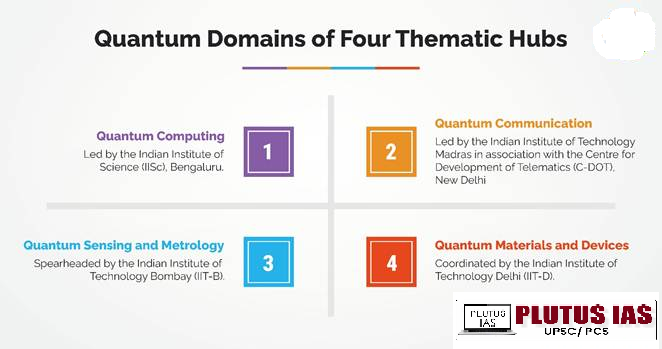
The National Quantum Mission is a nationwide initiative driving cutting-edge advancements in quantum technology. As part of this mission, four Thematic Hubs (T-Hubs) have been set up, bringing together 14 Technical Groups across 17 states and 2 Union Territories. These hubs focus on technology innovation, skill development, entrepreneurship, industry partnerships, and global collaborations, ensuring a truly national impact. Women scientists from every corner of the country are actively encouraged to participate and benefit from the mission’s exciting programs.
The four T-Hubs have been established across leading institutions in India:
1. Indian Institute of Science (IISc) Bengaluru
2. Indian Institute of Technology (IIT), Madras, in association with the Centre for Development of Telematics, New Delhi
3. Indian Institute of Technology (IIT), Bombay
Indian Institute of Technology (IIT), Delhi.
These hubs were selected through a rigorous competitive process,s and each hub focuses on a specific quantum domain, driving advancements in Quantum Computing, Quantum Communication, Quantum Sensing & Metrology, and Quantum Materials & Devices.
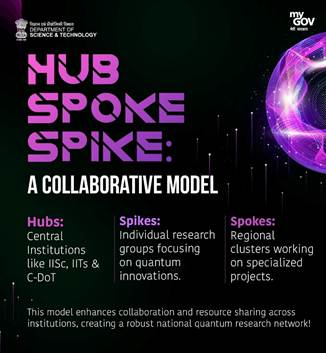
Hub-Spoke-Spike Model: Each T-Hub will follow the Hub-Spoke-Spike model, fostering a cluster-based network where research projects (Spokes) and individual research groups (Spikes) operate alongside central hubs. This structure enhances collaboration among research institutions, allowing them to share resources and expertise more effectively.
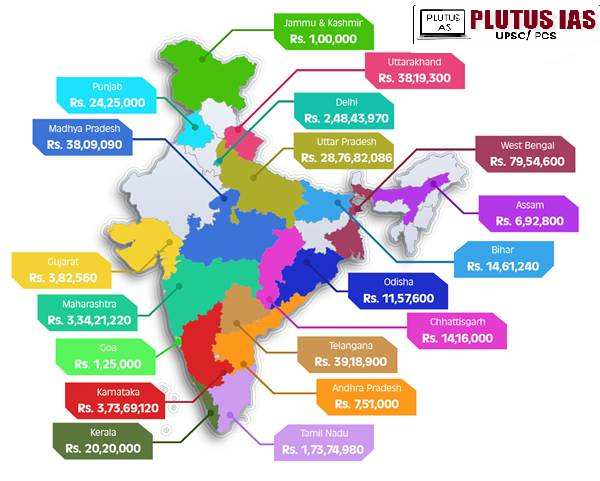
State-wise Funds Allocation: The four T-Hubs selected under NQM collectively involve 152 researchers from 43 institutions nationwide, fostering a collaborative ecosystem to drive research and innovation in quantum technologies. The activities carried out by these hubs include Technology Development, Human Resource Development, Entrepreneurship Development, Industry Collaboration, and International Collaboration.
Significance of National Quantum Mission
1. Technological Advancement: The NQM propels India into the global race for quantum supremacy, fostering innovation in computing, communication, and security.
2. Economic Growth: With a budget of ₹6,003.65 crore, the mission can drive investments, create jobs, and boost the tech sector.
3. Cybersecurity & National Security: Quantum encryption can significantly enhance data security, making cyber communication unbreakable.
4. Scientific Innovation: Encourages indigenous research, fostering advancements in quantum computing, materials science, and precision sensing.
5. Industry & Start-up Ecosystem: Strengthens partnerships between academia, industry, and startups, driving the commercialization of quantum technologies.
6. Global Competitiveness: Positions India as a key player in the quantum revolution, fostering international collaborations and technology exports.
7. Interdisciplinary Impact: Advances in quantum science benefit healthcare, clean energy, finance, and logistics through enhanced computational and analytical capabilities.
8. Human Resource Development: Establishes a skilled workforce in quantum technology, promoting education and research across premier institutions.
Challenges of National Quantum Mission
1. Technological Barriers: Developing stable qubits and error correction mechanisms remains a significant challenge.
2. High Cost of Implementation: Quantum technology requires substantial investment in infrastructure, research, and skilled professionals.
3. Limited Skilled Workforce: A shortage of trained quantum scientists and engineers could slow progress.
4. International Competition: Leading nations like the US, China, and the EU are investing heavily in quantum research, creating intense competition.
5. Scalability Issues: Building quantum computers with more qubits while maintaining stability and coherence is complex.
6. Data Security Risks: While quantum encryption enhances security, adversaries may also develop quantum capabilities to break existing cryptographic protocols.
7. Industry Readiness: Indian industries need awareness and investment to integrate quantum solutions into real-world applications.
8. Infrastructure Constraints: Establishing quantum labs, computing centers, and network systems across the country requires significant infrastructural development.
Ways to make India self Reliant
1. Strengthening Research & Development: Increase funding for quantum research, establish dedicated R&D centres, and promote academic-industry collaborations.
2. Skill Development Programs: Launch specialized quantum computing courses, fellowships, and training programs to build a strong talent pool.
3. Encouraging Startups & Entrepreneurship: Provide grants, tax incentives, and incubation support to quantum technology startups.
4. Public-Private Partnerships: Facilitate collaborations between government, academia, and private enterprises to accelerate innovation.
5. Building Quantum Infrastructure: Invest in quantum labs, high-performance computing facilities, and secure communication networks.
6. Enhancing Global Collaborations: Partner with leading quantum research nations to exchange knowledge, technology, and best practices.
7. Regulatory & Policy Support: Develop national policies for quantum technology adoption, ethical AI, and cybersecurity frameworks.
8. Commercialization of Quantum Technologies: Focus on developing market-ready quantum solutions for industries such as finance, healthcare, defence, and logistics.
Conclusion
The National Quantum Mission (NQM) is more than just a technological initiative—it is a strategic step towards securing India’s future in the quantum era. With significant investments, world-class research collaborations, and dedicated innovation hubs, the mission is set to propel India to the forefront of the global quantum revolution. This initiative underscores India’s commitment to scientific excellence, economic resilience, and national security in a world where quantum technologies are poised to reshape industries and societies.
Download Plutus IAS Current Affairs (Eng) 21st Mar 2025
Prelims Questions
Q. With reference to the National Quantum Mission (NQM), consider the following statements:
1. The mission was approved by the Union Cabinet in 2022.
2. It aims to establish satellite-enabled quantum-secured communication over 2000 km within India.
3. The mission focuses only on quantum computing and does not include quantum communication or sensing.
How many of the above-given statements are correct?
A. Only one
B. Only two
C. All three
D. None
Answer: A
Mains Questions
Q. Discuss the significance of the National Quantum Mission (NQM) in the context of India’s technological and economic growth. Highlight the challenges and suggest measures to make India self-reliant in quantum technology. (250 words, 15 marks)

- RBI’s Shrinking Real-Rate Cushion Amid Rising Inflation and Strong Demand - September 21, 2026
- India’s NGOs at a New Funding Crossroads - September 21, 2026
- Deep-Sea Discovery, Environmental Responsibility - September 19, 2026

No Comments