


22 Apr Anthropology vs Psychology which is better optional for UPSC CSE exam
Anthropology VS Psychology: Which Optional Subject is Better for UPSC CSE?
One of the most common dilemmas faced by UPSC aspirants is the selection of the right optional subject for the Mains examination. With 500 marks at stake, your choice of optional can significantly influence your overall score and final rank. Among the popular humanities subjects, Anthropology and Psychology stand out for their scoring potential, conceptual clarity, and relevance. But which one is better for you? In this article, we offer a detailed comparison of Anthropology vs Psychology optional for UPSC Civil Services Examination (CSE) to help you make an informed decision.
1. Understanding the Subjects
Anthropology is the holistic study of human beings, covering their biological evolution, cultural development, societal structures, and tribal issues. It combines both science and social science elements, making it suitable for candidates from various academic backgrounds.
Psychology focuses on the scientific study of human behavior, mental processes, emotions, personality, and cognitive functions. It includes both theoretical and application-based concepts, making it a deeply analytical and insightful subject.
2. Syllabus Comparison
The Anthropology syllabus is concise and well-defined. It includes:
- Paper I: General Anthropology (Physical, Archaeological, Socio-cultural)
- Paper II: Indian Anthropology (Tribal studies, Social structure, and development programs)
The Psychology syllabus is broader and includes:
- Paper I: Foundational theories, learning, perception, intelligence, personality, motivation, and emotions
- Paper II: Psychological testing, therapies, work psychology, organizational behavior, and Indian applications
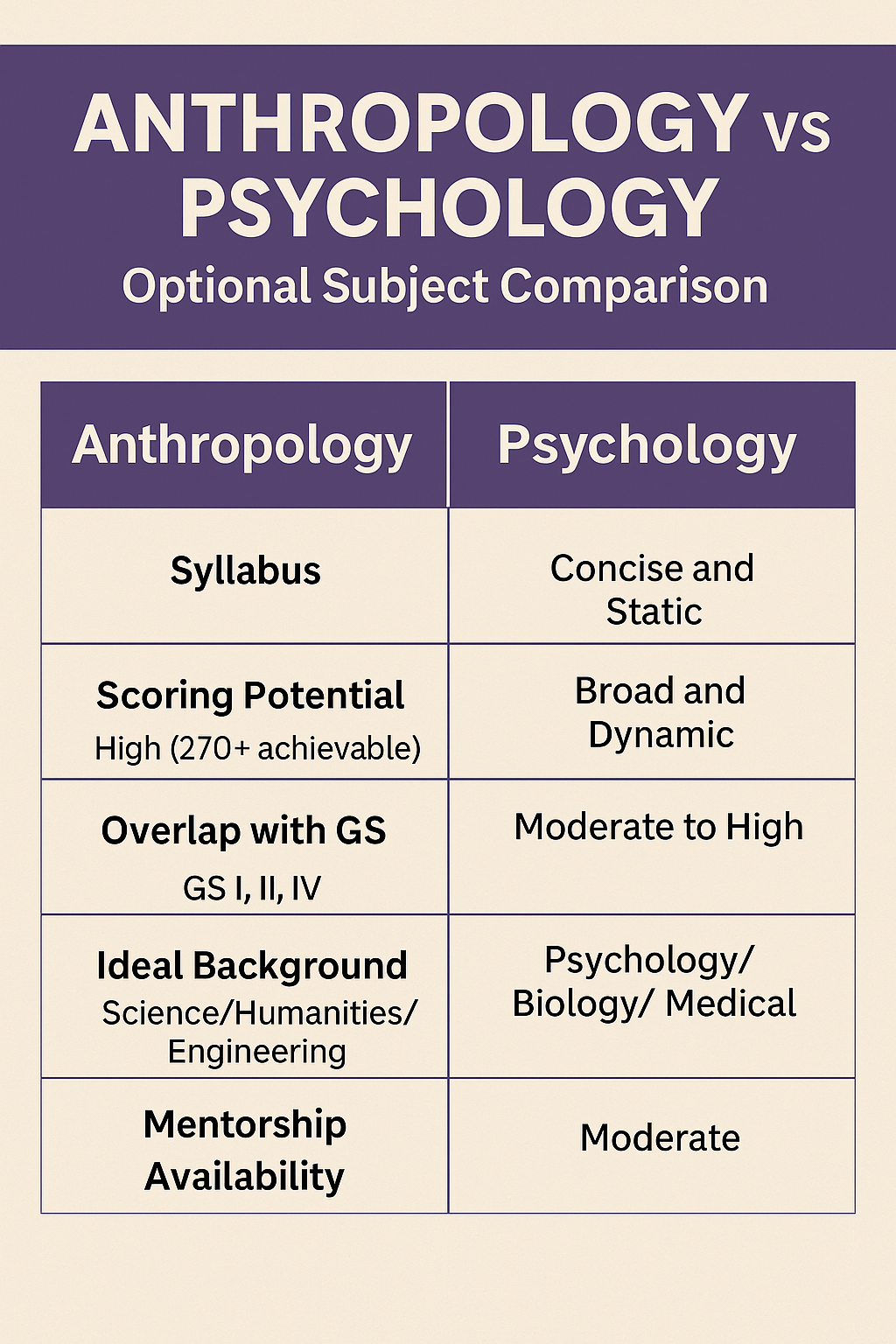
Verdict: Anthropology offers a more concise and manageable syllabus, whereas Psychology is broader and requires a deeper understanding of theories and case studies.
3. Scoring Potential and Past Trends
In recent years, Anthropology has shown consistent high scores for candidates with proper preparation. The subject’s static nature, use of diagrams, flowcharts, and case studies helps aspirants present structured answers and secure good marks.
Psychology can also be a scoring optional, but it requires conceptual clarity and effective articulation of psychological theories. The subject is theoretical, and answer writing demands depth and real-life examples for scoring well.
As per the top Anthropology optional coaching , many toppers who opted for Anthropology scored 270+ consistently. Psychology, while competitive, is generally seen as requiring more writing finesse.
4. Overlap with General Studies and Essay
Anthropology overlaps well with GS Paper I (Society, Indian Culture, Tribal Issues), GS Paper II (Welfare Schemes for Tribals), GS Paper IV (Ethics, Human Values), and the Essay paper. Topics like social institutions, kinship, and evolution are directly relevant in multiple segments.
Psychology overlaps moderately with GS Paper IV (Ethics, especially emotional intelligence and decision-making) and the Essay paper. However, its contribution to GS Papers I-III is limited.
Verdict: Anthropology provides a stronger overlap with GS and Essay compared to Psychology.
5. Background Suitability
Anthropology is friendly for aspirants from both science and humanities backgrounds. Even engineers and commerce graduates find it approachable due to its structured syllabus and scoring diagram-based answers.
Psychology is ideal for those with prior knowledge in psychology, biology, or medicine. Non-psychology students may find certain topics challenging without guided learning.
You can explore this list of best Psychology optional coaching by OurEducation to check the right guidance if you are considering Psychology.
6. Answer Writing Style
Anthropology answers benefit from diagrams, flowcharts, maps, and structured headings. Even theoretical questions can be enriched with case studies and visual representation, making the subject very scoring.
Psychology answers are more theoretical, requiring a balanced approach between explanation, examples, and empirical studies. Writing style in Psychology must be analytical with clarity on theories and their applications.
7. Time Management and Preparation Strategy
Due to its compact syllabus and static content, Anthropology preparation usually takes 3-4 months with proper study plans and test series.
In contrast, Psychology preparation may require 5-6 months for thorough understanding and conceptual clarity, especially for aspirants from non-psychology backgrounds.
8. Guidance and Mentorship Availability
Anthropology has seen an increase in expert guidance and coaching options. Mentors like Dr. Huma Hassan who is considered as best Anthropology optional teacher and others provide personalized test series and mentorship.
Psychology also has guidance available but fewer UPSC-specific coaching options compared to Anthropology. Access to the right mentor is essential for non-psychology students to perform well.
9. UPSC Previous Year Question Papers
To understand the pattern and difficulty level, go through the UPSC official previous year question papers. Analyze the questions of Anthropology and Psychology optionals before making your final decision.
10. Final Verdict: Which Optional Should You Choose?
Choose Anthropology if:
- You prefer a concise syllabus with high scoring potential.
- You are looking for overlap with GS Papers and Essay.
- You are from any academic background (Science/Humanities/Engineering).
Choose Psychology if:
- You have a background or strong interest in human behavior and mental health studies.
- You can handle a more theoretical subject with application-based answers.
- You are interested in enhancing your understanding of Ethics and Essay writing through psychological perspectives.
Conclusion
Both Anthropology and Psychology are good optional subjects in UPSC CSE. Your decision should be based on your academic background, interest, aptitude, and availability of resources. Anthropology is generally considered more beginner-friendly and scoring, while Psychology can be rewarding for those who enjoy analytical thinking and behavioral sciences.
Remember, consistency in preparation and effective answer writing matter more than the subject itself. Choose the subject that excites you and allows you to maintain sustained focus throughout your UPSC journey.

- एनसीएल द्वारा शुरू हुआ ‘विशेष अभियान 6.0’: स्वच्छता और ई-कचरा प्रबंधन पर जोर - September 19, 2026
- NCERT & NCL Launch ‘Special Campaign 6.0’ for Clean Governance: Key Details for UPSC - September 19, 2026
- ‘नशा मुक्त युवा अभियान’: 100 सप्ताह के राष्ट्रव्यापी अभियान का शुभारंभ, जानिए प्रमुख तथ्य - September 19, 2026

No Comments