


23 Apr Core Sector Posts 3.8% Growth in March Amid Stabilizing Economic Indicators
This article covers “Daily Current Affairs” and the Topic of Core Sector Posts 3.8% Growth in March Amid Stabilising Economic Indicators
SYLLABUS MAPPING:
GS-3- Economy- Core Sector Posts 3.8% Growth in March Amid Stabilising Economic Indicators
FOR PRELIMS
What are the Eight Core Sectors of the Indian economy? Why are they important?
FOR MAINS
What does the Index of Eight Core Industries (ICI) show? Why is it important for the Indian economy?
Why in the News?
India’s infrastructure output, represented by the Index of Eight Core Industries (ICI), recorded a growth of 3.8% in March 2025 on a year-on-year basis, according to provisional data released by the Ministry of Commerce and Industry. These eight core industries — cement, coal, crude oil, natural gas, refinery products, fertilisers, steel, and electricity — together account for 40.27% of the weight of items included in the Index of Industrial Production (IIP). The growth in March was primarily driven by a strong performance in six sectors: cement production rose by 11.6%, fertilisers by 8.8%, steel by 7.1%, electricity by 6.2%, coal by 1.6%, and refinery products by 0.2%. However, the output of natural gas and crude oil declined by 12.7% and 1.9%, respectively. On a cumulative basis, the core sector registered a 4.4% growth rate during the financial year 2024–25 compared to the corresponding period of the previous year.
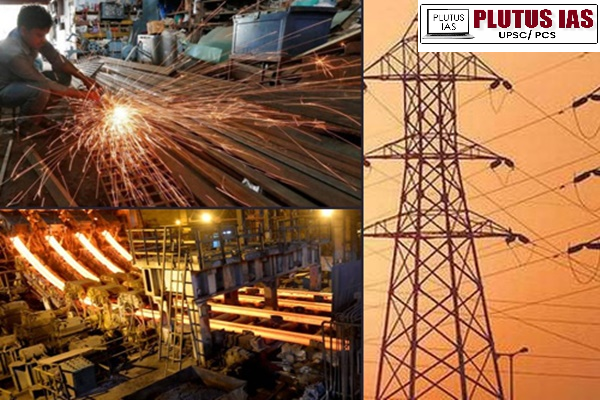
Contributions of the 8 core sectors in the Indian economy
1. Backbone of Industrial Output: The Eight Core Industries—coal, crude oil, natural gas, refinery products, fertilisers, steel, cement, and electricity—constitute 40.27% of the Index of Industrial Production (IIP), making them a reliable indicator of overall industrial performance.
2. Recent Growth Performance: According to the Ministry of Commerce and Industry, core sector output grew by 3.8% in March 2025, showing a stable pace of economic activity across essential infrastructure sectors.
3. Cement and Steel – Indicators of Infrastructure Development: Cement and steel, key indicators of infrastructure growth, grew by 11.6% and 7.1% respectively in March 2025, signalling increased construction and development activity in both public and private sectors.
4. Electricity – Powering Industries and Households: Electricity generation, a crucial input across all sectors, increased by 6.2%, reflecting robust energy demand and improved power supply infrastructure.
5. Fertilisers – Supporting Agricultural Growth: Fertiliser production grew by 8.8%, aiding agricultural productivity and ensuring food security, especially critical as India remains largely agrarian.
6. Coal – Key Energy Source: Coal production, which fuels over 70% of India’s power generation, grew by 1.6%, supporting the thermal power sector and base-load energy supply.
7. Refinery Products – Boosting Energy Self-sufficiency: Petroleum refinery production rose slightly by 0.2%, contributing to domestic energy availability and reducing reliance on imported finished fuels.
8. Crude Oil and Natural Gas – Mixed Performance: Crude oil and natural gas witnessed a decline of 1.9% and 12.7%, respectively, highlighting ongoing challenges in upstream energy exploration and production.
9. Infrastructure Investment Driver: These core sectors attract significant public and private investment, especially under initiatives like PM Gati Shakti, National Infrastructure Pipeline (NIP), and Make in India, driving long-term economic growth.
10. Economic Indicator for Policy Planning: The performance of the eight core sectors serves as a leading economic indicator for policymakers and investors, influencing fiscal planning, monetary policy, and industrial strategy.
Govt. Scheme to promote the core sector in india
1. PM Gati Shakti – National Master Plan for Multimodal Connectivity: Launched in 2021, this scheme integrates infrastructure development across 16 ministries to boost connectivity, reduce logistics costs, and ensure coordinated growth in sectors like steel, cement, and electricity.
2. National Infrastructure Pipeline (NIP): With an investment target of over ₹100 lakh crore, NIP supports large-scale infrastructure projects across core sectors like energy, roads, ports, and steel, enhancing industrial capacity and employment.
3. Ujjwala and Saubhagya Schemes: These schemes promote energy access by providing LPG connections to rural households and ensuring universal electricity access, thereby increasing demand and output in the refinery, natural gas, and electricity sectors.
4. Production Linked Incentive (PLI) Scheme: Applied to steel and other manufacturing sectors, PLI incentivises increased domestic production and global competitiveness, especially in speciality steel, thereby strengthening core industries.
5. Revamped Distribution Sector Scheme (RDSS): Aims to improve the operational efficiency and financial sustainability of power distribution companies, ultimately boosting electricity generation and transmission capacity in the country.
6. Atmanirbhar Bharat Abhiyan: Supports self-reliance in core sectors, including coal, fertilisers, steel, and crude oil, through reforms, investment incentives, and liberalised FDI policies to reduce dependence on imports.
7. New National Steel Policy, 2017: Targets a steel production capacity of 300 million tonnes by 2030, promoting investment, innovation, and sustainability in the steel sector, which is critical for infrastructure and manufacturing.
8. National Electric Mobility Mission Plan (NEMMP) and FAME Scheme: While focused on transport electrification, these indirectly stimulate growth in electricity generation, coal, and refinery sectors through increased energy demand and grid development.
Issues faced by the core sector in india
1. Supply Chain Bottlenecks: Inefficient logistics, delays in transportation, and poor multimodal connectivity often disrupt the smooth supply of raw materials and finished goods, especially in the cement, coal, and steel sectors.
2. Dependence on Imports for Energy Needs: Despite being energy-rich, India imports a large share of its crude oil and natural gas, exposing the sector to global price volatility and geopolitical risks.
3. Infrastructure Deficiencies: Inadequate storage facilities, outdated machinery, and poor last-mile connectivity hamper production and distribution, particularly in the electricity and fertiliser sectors.
4. Environmental and Regulatory Challenges: Stringent environmental clearances, land acquisition issues, and frequent changes in regulations often delay core sector projects, especially mining, power, and refinery ventures.
5. Underperformance of DISCOMs: Financially stressed power distribution companies (DISCOMs) fail to clear dues to electricity generators, impacting the liquidity and performance of the entire power sector value chain.
6. Lack of Private Investment: Many core sectors, such as steel and crude oil exploration, suffer from limited private sector participation due to high capital intensity, policy uncertainty, and long gestation periods.
7. Technological Gaps and Low R&D: Several industries still rely on obsolete technologies, and there is a lack of innovation and research, which lowers efficiency and increases production costs.
8. Skilled Manpower Shortage: There is a mismatch in skill availability, particularly in sectors like petrochemicals, steel, and energy management, limiting productivity and modernisation efforts.
9. Fluctuating Demand Cycles: Many core industries are highly cyclical and sensitive to global and domestic demand variations, impacting stability and investment confidence.
Way forward
1. Accelerate Infrastructure Development through Gati Shakti: Strengthen implementation of the PM Gati Shakti Master Plan to improve logistics, reduce transport costs, and ensure time-bound execution of large-scale projects across core sectors.
2. Boost Domestic Energy Production: Encourage exploration and investment in crude oil and natural gas through liberalised FDI norms and improved ease of doing business, reducing dependence on imports.
3. Modernise and Digitise Core Industries: Promote adoption of Industry 4.0 technologies like automation, IoT, and AI to improve efficiency, reduce wastage, and increase competitiveness in sectors like steel, cement, and power.
4. Focus on Renewable Integration: Enhance renewable energy adoption and reduce over-reliance on coal by supporting solar, wind, and green hydrogen initiatives alongside existing power infrastructure.
5. Revive Power Sector Reforms: Improve the financial health of DISCOMs through schemes like RDSS, smart metering, and rational tariff structures to ensure a sustainable electricity ecosystem.
6. Encourage Private Investment and PPPs: Attract private capital through public-private partnerships, transparent bidding processes, and viability gap funding, especially in steel, fertilisers, and refinery infrastructure.
7. Ensure Environmental and Regulatory Stability: Streamline environmental clearance norms and create a single-window approval system to reduce project delays while ensuring ecological balance.
8. Develop a Skilled Workforce: Launch sector-specific skilling programs aligned with the National Skill Development Mission to meet the growing demands of high-tech and energy-intensive industries.
Conclusion
The Eight Core Sectors form the foundation of India’s industrial and infrastructural framework, driving economic growth, employment, and national development. The recent 3.8% growth in March 2025 underscores their resilience amid global uncertainties and domestic challenges. Government initiatives such as PM Gati Shakti, the National Infrastructure Pipeline, and Production Linked Incentive schemes are significantly contributing to their expansion and modernisation. However, persistent issues like regulatory delays, energy import dependency, underperformance in certain segments, and technological lag need urgent redressal. Going forward, a holistic and coordinated strategy focusing on infrastructure upgrades, energy diversification, skilling, and investment promotion will be crucial. By modernising the core sectors and ensuring policy stability, India can not only strengthen its industrial base but also achieve sustainable and inclusive economic growth in the coming decades.
Download Plutus IAS Current Affairs (Eng) 23rd April 2025
Prelims Questions
Q. Discuss the significance of the core sectors in India’s economic development. Also, highlight key government initiatives taken to promote them and suggest a suitable way forward.
(250 words, 15 marks)

- RBI’s Shrinking Real-Rate Cushion Amid Rising Inflation and Strong Demand - September 21, 2026
- India’s NGOs at a New Funding Crossroads - September 21, 2026
- Deep-Sea Discovery, Environmental Responsibility - September 19, 2026

No Comments