


21 May Amrit Bharat Station Scheme: A New Era for Indian Rail Infrastructure
This article covers “Daily Current Affairs” and the Topic Amrit Bharat Station Scheme: A New Era for Indian Rail Infrastructure
SYLLABUS MAPPING:
GS- 3-Economic- Amrit Bharat Station Scheme: A New Era for Indian Rail Infrastructure
FOR PRELIMS
What is the Amrit Bharat Station Scheme? How will it help modernize railway stations in India?
FOR MAINS
In what ways does the Amrit Bharat Station Scheme contribute to sustainable and inclusive urban development?
Why in the News?
Prime Minister Shri Narendra Modi is set to inaugurate 103 Amrit Bharat stations across 18 states from Bikaner, Rajasthan, under the Amrit Bharat Station Scheme. This event marks a major milestone in India’s effort to modernise its railway infrastructure, transforming old and often neglected railway stations into modern, passenger-friendly, and aesthetically appealing public spaces. These revamped stations will feature improved amenities, better accessibility, upgraded infrastructure, and a boost to local connectivity and economic growth. The inauguration reflects the government’s commitment to infrastructure development and aims to enhance the overall travel experience for millions of daily passengers across the Indian Railways network.
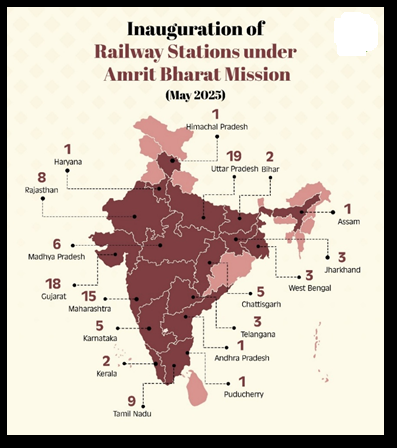
Amrit Bharat Station Scheme: Vision and Objective
Vision
The Amrit Bharat Station Scheme is a long-term, need-based initiative aimed at the holistic redevelopment of over 1,300 railway stations across the country. It adopts a phased and inclusive approach, allowing each station to be modernised according to its specific needs and context.
Key Features of the Scheme
1. Modern Amenities: Stations will have roof plazas, aesthetic façades, food courts, resurfaced platforms, and kids’ play areas.
2. Passenger Comfort: Focus on safety, convenience, clean toilets, free Wi-Fi, digital signage, and waiting lounges.
3. Accessibility for All: Divyang-friendly features like ramps, Braille signages, low-height counters, lifts, and tactile paths under Sugamya Bharat Abhiyan.
4. Cultural & Regional Design Themes: Station architecture inspired by local heritage (e.g., Modhera Sun Temple, Jagannath Temple, Chola architecture).
5. One Station One Product (OSOP): Promotes local artisans and products through kiosks showcasing regional crafts, handlooms, and foods.
6. Eco-Friendly Development: Emphasis on green practices—landscaping, noise-reduction measures, sustainable materials, and energy efficiency.
7. Urban Connectivity: Integration with roads, metros, and bus networks; improved lighting, parking, and pedestrian infrastructure.
8. City-Centric Transformation: Stations to serve as vibrant city centres, beyond transit points, with business lounges and community spaces.
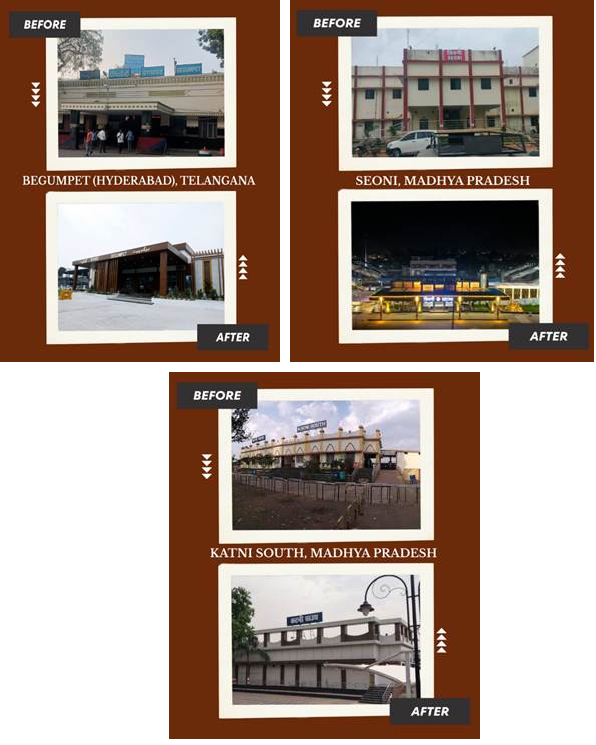
Evolution of the Amrit Bharat Station Scheme
1. Conceptual Origin (2021): The idea of station modernisation began with Gandhinagar Capital Railway Station, the first to be redeveloped with modern facilities and a 5-star hotel.
2. Inspiration from Rani Kamalapati Station: Habibganj Station (renamed Rani Kamalapati) became a model for future upgrades with airport-like features and smart amenities.
3. Launch of Amrit Bharat Station Scheme: Officially launched to systematically redevelop 1,309 stations across India in phases based on local needs and potential.
4. Integration with National Missions: Aligned with schemes like Sugamya Bharat Abhiyan for accessibility and Swachh Bharat Mission for cleanliness.
5. Incorporation of OSOP (One Station One Product): Evolved to include promotion of local artisans and regional products through dedicated kiosks at stations.
6. Architectural Localization: Shift towards culturally themed station designs to reflect India’s rich heritage and identity.
7. Focus on Sustainability: Adopted green technologies, solar energy, noise-free tracks, and eco-friendly construction materials.
8. From Transit Points to Urban Hubs: Vision expanded to make stations multifunctional—integrated with cities and offering commercial, social, and mobility services.
Conclusion
The Amrit Bharat Station Scheme is not merely a railway modernization initiative—it is a visionary step towards building smart, inclusive, and sustainable urban infrastructure. By reimagining railway stations as clean, accessible, culturally rooted, and future-ready public spaces, the scheme reflects India’s broader goals of urban rejuvenation, inclusive development, and national pride. As Indian Railways evolves into a more passenger-centric and globally competitive network, the Amrit Bharat initiative stands as a symbol of purposeful progress. These stations are no longer just platforms for travel—they are becoming gateways of transformation, echoing the aspirations of a New India.
Download Plutus IAS Current Affairs (Eng) 21st May 2025
Prelims Questions
Q. With reference to the Amrit Bharat Station Scheme, consider the following statements:
1. It aims to redevelop over 1,300 railway stations across India in a phased manner.
2. The scheme includes provisions for promoting local products under the ‘One District One Product’ initiative.
3. Station designs under this scheme are inspired by local art, culture, and architecture.
4. It is being implemented by the Ministry of Housing and Urban Affairs.
Which of the above statements are correct?
(a) 1 and 3 only
(b) 1, 2 and 3 only
(c) 1, 3 and 4 only
(d) All of the above
Answer: A
Mains Questions
Q. The Amrit Bharat Station Scheme marks a transformative step towards modernising India’s railway infrastructure. Discuss the key features, objectives, and broader implications of the scheme in enhancing passenger experience and urban connectivity.
(250 words, 15 marks)

- E-NAM and the Transformation of Agricultural Marketing in India - April 17, 2026
- Indian Railways: Journey from Steam Engines to a Modern Transport Backbone - April 16, 2026
- Mission Poshan 2.0: Strengthening India’s Nutrition Ecosystem - April 15, 2026

No Comments