


31 May Revered Relics of Lord Buddha Return to India: Strengthening Spiritual and Cultural Ties with Vietnam
This article covers “Daily Current Affairs” and the Topic of Revered Relics of Lord Buddha Return to India: Strengthening Spiritual and Cultural Ties with Vietnam
SYLLABUS MAPPING:
GS-1- History and culture- Revered Relics of Lord Buddha Return to India: Strengthening Spiritual and Cultural Ties with Vietnam
FOR PRELIMS
What are the broader implications of India promoting Buddhist heritage internationally?
FOR MAINS
What is the significance of India being the birthplace of Buddhism?
Why in the News?
The Holy Relics of Lord Buddha are set to return to India, following a highly successful month-long exposition tour across Vietnam. Originally scheduled to conclude on 21st May, the tour was extended till 2nd June upon the special request of the Government of Vietnam due to the overwhelming spiritual response and public reverence. During the extended pilgrimage, the sacred relics visited nine cities and attracted over 15 million devotees, reflecting the deep cultural and spiritual bonds between India and Vietnam. The relics will arrive in Delhi around 10:00 PM aboard an Indian Air Force aircraft, accompanied by a Government of India delegation led by Dr. Hari Babu Kambhampati, the Governor of Odisha. They will be ceremoniously received at the Palam Air Force Station by officials of the International Buddhist Confederation (IBC) and senior Indian monks.
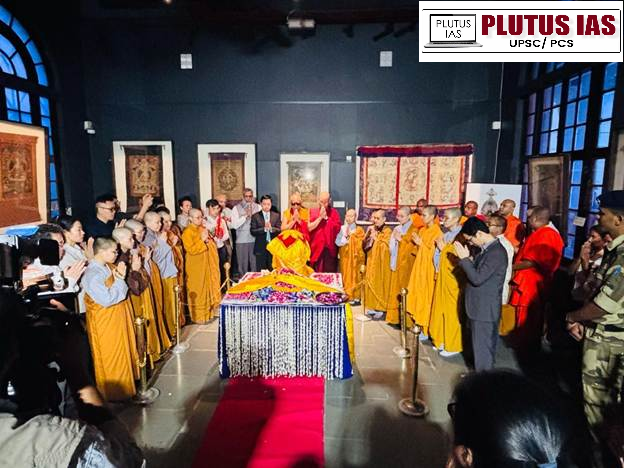
What are Buddha’s Relics?
Buddha’s relics are sacred physical remains of Gautama Buddha, such as bones, teeth, or ashes, preserved after his cremation. These relics hold immense religious and spiritual significance for Buddhists worldwide, symbolising the Buddha’s presence and teachings. Traditionally enshrined in stupas or special shrines, they serve as objects of veneration and meditation. Relics are believed to carry blessings and inspire devotion, helping followers connect with the Buddha’s path to enlightenment. Their preservation and reverence reflect the deep respect for Buddhist heritage and the continuity of the Dharma.
The Vietnam Pilgrimage: Key Facts and Highlights
1. Extended Pilgrimage Duration: Originally scheduled to conclude on 21st May 2025, the pilgrimage was extended until 2nd June 2025 at the special request of the Government of Vietnam, reflecting the deep spiritual engagement it inspired.
2. Wide Geographic Coverage: The sacred relics toured nine major cities across Vietnam, enabling widespread access and devotion among diverse Buddhist communities throughout the country.
3. Massive Devotee Participation: Over 15 million devotees gathered across the pilgrimage route to pay homage, highlighting the profound religious and cultural significance of the relics.
4. Indian Government Delegation: The relics were escorted by a high-level delegation led by Dr. Hari Babu Kambhampati, Governor of Odisha, symbolising India’s official custodianship and diplomatic goodwill.
5. Organisational Leadership: The tour was jointly coordinated by the International Buddhist Confederation (IBC) and the Indian government, ensuring smooth execution and international collaboration.
6. Vietnamese Government Support: The Government of Vietnam actively facilitated and extended the exposition, demonstrating its reverence for the Buddha’s relics and fostering closer bilateral ties.
7. Spiritual Atmosphere: The pilgrimage created a spiritually charged environment across cities, with devotees expressing deep reverence and seeking blessings, enhancing religious harmony.
8. Diplomatic Significance: Beyond religious dimensions, the pilgrimage reinforced India-Vietnam cultural diplomacy, strengthening bilateral relations and showcasing India’s soft power in Southeast Asia.
India’s Custodianship and Global Role in Buddhist Diplomacy
1. Birthplace of Buddhism: India is the cradle of Buddhism, with sacred sites like Bodh Gaya (where Buddha attained enlightenment), Sarnath (first sermon), and Kushinagar (parinirvana) forming the spiritual heart of the religion.
2. Custodian of Sacred Relics: India holds and preserves the holy relics of the Buddha, symbolizing its responsibility to protect and promote Buddhist heritage globally.
3. Sharing Relics as Goodwill Gesture: India periodically shares the Buddha’s relics with Buddhist-majority countries, fostering religious harmony and diplomatic goodwill.
4. Strengthening Cultural Diplomacy: This practice enhances India’s image as a spiritual leader and promotes people-to-people connections with Buddhist communities worldwide.
5. Role of Ministry of Culture: The Ministry actively supports international Buddhist events, pilgrimage facilitation, and preservation of Buddhist heritage sites.
6. International Buddhist Confederation (IBC): The IBC plays a vital role in coordinating global Buddhist cooperation and representing India’s interests in Buddhist forums.
7. Soft Power Instrument: Sharing relics and promoting Buddhism serve as effective tools of soft power, improving India’s influence in Asia and beyond.
8. Alignment with Act East Policy: Buddhist diplomacy complements India’s Act East Policy, strengthening ties with ASEAN countries through shared cultural and spiritual values.
Events in India: Reception, Exposition, and Enshrinement
| Event | Details | Date | Significance |
|---|---|---|---|
| Ceremonial Reception in Delhi | Official reception of relics at Palam Air Force Station by International Buddhist Confederation officials and senior monks. | 2nd June 2025 | Marks the formal return and welcome of the sacred relics. |
| Public Exposition at National Museum | Relics displayed for public viewing, allowing devotees to pay homage. | 3rd June 2025 | Provides public access for spiritual connection. |
| Formal Prayer Meeting | Conducted by senior Buddhist monks, IBC Secretary General, and diplomatic representatives. | 3rd June 2025 | Emphasizes spiritual and diplomatic importance. |
| Presidential Cavalcade | Relics transported from Delhi to Sarnath via Varanasi with full state protocol. | 4th June 2025 | Highlights the relics’ national and historical significance. |
| Route Significance | Journey connecting relics with one of Buddhism’s most important historical sites. | 4th June 2025 | Symbolizes spiritual heritage and continuity. |
| Enshrinement at Mulagandha Kuti Vihar | Relics enshrined at the renowned Buddhist monastery in Sarnath. | 4th June 2025 | Marks the sacred closure of the pilgrimage. |
| Spiritual Closure | Final enshrinement act reinforcing India’s custodianship of Buddhist heritage. | 4th June 2025 | Reinforces spiritual legacy and international cultural ties. |
Significance for India-Vietnam Relations
1. Cultural Diplomacy: Pilgrimage strengthens cultural ties and goodwill between India and Vietnam.
2. Shared Buddhist Heritage: Buddhism acts as a non-political, unifying bond.
3. People-to-People Links: Deepens community connections beyond official diplomacy.
4. Supports Act East Policy: Enhances India’s strategic and cultural engagement with Southeast Asia.
5. Boosts Bilateral Cooperation: Cultural ties facilitate broader economic and strategic collaboration.
6. Vietnam’s Respect for India: Extension of relic exposition shows appreciation for India’s spiritual leadership.
7. Reaffirms Religious Bonds: Strengthens historic Buddhist and cultural solidarity.
8. Catalyst for Deeper Engagement: Promotes cooperation in culture, education, and diplomacy
Broader Implications: Culture as Soft Power
1. Peaceful Influence through Culture: Demonstrates India’s capacity to project soft power using cultural and spiritual heritage.
2. Alignment with Diplomatic Policies: Supports India’s Neighbourhood First and Act East policies through cultural outreach.
3. Global Buddhist Leadership: Enhances India’s role in international Buddhist discourse and heritage diplomacy.
4. Promotion of Religious Dialogue: Encourages interfaith understanding and religious harmony worldwide.
5. Tourism Enhancement: Boosts tourism focused on Buddhist pilgrimage and heritage sites.
6. Academic and Scholarly Collaboration: Facilitates partnerships and research related to Buddhist culture and history.
7. Custodianship of Heritage Sites: Highlights India’s stewardship of UNESCO World Heritage Buddhist sites.
8. Global Image Building: Reinforces India’s reputation as a promoter of peace, unity, and cultural harmony.
Conclusion
Download Plutus IAS Current Affairs (Eng) 31st May 2025
Prelims Questions
Q. With reference to the recent pilgrimage of the Holy Relics of Lord Buddha to Vietnam, which of the following statements is/are correct?
1. The pilgrimage was extended beyond its original schedule upon request from the Government of Vietnam.
2. The relics were escorted by an Indian delegation led by the Governor of Odisha.
Select the correct answer using the code given below:
a) 1 only
b) 2 only
c) Both 1 and 2
d) Neither 1 nor 2
Answer: C
Mains Questions
Q. Discuss the significance of the recent pilgrimage of the Holy Relics of Lord Buddha to Vietnam in the context of India’s cultural diplomacy and foreign policy. How does this event reinforce India’s role as the custodian of Buddhist heritage and strengthen India-Vietnam bilateral relations?
(250 words, 15 marks)

- RBI’s Shrinking Real-Rate Cushion Amid Rising Inflation and Strong Demand - September 21, 2026
- India’s NGOs at a New Funding Crossroads - September 21, 2026
- Deep-Sea Discovery, Environmental Responsibility - September 19, 2026

No Comments