


02 Jun India and European Union set to conduct joint naval exercise
This article covers “Daily Current Affairs” and the Topic of India and the European Union set to conduct a joint naval exercise
SYLLABUS MAPPING:
GS-2- International Relations – India and the European Union set to conduct joint naval exercise
FOR PRELIMS
What are the main areas of cooperation between India and the European Union (EU)?
FOR MAINS
What are the major challenges in India-EU relations?
Why in the News?
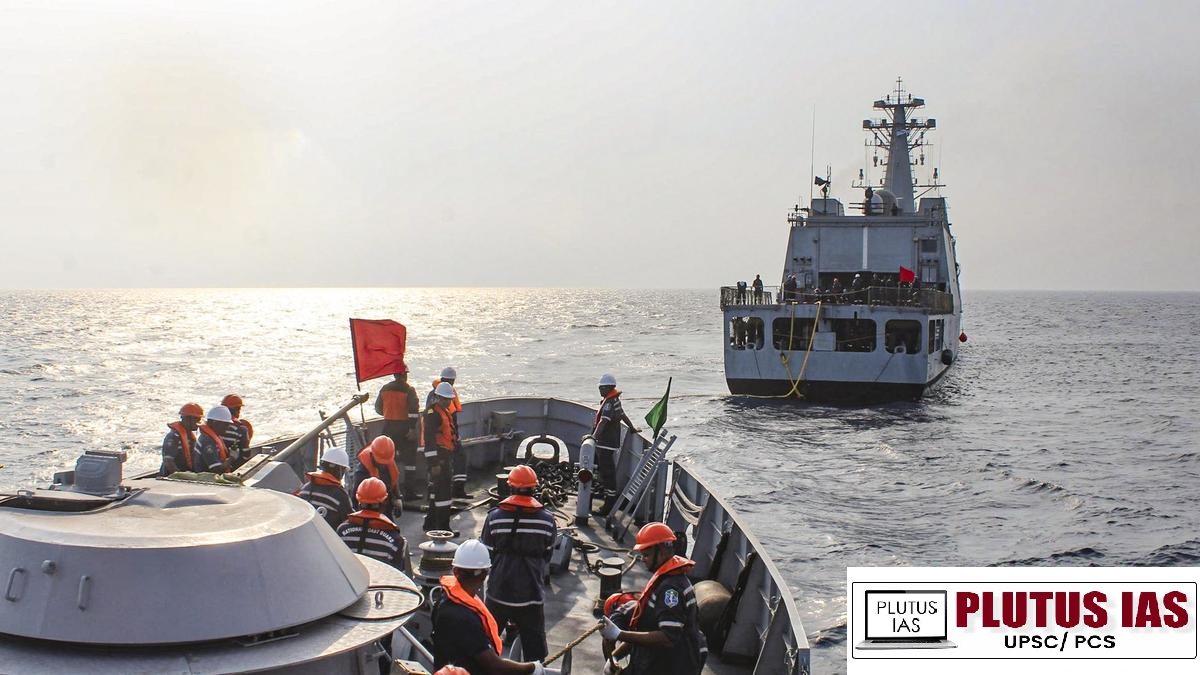
India and the European Union (EU) are set to conduct a joint naval exercise in the Indian Ocean from June 1 to 3, marking a significant step in their growing maritime security cooperation. The exercise will focus on advanced counter-piracy operations, tactical manoeuvres, interoperability, and enhanced communication protocols. It underscores the shared commitment of both sides to a free, open, inclusive, and rules-based maritime order in the Indo-Pacific, rooted in principles such as respect for sovereignty, the rule of law, freedom of navigation, and peaceful dispute resolution as per UNCLOS. Indian Navy ships and two EU Naval Force (EUNAVFOR) frigates from Operation ATLANTA will participate in this engagement.
Key Areas of Cooperation
1. Trade and Investment: The EU is India’s largest trading partner, with bilateral trade volumes reaching new highs. Ongoing negotiations for a Free Trade Agreement (FTA), an Investment Protection Agreement, and an Agreement on Geographical Indications aim to further liberalise and protect trade and investment flows.
2. Technology and Innovation: The India-EU Trade and Technology Council (TTC) drives cooperation on trusted technology, digital governance, and innovation. Focus areas include artificial intelligence, 5G/6G, quantum computing, and harmonisation of standards for emerging technologies.
3. Climate Change and Green Transition: Both partners are committed to achieving net-zero emissions, with cooperation on clean energy, sustainability, and green industrial transition. Collaboration includes initiatives in solar energy, disaster-resilient infrastructure, and biofuels.
4. Security and Defence: Enhanced cooperation on maritime security, cyber defence, and intelligence sharing to address regional and global security threats. Both sides support a free, open, and peaceful Indo-Pacific, with the EU joining India’s Indo-Pacific Oceans Initiative.
5. Connectivity and Infrastructure: The India-Middle East-Europe Economic Corridor (IMEC) is a flagship initiative to improve connectivity between India, the Middle East, and Europe. Efforts focus on resilient infrastructure and sustainable logistics networks.
6. People-to-People Exchanges: Strengthening ties in higher education, research, tourism, culture, sports, and youth exchanges. Promoting legal, safe, and orderly migration, particularly for skilled professionals.
7. Global Governance and Multilateral Cooperation: Commitment to upholding the rules-based international order, democracy, and multilateralism. Joint efforts to tackle global issues such as climate change, terrorism, and the governance of artificial intelligence.
Strategic Significance of the European Union for India
1. Trade & Investment: EU is India’s 3rd largest trading partner with €87 bn FDI (2000–2022). The relationship has matured into one of mutual economic interdependence.
2. Technology Cooperation: Collaboration in AI, 5G, cybersecurity via Horizon Europe & Digital Partnership. Combining India’s demographic strength with the EU’s tech expertise.
3. Climate & Energy: Joint work under Clean Energy & Climate Partnership; €2.5 bn EU support. Strengthens India’s energy transition and global climate leadership.
4. Maritime Security: Anti-piracy ops and Indo-Pacific cooperation through EUNAVFOR ATLANTA. Naval visits reflect deepening strategic maritime ties.
5. Multipolarity & Strategic Autonomy: Shared support for multilateralism, UNSC reform, and global rule-based order. Both resist bipolar dominance and seek equitable governance.
6. Supply Chain Diversification: TTC (2023) focuses on semiconductors, pharma, and critical minerals. India si seen as a trusted partner amid global tech rivalries.
7. People-to-People Links: 100,000+ Indian students in EU; Erasmus+ and diaspora deepen ties. Education and mobility foster long-term strategic identity.
8. China Balancing: Converging concerns over China’s assertiveness and trade practices. The EU sees India as a key Asian partner to balance Chinese influence.
Key Issues Affecting India-EU Bilateral Ties
1. Trade Barriers: The EU faces TBT and SPS hurdles in India; Indian pharma exports face complex EU certifications.
2. Non-Tariff Barriers (NTBs): EU rules (e.g. local office requirement for IT firms) raise compliance costs and restrict remote services.
3. Market Access Constraints: High Indian tariffs on EU cars, wines; limited access to public procurement.
4. IPR Concerns: EU demands stricter patent laws and data exclusivity; India defends generics and public health.
5. Carbon Border Tax (CBAM): EU’s green regulations raise competitiveness concerns for Indian steel, aluminium exports.
6. Suspension of GSP: Loss of tariff benefits for Indian textiles and leather after crossing EU safeguard limits.
7. Investment Protection: Disagreements over investor-state dispute resolution and investment security persist.
8. Mobility & Visa Issues: Cumbersome EU visa rules for Indian students/professionals; EU seeks reciprocal access.
9. Geopolitical Divergences: India’s neutrality on the Russia-Ukraine war contrasts with the EU’s position, causing friction.
10. Cyber & Digital Policy Gaps: Divergence on data protection, cybercrime treaties (e.g. India not part of the Budapest Convention) limits cooperation.
Way Forward to Strengthen India-EU Ties
1. Fast-Track FTA Negotiations: Adopt a phased approach to resolve tariff, IPR, and regulatory issues; prioritise convergence on key sectors like pharmaceuticals, dairy, and wines.
2. Promote Mutual Policy Sensitivity: Encourage political engagement based on mutual respect; avoid value-based criticism that may strain strategic trust.
3. Joint Climate Action with Equity: Strengthen cooperation in climate finance, green tech, and capacity building while addressing concerns over mechanisms like CBAM.
4. Institutionalise Strategic Dialogues: Leverage platforms like the Trade and Technology Council (TTC) for collaboration in AI, semiconductors, cybersecurity, and disaster response.
5. Expand Trilateral & Multilateral Cooperation: Implement joint development and connectivity projects in Africa and the Indo-Pacific to counterbalance China’s BRI.
6. Boost Educational and Cultural Exchanges: Enhance academic mobility, vocational training, and cultural ties through programs like Erasmus+ to deepen people-to-people bonds.
7. Strengthen Cyber & Maritime Security: Advance cooperation on cybercrime, data governance, and conduct regular joint naval exercises to ensure Indo-Pacific maritime stability.
Conclusion
The India-EU partnership stands at a strategic crossroads amid evolving global geopolitical shifts. While there are immense opportunities in trade, technology, climate action, and security cooperation, realising the full potential of this relationship requires greater mutual understanding and trust. It is crucial for the EU to adopt a more nuanced appreciation of India’s complex socio-political realities to avoid friction and foster meaningful engagement. With sustained strategic dialogue, policy alignment, and respect for each other’s domestic priorities, India and the EU can emerge as key partners in shaping a resilient, rules-based, and multipolar global order.
Source: TH- 02 June 2025 – page-06
Download Plutus IAS Current Affairs (Eng) 2nd June 2025
Prelims Questions
Q. Which of the following organisations has implemented the Carbon Border Adjustment Mechanism (CBAM)?
(a) World Trade Organisation (WTO)
(b) European Union (EU)
(c) United Nations Framework Convention on Climate Change (UNFCCC)
(d) G20
Answer: B
Mains Questions
Q. Discuss the significance of the recent India-EU engagement in the context of global geopolitics. What are the key challenges in concluding a comprehensive Free Trade Agreement (FTA) between India and the EU, and what measures to strengthen this strategic partnership?
(250 words, 15 marks)

- RBI’s Shrinking Real-Rate Cushion Amid Rising Inflation and Strong Demand - September 21, 2026
- India’s NGOs at a New Funding Crossroads - September 21, 2026
- Deep-Sea Discovery, Environmental Responsibility - September 19, 2026

No Comments