


22 Jul Endogenetic and Exogenetic forces
Endogenetic and Exogenetic Forces – UPSC Geography Optional
Introduction
The Earth’s surface is continually shaped and reshaped by dynamic geomorphic processes. These processes are broadly categorized into two types—endogenetic forces that originate from within the Earth and exogenetic forces that act on the surface. The interaction of these forces results in the evolution of diverse landforms observed on Earth. This topic is vital for UPSC Geography Optional as it builds foundational understanding of Geomorphology.
1. Endogenetic Forces
Endogenetic (internal) forces originate from the Earth’s interior and derive energy primarily from geothermal gradients and radioactivity.
Types of Endogenetic Forces:
- Tectonic Movements: Cause large-scale folding and faulting, giving rise to mountain chains, plateaus, and rift valleys. Examples include the Himalayas and the East African Rift.
- Volcanism: Results from magma movements. Intrusive (e.g., batholiths, dykes) and extrusive (e.g., volcanic cones) landforms are products of volcanic activity.
- Earthquakes: Sudden release of energy along faults causes ground shaking and surface rupture. Earthquakes may cause elevation, subsidence, and formation of lakes or cracks.
- Isostatic Adjustments: Balancing of the Earth’s crust due to the addition or removal of weight (e.g., post-glacial rebound).
Endogenetic and Exogenetic forces
Endogenetic Processes: Diastrophism and Sudden Movements
- Diastrophism: Large-scale deformation including orogenesis (mountain-building) and epeirogenesis (uplift/subsidence of landmasses).
- Sudden Movements: Earthquakes and volcanic eruptions that modify landforms almost instantly.
2. Exogenetic Forces
Exogenetic (external) forces originate on or near the Earth’s surface and are powered by solar energy and gravity. They tend to degrade and modify existing landforms.
Key Exogenetic Processes:
- Weathering: The breakdown of rocks through mechanical (frost action, exfoliation), chemical (oxidation, carbonation), and biological (root wedging, organic acids) means.
- Erosion: The removal and transportation of weathered material by agents like rivers, wind, glaciers, and waves.
- Mass Wasting: Downslope movement of soil and rock under the influence of gravity (e.g., landslides, rockfalls, slumps).
- Deposition: Process of accumulation of sediments in lower-lying areas such as floodplains, deltas, beaches, and loess plains.
Agents of Exogenetic Forces:
- Running Water: Creates valleys, gorges, deltas, meanders, and alluvial fans.
- Wind: Forms dunes, deflation hollows, and yardangs especially in deserts.
- Glaciers: Carve out U-shaped valleys, cirques, and moraines.
- Sea Waves: Shape coastlines through erosion (cliffs, stacks) and deposition (beaches, bars).
3. Interaction Between Endogenetic and Exogenetic Forces
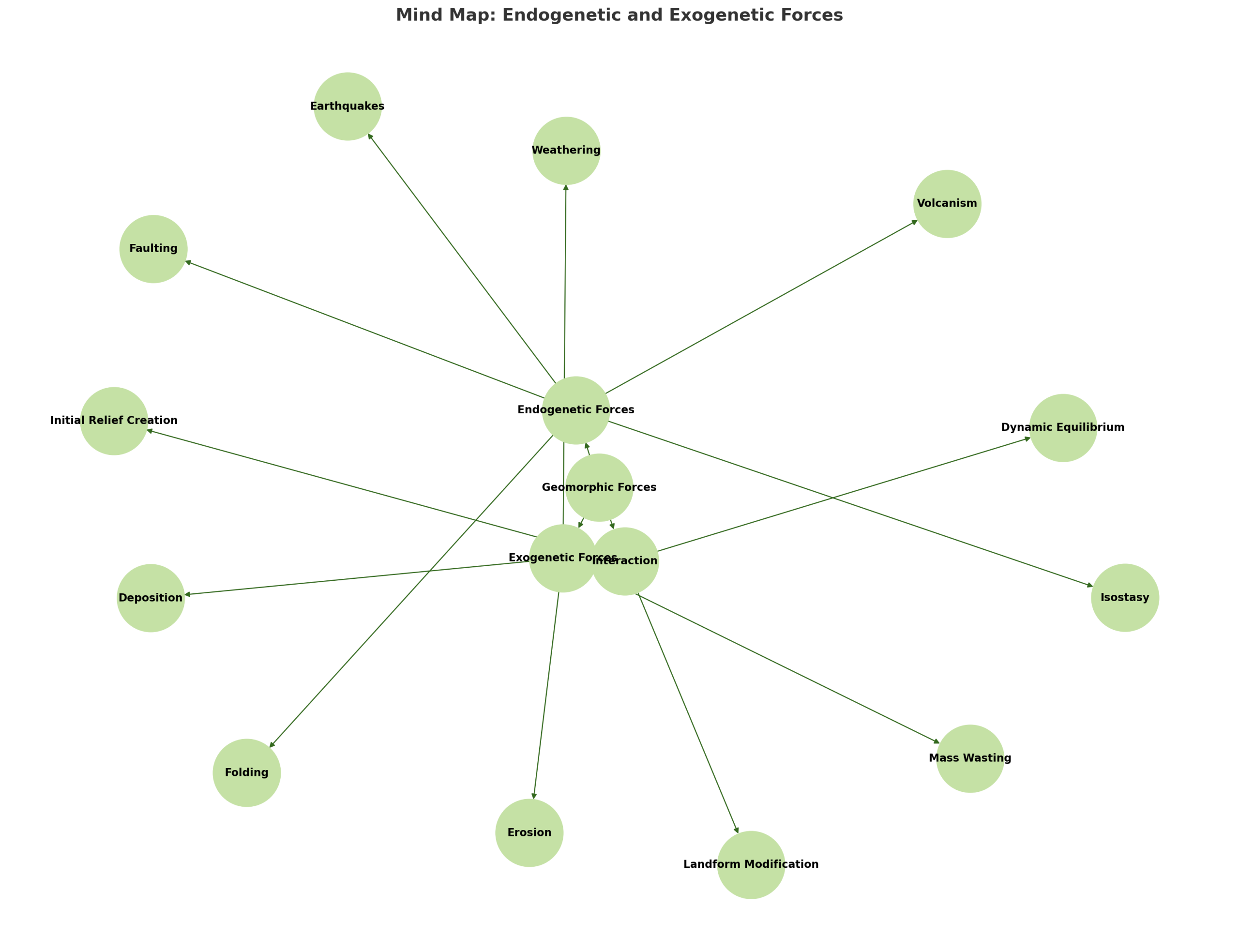
The Earth’s surface is the result of continuous interplay between internal constructional forces and external destructional forces.
- Initial Landforms: Created by endogenetic processes (uplifted plateaus, mountains).
- Modifying Agents: Exogenetic forces reduce relief by breaking down and transporting materials.
- Dynamic Equilibrium: Landforms evolve toward a balance between uplift and denudation. Example: Davisian model of cycle of erosion.
4. Diastrophic vs Sudden Movements (Comparative Table)
| Diastrophic Movements | Sudden Movements |
|---|---|
| Slow, long-term crustal deformation | Instantaneous or short-duration events |
| Folding, faulting, uplift, subsidence | Earthquakes, volcanic eruptions |
| Examples: Formation of Himalayas | Examples: 2001 Bhuj Earthquake |
5. Geomorphic Theories Referenced
- Davisian Cycle: Youth, maturity, and old age in landform development.
- Penck’s Model: Emphasizes slope development and parallel retreat.
- Hack’s Theory: Landforms evolve in dynamic equilibrium with geomorphic processes.
Previous Year Questions (PYQs) – UPSC Geography Optional
- 2022: Explain the interplay of endogenic and exogenic forces in landform development.
- 2020: Distinguish between tectonic and gradational forces with suitable examples.
- 2018: Discuss the classification of geomorphic processes and their impact on landscape evolution.
- 2015: Bring out the role of climate in weathering and mass movement.
Probable Questions for UPSC Mains 2025
- Evaluate the role of internal and external forces in shaping the Indian subcontinent’s physiography.
- Explain how exogenetic forces modify the landforms created by endogenetic forces.
- Compare the Davisian and Penckian concepts of geomorphic evolution.
- Discuss the impact of tectonic activities on erosion cycles.
Visual Aids
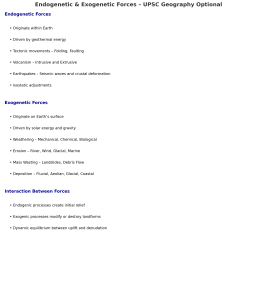
📊 Download Infographic
🧠 Download Mind Map
Conclusion
Understanding the nature, origin, and impact of endogenetic and exogenetic forces is crucial for a Geography Optional student. These forces collectively govern the creation, transformation, and degradation of landforms. Their dynamic equilibrium helps in decoding the geomorphic history and future evolution of the Earth’s surface—an indispensable skill for scoring well in UPSC Geography Paper 1.

- हिमाचल में ई-ग्राम स्वराज पोर्टल पर पंचायत विकास योजना अपलोड करने की समय सीमा बढ़ी - October 7, 2026
- UPSC & State PCS: Apply for BNYS 2026-27 at NIN Pune - October 7, 2026
- कर्नाटक उच्च न्यायालय ने बाल हिरासत मामलों में ‘पेरेंटिंग टाइम’ शब्द अपनाने का आदेश दिया - October 7, 2026

No Comments