


05 Aug Subject-Wise Study Plan for UPSC 2026
The Union Public Service Commission Civil Services Examination is one of the most competitive and prestigious exams in India. For UPSC CSE 2026 aspirants, the advantage lies in having enough time to prepare, plan, and build a strong foundation before the actual exam year. In this article by plutusias.com, we will discuss the Subject-Wise Study Plan for UPSC 2026. However, the vast syllabus demands a subject-wise strategy rather than a random study approach.
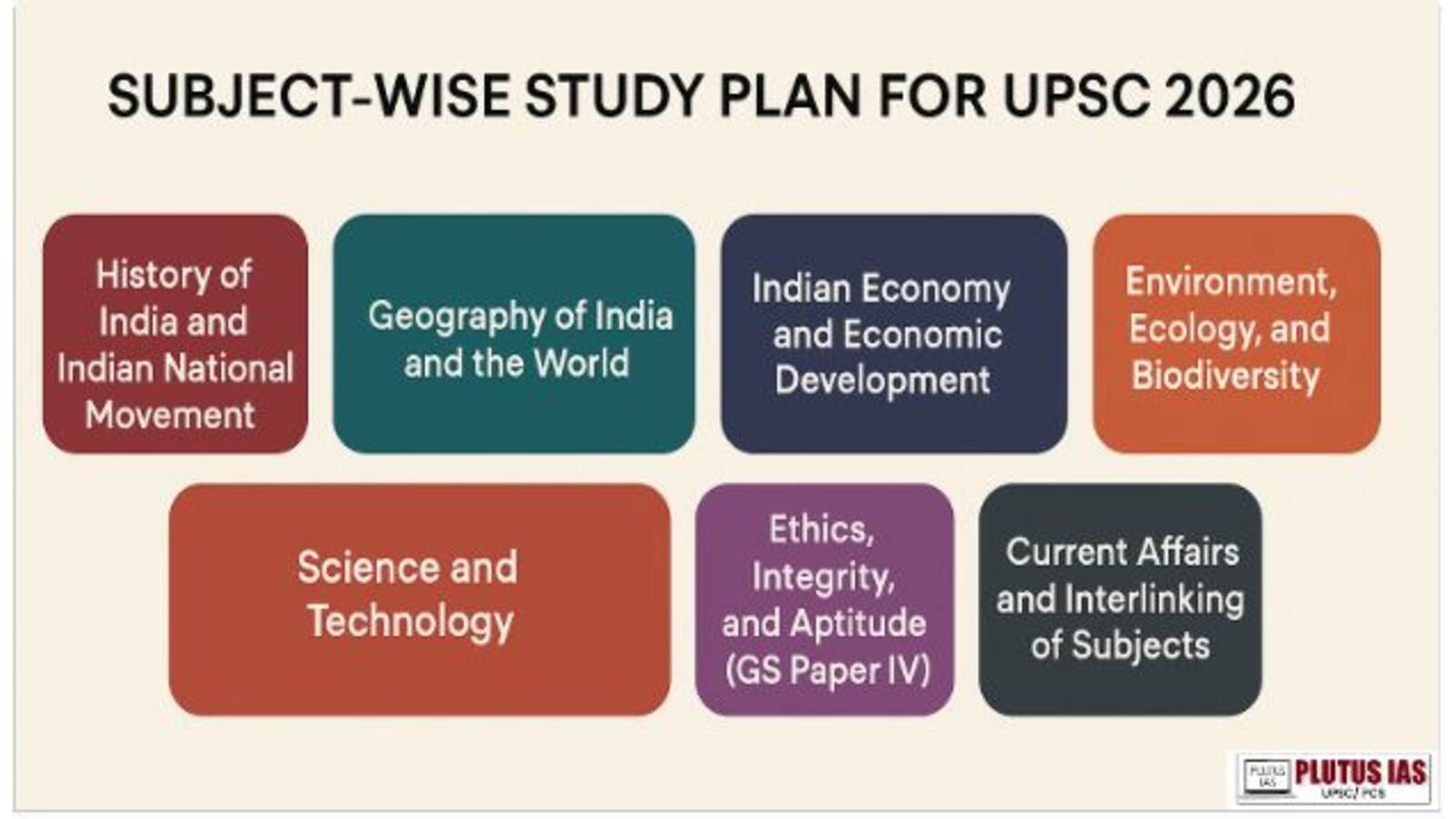
A well-structured subject-wise study plan helps you to give the right attention to every area, use resources optimally, and manage revision cycles smoothly. Preparing for the UPSC Civil Services Examination is not just about hard work- it is about working smart with a well-defined strategy. Since the UPSC Prelims and Mains syllabus is vast, breaking it down subject-wise helps aspirants focus better and cover every area comprehensively. This article provides an 8-point subject-wise study plan for aspirants targeting UPSC CSE 2026.
Read More: Best IAS Coaching in Delhi
1. History of India and Indian National Movement
History is a high-weightage subject in both Prelims and Mains. For ancient and medieval history, focus on NCERT textbooks (Class 6 to 12) for clarity on basic concepts. Ancient history covers topics like the Indus Valley Civilisation, Vedic period, Mauryan and Gupta empires, while medieval history includes the Delhi Sultanate, the Mughal Empire, and regional kingdoms.
Modern history and the Indian freedom struggle are very important- study Bipan Chandra’s India’s Struggle for Independence fully. Keep a timeline of important events, leaders, and movements. Practice map-based questions for cultural heritage and locations of historical importance. Revision is a never-ending process- prepare crisp notes for repeated revision before the exam.
2. Geography of India and the World
Indian polity and governance, including constitutional developments, constitute another weighty area in GS Paper 1 and prelims. Start with the NCERTs to understand the basic concepts of constitutionalism and Parliament, as well as to get a preliminary idea of the Union, State, and local governments. For a robust grounding in Indian polity, one must use other books, especially those by M. Laxmikanth. Initially, they may seem a bit heavy in content, but reading all of them thoroughly will give one an excellent conceptual base for the subject. Go through topics with special attention to governance structures within states and Union Territories, public administration, and the functioning of the central government.
3. Indian Polity and Governance
Polity remains one of the most scoring and predictable sections in UPSC Prelims. Start with M. Laxmikanth’s Indian Polity and read it several times until the concepts become second nature. Start with the structure, powers, and functions of the Union Governments and the State Governments, the Parliament, the Judiciary, and constitutional bodies like the Election Commission.
Make sure you connect the currently unfolding happenings with the static polity by following current affairs via The Hindu, Indian Express, or PRS Legislative Research. Focus on governance issues, transparency, accountability, and e-governance initiatives for Mains. Keep rehearsing the previous years’ polity questions for an idea of UPSC’s trends.
4. Indian Economy and Economic Development
At a primary stage, the aspirant should better acquaint themselves with concepts such as the GDP, inflation, fiscal policy, and monetary policy through the NCERTs of classes 9 to 12. Thereafter, you may pursue Ramesh Singh’s Indian Economy for lateral learning.
Follow the latest economic developments by going through the Economic Survey, Union Budget, and NITI Aayog‘s reports. Sectors like agriculture, industry, and services, plus schemes and reforms, deserve attention. Focus on terms and indices that often appear in prelims. For Mains, prepare analytical notes on economic problems, prospects for growth, and inclusive development.
Environment, Ecology, and Biodiversity
The UPSC has increased the number of questions from the environmental section since climate change is now considered a global issue of prime importance. Start studying from the Ecology and Environment chapters of Class 12 Biology, and then move on to Environment by Shankar IAS Academy. Do topics such as environmental laws, conventions, biodiversity hotspots, endangered species, pollution control mechanisms, and so on? Connect the environment with current affairs such as COP summits, IPCC reports, and renewable energy initiatives in India. You will need to practice maps of national parks, wildlife sanctuaries, and biosphere reserves for prelims.
Science and Technology
Science and Technology an ever-dynamic fields in which static concepts meet present innovations. General science can be taught from NCERT Physics, Chemistry, and Biology (Classes 9-10). For contemporary coverage, give space geography to ISRO missions, biotechnology, artificial intelligence, robotics, and nuclear technology.
Keep yourselves posted on the recent developments, either from the PIB (Press Information Bureau) or from the Science sections of different newspapers. Make sure that you discuss MOL issues that concern ethics, social and economic implications of evolving technologies. India’s technological achievements and global partnerships are frequently brought up by the UPSC in its questions.
Ethics, Integrity, and Aptitude (GS Paper IV)
The practice of ethics is most crucial for the Mains examination. Begin with the syllabus: cover concepts that include integrity, accountability, emotional intelligence, and moral values. Use Lexicon for Ethics, and also check out the Second Administrative Reforms Commission (ARC) Report on Ethics in Governance.
Regularly undertake case studies focusing on real-life problem-solving and decision-making frameworks with examples drawn from the experiences of eminent personalities, civil servants, and ethical dilemmas in public administration. Bearing in mind that Ethics is less concerned with rote learning than with clarity of expression, your answers must demonstrate balance, empathy, and beneficial wisdom.
Current Affairs and Subjects Interlinking
Contemporary affairs serve as the lifeblood for any UPSC candidate. Hence, newspapers such as The Hindu or The Indian Express should be read for a minimum period of one hour every day. Along with newspapers, monthly magazines like Yojana and Kurukshetra should be gone through from time to time, along with compilations prepared by renowned coaching institutes.
The crux lies in interlinking current affairs to static topics. For instance news item on a Supreme Court judgment can be tied to Polity. Similarly, a news item on new environmental policies ought to be linked to Ecology. Keep a separate notebook for many government schemes, international summits, and socio-economic data. Revision of current affairs is done on a monthly, quarterly, and pre-examination basis.
Conclusion
A subject-wise study plan forms the framework of a successful UPSC preparation philosophy. In doing so, the vast syllabus can be structured and covered with a separate focus on each subject and linking it with current affairs. Regularity, smart revisions, and practice form an important set; building a disciplined schedule from the right set of resources would make a successful balancing act for aspirants of UPSC CSE 2026 so that they may opt for entering the world of civil service with clarity and confidence, the realisation of their dreams standing right there.
Related Articles
How to Build a Strong Foundation for UPSC Prelims
10 Tips to Crack UPSC Prelims 2026 in First Attempt
What are the Best Tips for UPSC Beginners?
How to Choose the Right Optional Subject for the UPSC Exam
Common Mistakes in UPSC Prelims
Mastering MCQs for UPSC Prelims 2026

- Best Optional Subjects to get High Marks in the UPSC - January 22, 2026
- Best IAS Coaching in Hindi Medium - November 17, 2025
- Smart Revision Techniques for UPSC Prelims 2026 - October 9, 2025

No Comments