India’s defence and internal security posture is in the news as the government under PM Narendra Modi completes eleven years, marking a significant transformation in national security strategy. Over this period, the focus has been on building stronger deterrence, modernising armed forces, and reducing dependence on imports through ‘Atmanirbharta’ in defence. The government has consistently emphasised that security is non-negotiable, leading to enhanced border infrastructure, indigenous weapons production, and reforms in defence procurement. India’s proactive stance has also been evident in counter-terrorism measures, maritime security, and cyber defence preparedness.
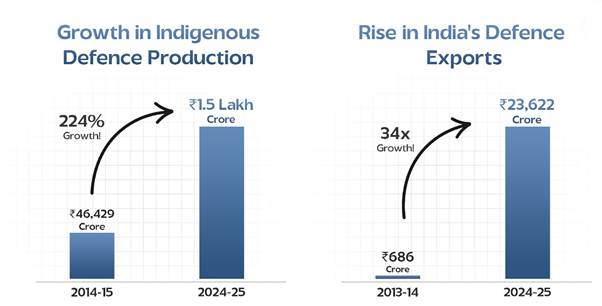
India’s defence capacity has grown significantly under the present government, with expenditure rising from ₹2.53 lakh crore in 2013–14 to ₹6.81 lakh crore in 2025–26. The focus has shifted from mere procurement to building domestic capabilities, with defence production hitting a record ₹1.50 lakh crore in 2024–25—over three times the 2014–15 level. India now manufactures fighter jets, missile systems, warships, artillery, and even aircraft carriers. Defence exports have also surged 34 times in a decade, reaching ₹23,622 crore in 2024–25, with Indian equipment now supplied to over 100 countries, including the U.S., France, and Armenia—reflecting a robust push for self-reliance and strategic deterrence.
Self-Reliance through Defence Acquisition & Indigenisation Reforms
India’s defence policy in the last decade has been guided by the principle of Atmanirbharta. Prime Minister Modi led government has pushed through structural reforms to reduce import dependence, boost indigenous production, and build a globally competitive defence ecosystem. The reforms span procurement, research, industry participation, and foreign investment.
Defence Acquisition Procedure (DAP) 2020 and Indian-IDDM
The Defence Acquisition Procedure 2020, revised from DPP 2016, aligned fully with the Aatmanirbhar Bharat Abhiyan spearheaded by PM Modi. It prioritises the Buy (Indian – Indigenously Designed, Developed and Manufactured) category for acquisitions, ensuring maximum reliance on local design, development, and manufacturing. This shift places Indian-IDDM projects at the top of the procurement pyramid.
So far, 146 projects of Army, Navy, Air Force & HQ IDS have been accorded ‘Approval in Principle’ under various ‘Make’ categories.
Liberalised FDI
To boost capital and advanced technology inflow, FDI in defence was liberalised—74% is now permitted through the automatic route, while up to 100% is allowed with government approval in cases involving advanced technology.
Innovation Push: iDEX and TDF
The iDEX initiative (2018) supports start-ups, MSMEs, and academia with grants for defence innovations, while the Technology Development Fund (TDF) provides up to ₹10 crore for MSMEs and start-ups to develop advanced defence and aerospace technologies.
Indigenisation Portals and Positive Lists
The SRIJAN Portal (2020) promotes local development of items earlier imported, with 46,798 items listed so far. Meanwhile, Positive Indigenisation Lists by DPSUs have phased out imports of 5,012 items across five tranches—First (2,851), Second (107), Third (780), Fourth (928), and Fifth (346).
Offsets and Strategic Partnerships
The Offset Portal (2019) has improved transparency in contracts, encouraging global OEMs to invest in Indian manufacturing and source defence products from India. Similarly, the Strategic Partnership (SP) Model (2017) enables Indian firms to collaborate with foreign OEMs for technology transfer and joint infrastructure creation, boosting indigenous capacity.
International Defence Cooperation
India has expanded defence ties globally, with the 2019 Inter-Governmental Agreement with Russia enabling joint production of spares for Russian-origin platforms in India—reducing import dependence and strengthening operational readiness.
Ease of Doing Business in Defence
Procedural reforms have simplified defence manufacturing. Industrial licence requirements for many components were removed, licence validity extended from 3 to 15 years (plus a 3-year extension), and R&D opened to industry, start-ups, and academia. Notably, 25% of the defence R&D budget is earmarked for them, ensuring wider participation in innovation.
Technology and AI Adoption
The government has set up the Defence AI Council (DAIC) and Defence AI Project Agency (DAIPA) to integrate artificial intelligence into defence systems, with each DPSU finalising an AI roadmap. DRDO has also identified nine thrust areas, ranging from weapon platforms and strategic systems to cyber security, robotics, and soldier support.
Responding to Cross-Border Terror
India’s counter-terror strategy has grown more decisive. After the Uri attack (2016) and Pulwama attack (2019), India conducted surgical strikes and the Balakot air strikes. The defining moment came in May 2025 with Operation Sindoor, when Indian forces, using drones and precision munitions, destroyed nine terrorist camps in Pakistan and PoJK, eliminating over 100 terrorists, including key figures behind the IC-814 hijacking and Pulwama attack. Pakistan’s retaliatory drone and missile strikes were neutralised by Indian systems. Declaring this a “new normal,” PM Modi affirmed in his 2025 Independence Day address that India will respond with full force against any terrorist threat.
Prime Minister Modi’s Five ‘New Normals’ on Pakistan
PM Modi has outlined five clear red lines that now define India’s Pakistan policy: a firm and decisive response to terror attacks; rejection of nuclear blackmail; no distinction between terrorists and their state sponsors; engagement with Pakistan, if any, limited to terrorism or Pakistan-occupied Kashmir; and zero compromise on sovereignty, with the principle that “terror and talks, terror and trade, and blood and water cannot go together.”
The Sudarshan Chakra Mission
Looking ahead, the government has launched the Sudarshan Chakra Mission, announced in 2025, as a futuristic defence programme. Its threefold aim is to develop a fully indigenous system, anticipate future warfare scenarios using predictive technologies, and build precise counter-action capabilities. By 2035, it seeks to create a comprehensive national security shield for both strategic and civilian assets, ensuring long-term deterrence.
Securing the Home Front
On the internal security front, Left-Wing Extremism has been sharply curtailed. The number of affected districts has dropped to fewer than twenty, and over 8,000 Naxalites have surrendered in the last decade. Extremist violence incidents fell from 1,936 in 2010 to 374 in 2024, while civilian and security force casualties have declined by 85 percent—marking a major consolidation of internal stability.
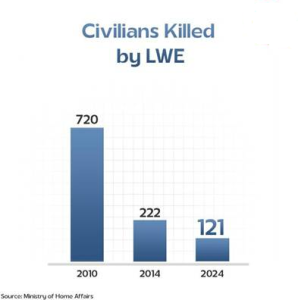
These results reflect not just security operations but also the focus on development and governance in areas once cut off from growth. Roads, communication, schools, and welfare measures have reduced the ground for extremist mobilisation.
Atmanirbharta Beyond Defence
India’s drive for self-reliance has expanded beyond defence into food, health, energy, technology, and financial inclusion. PM Modi has repeatedly stressed that national security now covers these critical sectors, ensuring resilience against global shocks while moving towards the goal of becoming the world’s third-largest economy by 2030.
Financial Inclusion
India has made remarkable gains in financial inclusion. The RBI’s FI-Index rose to 67.0 in March 2025, a 24.3% jump since 2021, and is recognised as vital for achieving 7 of the 17 SDGs. According to Global Findex 2025 (World Bank), account ownership in India has reached 89% since 2011, with active usage steadily increasing. The Pradhan Mantri Jan Dhan Yojana (PMJDY) has opened 56.04 crore accounts with deposits of ₹2.64 lakh crore (as of Aug 2025), with women comprising nearly 55% of account holders.
Food Security and Farmer Welfare
Foodgrain production has grown from 246.42 MT in 2013–14 to 353.96 MT in 2024–25 (3rd AE). Farmers are supported through PM-KISAN (2019), which provides ₹6,000 annually; by Aug 2025, ₹3.90 lakh crore had been transferred across 20 installments. Meanwhile, the PM Garib Kalyan Anna Yojana ensures free foodgrain supply to 81 crore people, cementing India’s food security net.
Dairy Sector
India remains the world’s largest milk producer, contributing 25% of global output. Milk production rose from 146.30 MT in 2014–15 to 239.30 MT in 2023–24—a 63.57% jump, with an annual growth of 5.7% against the global average of 2%.
Technology & Innovation
India’s semiconductor push under the India Semiconductor Mission (ISM) (2021, ₹76,000 crore outlay) has gained traction. Between 2023–25, 10 projects worth ₹1.60 lakh crore were approved across six states. In 2025, India inaugurated its first 3-nanometer chip design centres in Noida and Bengaluru, with its first indigenous semiconductor chip set for production this year.
Blue Revolution (Fisheries)
Fish production has doubled from 96 lakh tonnes in 2013–14 to 195 lakh tonnes in 2024–25, with inland fisheries rising 142% to 147.37 lakh tonnes. The Union Budget 2025–26 allocated a record ₹2,703.67 crore for the fisheries sector, reflecting its growing importance to rural livelihoods and exports.
Conclusion
India’s defence and internal security posture under the Modi government reflects a decisive shift towards strength, clarity, and self-reliance. With record investments in defence, rapid growth in indigenous production, bold reforms, and the adoption of emerging technologies, India has transitioned from being a major importer to a rising global exporter of defence equipment. Firm responses to terrorism, the clear articulation of new normal with Pakistan, and futuristic initiatives like the Sudarshan Chakra Mission underscore a forward-looking security doctrine. At the same time, progress in internal stability, food and energy security, financial inclusion, and technology innovation demonstrates that Atmanirbharta is not confined to defence alone but forms the foundation of a resilient and confident India prepared to meet both traditional and non-traditional challenges on its path to becoming a global leader.
Prelims Questions





No Comments