India and Japan share a deep-rooted historical connection built on Buddhism, cultural exchanges, and post-war economic cooperation. Japan played a supportive role in India’s economic reforms in the 1990s, becoming a leading development partner. The partnership was elevated to a Global and Strategic Partnership in 2006, further upgraded to a Special Strategic and Global Partnership in 2014. Over the years, Japan has been among India’s largest ODA (Official Development Assistance) providers, backing critical infrastructure projects like the Delhi Metro and Mumbai–Ahmedabad High-Speed Rail (Bullet Train).
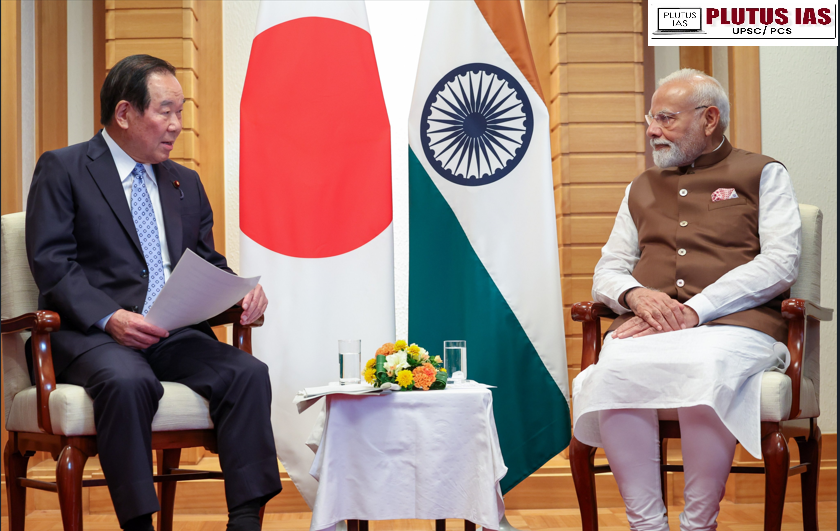
Recent High-Level Visits and Dialogues
1. In recent years, top-level exchanges have accelerated:
2. PM Modi’s frequent visits to Japan (2014, 2016, 2018, 2022, and 2025).
3. Former Japanese PMs Shinzo Abe, Fumio Kishida, and Yoshihide Suga have all actively strengthened ties with India.
4. The 2025 visit reinforced continuity, with Modi meeting Japan’s current PM Shigeru Ishiba, former PMs Kishida and Suga, and parliamentary leaders.
Japan’s Importance in Act East Policy & Indo-Pacific Strategy
Japan is a linchpin in India’s Act East Policy and a central partner in promoting a Free, Open, and Inclusive Indo-Pacific. Both nations collaborate within the QUAD (with the U.S. and Australia), ensuring maritime security and supply chain resilience. Japan’s advanced technology and India’s demographic advantage together form a natural synergy in shaping regional order.
Parliamentary Diplomacy
Significance of Meeting with Speaker Fukushiro Nukaga and MPs
PM Modi’s meeting with the Speaker of Japan’s House of Representatives and MPs underscores the role of parliamentary diplomacy in strengthening bilateral ties. Such interactions enhance cross-party support for long-term cooperation, beyond government-level engagement.
Role of Parliamentary Exchanges
Regular exchanges between lawmakers build trust, improve people-to-people linkages, and encourage broader collaboration in governance, policy formulation, and socio-cultural understanding. This provides durability to the partnership even during leadership transitions in either country.
Economic Cooperation
Traditional Areas: Automobiles, Infrastructure, Investment
1. Japan’s investments in automobiles (Suzuki, Toyota, Honda) and infrastructure projects have been cornerstones of the bilateral economic partnership.
2. Japanese FDI in India has crossed $40 billion, making Japan the 5th largest investor.
New Areas: Batteries, Robotics, Semiconductors, Shipbuilding, Nuclear Energy
1. PM Modi’s 2025 Economic Forum address emphasized replicating the automobile sector’s success in EV batteries, robotics, semiconductors, shipbuilding, and nuclear energy.
2. These sectors are vital for India’s Atmanirbhar Bharat and Make in India initiatives.
Trade and Investment Flows
1. Bilateral trade crossed $21 billion in 2023–24, but potential remains underutilized.
2. Japan is a major contributor to flagship projects like Dedicated Freight Corridors, Smart Cities, and Industrial Corridors.
Role in India’s Manufacturing Push
Japan’s expertise, combined with India’s large market and labor force, positions the partnership to drive India’s ambition to become a global manufacturing hub.
Technology and Innovation
1. Collaboration in AI, Science, Critical Technologies, and Semiconductors
Both nations are investing in AI research, semiconductor ecosystems, and critical technologies like quantum computing and 5G/6G.
2. India–Japan Digital Transformation Partnership
The two countries signed digital cooperation agreements, enhancing cybersecurity, e-governance, and next-gen digital public infrastructure.
3. Tech–Talent Synergy
With India’s young skilled workforce and Japan’s technological leadership but aging population, human resource mobility programs can create a win–win model.
Green and Sustainable Development
1. Green Energy and Clean Technologies: Japan has supported India’s National Solar Mission, energy-efficient technologies, and low-carbon transport.
2. Climate Change Cooperation: Both countries are aligned on Paris Agreement goals and collaborate on green hydrogen, offshore wind, and carbon-neutral pathways.
3. Japan’s Role in India’s Energy Transition: Japan is helping India expand its renewable energy capacity, especially through financing and technology transfer for hydrogen and nuclear energy projects.
Human Resource and Cultural Linkages
1. Mobility Partnerships and Skill Development: The India–Japan Skill Partnership aims to train thousands of Indian youth to work in Japan, addressing labor shortages while providing opportunities for Indian professionals.
2. Cultural and Civilizational Links: Shared values, Buddhism, and cultural exchanges strengthen civilizational ties. Festivals, yoga, and Japanese language learning are expanding mutual understanding.
Student Exchanges, Tourism, and Diaspora Role
1. Educational collaborations between universities are rising.
2. Tourism flows are increasing, with Buddhist circuits attracting Japanese visitors.
3. The Indian diaspora in Japan serves as a bridge between societies.
Strategic and Geopolitical Significance
Japan as a Key Indo-Pacific Partner
Both countries advocate a Free and Open Indo-Pacific (FOIP) to ensure freedom of navigation and rule-based maritime order.
Defence and Maritime Cooperation
Regular Malabar Naval Exercises (QUAD).
Joint development of defence technologies.
Security dialogues to counterbalance regional threats.
Balancing China
With rising Chinese assertiveness, India and Japan coordinate strategies to maintain stability and reduce risks in the Indo-Pacific.
Challenges and Concerns
1. Trade Imbalance: India’s exports to Japan remain limited compared to imports, leading to an imbalance that constrains equitable economic ties.
2. Low FDI Utilization: Despite Japan being a top investor, India has struggled to absorb investment efficiently due to bureaucratic delays and regulatory hurdles.
3. Project Delays: Flagship projects like the Mumbai–Ahmedabad Bullet Train face delays due to financing issues, land acquisition bottlenecks, and execution challenges.
4. Technology Transfer Constraints: Japan is cautious about sharing cutting-edge technologies, limiting India’s ambition for technological self-reliance.
5. Labour and Language Barriers: Indian professionals face difficulties integrating into Japan’s workforce due to linguistic and cultural gaps.
6. Regional Security Risks: Both countries must navigate sensitive regional challenges, particularly China’s assertiveness, maritime disputes in the East China Sea, and instability in the wider Indo-Pacific.
7. Geopolitical Divergences: While broadly aligned, India and Japan occasionally differ on specific global issues (e.g., Russia–Ukraine war stance), which can complicate coordination.
Way Forward
1. Deepen Economic Partnership: Expand trade in goods and services, reduce non-tariff barriers, and encourage Japanese firms to invest in India’s manufacturing hubs.
2. Technology and Innovation Collaboration: Prioritize cooperation in semiconductors, EV batteries, robotics, green hydrogen, and AI, ensuring tech transfer and joint R&D.
3. Skill Development and Mobility: Scale up India–Japan skill partnership programs to train Indian youth for Japan’s labor market, addressing Japan’s aging population needs.
4. Strengthen People-to-People Ties: Promote student exchanges, tourism, cultural diplomacy, and diaspora engagement to create stronger social linkages.
5. Accelerate Infrastructure Projects: Fast-track pending projects like the bullet train and industrial corridors through better land acquisition, policy clarity, and timely financing.
6. Enhance Multilateral Cooperation: Coordinate positions in forums like QUAD, G20, SCO, and UN to push shared agendas in security, trade, and climate change.
7. Long-Term Vision: Build a future-oriented partnership anchored in next-gen infrastructure, digital economy platforms, clean energy ecosystems, and mutual trust in human capital.
Conclusion
India and Japan today stand at a crucial juncture in their partnership—bound not just by shared history and cultural affinities but also by a common vision for the future. Japan has been a reliable partner in India’s economic modernization, infrastructure building, and capacity development, while India offers Japan a vast market, a young workforce, and a trusted strategic ally in Asia. The relationship has steadily moved beyond developmental assistance to encompass cutting-edge technology, clean energy, supply chain resilience, and Indo-Pacific security cooperation.
Prelims Questions





No Comments