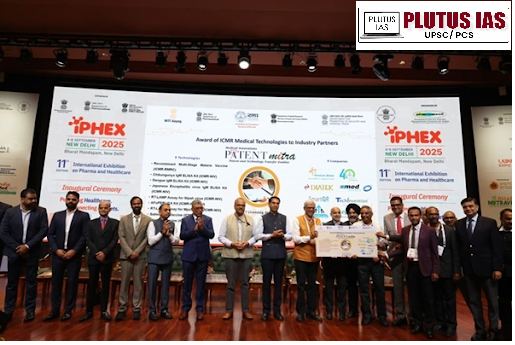
The Indian Council of Medical Research (ICMR) licensed nine cutting-edge technologies to industry partners under its Medical Innovations- Patent Mitra initiative at India MedTech Expo 2025 in New Delhi today.
What is a Patent?
A patent is a legal right given by the government to an inventor for a new invention. It lets the inventor stop others from making, using, selling, or importing the invention without permission—for a limited time. In return, the inventor must fully explain the invention in the patent application.
What Can Be Patented?
You can patent a new product or process if it:
Is new
Has an inventive step (not obvious)
Can be used in industry
Is not excluded under Sections 3 and 4 of the Patents Act
Key Government Policy Aspects on Patents in India
| Key Policy Aspect |
Policy Support & Description |
Relevant Data / Example |
| 1. Legal Framework |
Patents Act, 1970 provides the legal structure for patent rights, defines patentable subject matter, and regulates the patent life cycle. |
– Patent term: 20 years
– Defines non-patentable items (Section 3 & 4) |
| 2. International Compliance |
National laws harmonized with TRIPS Agreement (WTO) ensuring global IP standards. |
– India amended patent law in 2005 to include product patents as required by TRIPS. |
| 3. Patentability Standards |
Specifies novelty, inventive step, and industrial application. Prevents evergreening via Section 3(d). |
– Section 3(d) blocks patents on mere modifications unless enhanced efficacy is shown (e.g., Novartis case). |
| 4. Procedural Streamlining |
Reforms under Patent Rules, 2024 introduced new forms, e-filing, reduced compliance, and faster examination. |
– Examination timeline cut from 48 to 31 months
– Working statements now once every 3 years |
| 5. Compulsory Licensing |
Enables government-authorized use of patents for public interest (e.g., health emergencies, affordability issues). |
– 2012: Natco Pharma received India’s first compulsory license for Nexavar (cancer drug). |
| 6. Government Use Provisions |
Allows government to use patented inventions in national interest under Section 100 of the Patents Act. |
– Used in defense & public health sectors (e.g., during pandemics). |
| 7. Funding Schemes |
Financial aid for inventors/startups to encourage filings & IP commercialization. |
– National Research Foundation (NRF) provides IP management & legal support for biotech startups.
– MSME schemes also support IP costs. |
| 8. Awareness and Training |
Programs through Patent Facilitating Cells (PFCs) & NIPAM for IP education. |
– NIPAM trained 1 million+ students & faculty under IP awareness missions by 2024. |
| 9. Recognition of Inventors |
New tools for acknowledgment such as Certificate of Inventorship (Patent Rules 2024). |
– Inventors now receive a formal certificate as proof of contribution to a granted patent. |
| 10. Access to Patent Information |
Free & transparent access to IP laws, rules, forms, and status of patents. |
– IP India Portal
– WIPO databases for global comparisons. |
Progress in the Indian Patent System:
1. Record High Patent Applications: In 2023, India received over 90,300 patent applications, the highest in its history.
2. Massive Increase in Patent Grants: In 2023–24, the Indian Patent Office granted over 1 lakh (100,000) patents — a 201.91% increase over the previous year.
3. Rise in Domestic Innovation: For the first time, Indian residents filed 55.2% of total patent applications in 2023, up from just 24.8% in 2013.
4. Improved Global Position: India climbed to 6th place globally in patent application rankings in 2023, improving from 9th in 2020 (WIPO data).
5. Policy Reforms for Faster Processing: The Patent Amendment Rules 2024 and 2025 reduced the time to request examination from 48 months to 31 months.
6. Support for Sustainability: Green technology patents now benefit from incentives and fast-track examination, promoting eco-innovation.
7. Technological & Operational Advancements: Full digitization of the patent system enables 24/7 e-filing, real-time tracking, and online hearings, improving transparency and efficiency.
Challenges in the Indian Patent System
A. Systemic and Operational Issues
1. Examination Backlog: Despite reforms, the average time for a first office action remains nearly 50 months (as of 2024).
2. Hiring Controversy: In May 2025, the All India Patent Officers Association demanded a Supreme Court probe into hiring third-party contract examiners, raising questions about the legal validity of their decisions.
3. Quality Concerns: Experts warn that the surge in patent grants may have affected examination quality, as the pace of application reviews slowed in 2024.
4. Training and Capacity Gaps: While hiring has increased, there are still concerns about insufficient training and validation for newly recruited examiners.
B. Innovation and R&D Ecosystem Challenges
1. Low Private Sector R&D Investment: India’s overall R&D spending remains low, particularly in the private sector, when compared to global innovation leaders.
2. Overreliance on Academic Filings: A large portion of resident filings comes from government institutes and academia, with limited industry participation.
3. Lag in High-Tech Patents: Despite CRI Guidelines 2025, India still lags behind in patents for AI, ML, and blockchain, compared to nations like the US and China.
4. Lack of International Patent Expansion: Few Indian inventors follow up with international filings (e.g., via PCT), limiting global commercial potential.
Policy Measures in the Indian Patent System
🇮🇳 Domestic-Level Measures Supporting the Patent System
| Category |
Measure |
Impact on Patent System |
Supporting Data |
| Legislative |
Patent (Amendment) Rules, 2024 |
Improved efficiency, reduced delays, incentivized digital compliance. |
– Examination time cut 48 → 31 months
– 10% discount for advance e-renewal
– Working statement once every 3 years |
|
Draft Patent (2nd Amendment) Rules, 2024 |
Strengthened enforcement and compliance. |
– Penalty raised to ₹10 lakh
– ₹1,000/day for continued violation
– Any person can file IP complaints |
| Institutional / Initiative-Based |
National IP Promotion Schemes (NIPAM, SIPP, KAPILA, PFP) |
Boosted IP awareness, startup support, and academia’s role in patents. |
– NIPAM: 1000s of awareness programs
– KAPILA: IP cells in 700+ colleges |
|
Centre of Excellence in IP & Patent Analysis (2023) |
Enabled big data use, analytics-based patent decisions. |
– Supported by MeitY
– Assists research institutions & IPO |
|
National Innovation Foundation (NIF–India) |
Supported grassroots inventors and indigenous knowledge. |
– 3.45 lakh innovations documented
– 1,377 patents filed (domestic & global) |
|
Traditional Knowledge Digital Library (TKDL) |
Prevented biopiracy; protected Ayurveda/agriculture knowledge. |
– 34 million pages digitized
– Shared with EPO, USPTO & others |
|
Panjab University IDP 2025 |
Focus on commercializing university research. |
– Includes incubators, faculty training & seed funding |
|
IIT Indore (KAPILA Programme) |
Boosted academic filings and global outreach. |
– 112% rise in filings (2024–25)
– 70 patents filed, 102 granted (incl. US & China) |
International-Level Measures Supporting the Patent System
| Category |
International Measure |
Impact on Indian Patent System |
Supporting Data |
| Legislative |
TRIPS Agreement (WTO, 1995) |
India amended its Patents Act (2005) to allow product patents in pharma/biotech. |
– 1+ lakh patents granted in 2023–24; TRIPS compliance boosted pharma filings. |
|
Patent Cooperation Treaty (PCT, 1998) |
Single international filing route for 150+ countries. |
– 3,946 PCT applications (2023)
– 12% YoY growth
– India in top 10 PCT filers |
| Institutional |
WIPO Technical Cooperation |
Strengthened examiner training, digitization, IT infra (IPAS). |
– IPO fully digitized by 2024
– Enabled 24/7 e-filing, online hearings, real-time tracking |
|
WIPO–India Cooperation Agreement (2020) |
Established TISCs (Technology and Innovation Support Centers). |
– India has 100+ TISCs
– Hosts WIPO Summer Schools |
| Initiatives |
WIPO GREEN Partnership (2023) |
Linked Indian innovators with global green-tech partners. |
– Led to fast-track examination for green patents (2024 rules). |
|
Global Innovation Index (GII) |
Benchmarked India’s IP & innovation ecosystem. |
– India ranked 40th in 2023 (up from 81st in 2015) due to stronger IP output. |
Additional Government Measures Supporting the Patent Ecosystem
| Category |
Initiative / Measure |
Description & Supporting Data |
| Education & Research |
1. National Research Foundation (NRF) |
– Proposed under NEP 2020 to strengthen research culture across universities.
– Budget: ₹50,000 crore over 5 years.
– Focus: Interdisciplinary research and patentable outcomes. |
|
2. Integration of IP in Higher Education |
– UGC & AICTE directives: IP education integrated in curricula.
– KAPILA scheme promotes IP literacy in 700+ institutions.
– Encourages patent filing by students & faculty. |
| Funding & Innovation |
3. Startup India Seed Fund & DPIIT Support |
– ₹945 crore fund to help early-stage innovators with prototype and IP-related costs.
– Startups eligible for up to ₹50 lakh support for product development & IP filings. |
|
4. BIRAC & Atal Innovation Mission (AIM) |
– BIRAC: Supports biotech startups with IP, legal, and tech transfer assistance.
– AIM (NITI Aayog): Funds incubators & IP hubs.
– 10,000+ startups supported as of 2024. |
| Government Support & Simplification |
5. Increasing GERD (Gross Expenditure on R&D) |
– Current GERD: 0.7% of GDP; target: 2%.
– Focus on public-private partnerships.
– National R&D Policy promotes collaborative research & patents. |
|
6. Simplified Patent Filing & Fast-Track Mechanisms |
– Expedited examination for startups, women, MSMEs, green technologies.
– Online IP filing, real-time tracking & 24/7 access via IP India portal. |
Conclusion
India’s evolving patent ecosystem, driven by strong legal reforms, institutional initiatives, and global alignment, underscores the nation’s resolve to promote innovation while protecting public interest. With rising patent filings, increased support for startups and academia, and streamlined processes, India is fast becoming a global leader in innovation
Prelims Questions





No Comments