


18 Sep PM Vishwakarma Scheme: Honouring Heritage, Powering Progress
This article covers “Daily Current Affairs” and Topic details ” From PM Vishwakarma Scheme: Honouring Heritage, Powering Progress
SYLLABUS MAPPING:
GS-2 and 3 -Governance and Economy – PM Vishwakarma Scheme: Honouring Heritage, Powering Progress
FOR PRELIMS
What is the PM Vishwakarma Scheme? Explain its main objectives.
FOR MAINS
What challenges do artisan communities face, and how does the PM Vishwakarma Scheme attempt to address them?
Why in the News?
In September 2025, the PM Vishwakarma Scheme completed two years, marking a significant milestone in its journey of empowering traditional artisans and craftsmen. Over this period, nearly 30 lakh artisans have been registered under the scheme, of which 86% have received skill training to upgrade their craft and adapt to modern market needs. Additionally, around 4.7 lakh collateral-free loans have been disbursed, providing crucial financial support for sustaining and expanding their livelihoods. Recognized as a major initiative for both heritage preservation and livelihood empowerment, the scheme has played a pivotal role in safeguarding India’s traditional crafts while ensuring the socio-economic upliftment of artisan communities.
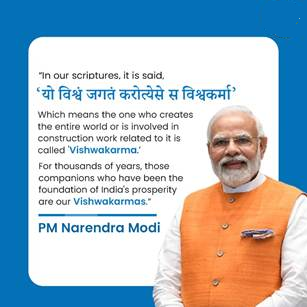
Vishvakarma
1. Identity: Vishvakarma is the divine architect and craftsman of the Hindu universe.
2. Role in Mythology: Creator of celestial palaces, mythical cities, divine weapons, and flying chariots for gods.
3. Symbolism: Revered as the first engineer, scientist, and craftsman in Hindu tradition.
4. Worship: Celebrated on Vishvakarma Jayanti (17 September), especially by artisans, engineers, architects, and industrial workers.
5. Cultural Importance: Represents India’s age-old respect for skill, innovation, and craftsmanship.
Need for PM Vishwakarma
| Domain | Why the Need? | Explanation / Example |
|---|---|---|
| Economic Empowerment | Traditional artisans face declining income & market access | Handloom & handicraft exports fell from 5% to 2% share in global trade (2010–2022) |
| Employment Generation | Unorganized crafts sector lacks job security & recognition | 13 crore artisans rely on informal work with low wages |
| Skill Development | Traditional skills are not upgraded to modern demands | Need for training in digital tools, modern machinery |
| Social Upliftment | Artisan communities often belong to marginalized sections | Scheme ensures social dignity & identity to traditional occupations |
| Cultural Preservation | Many traditional crafts are disappearing due to industrialization | E.g., Banarasi weavers, metal craftsmen losing livelihood |
| Inclusivity | Women artisans face double discrimination in skill & finance access | Scheme promotes gender-sensitive credit & training |
| Technological Upgradation | Lack of tech integration reduces productivity & global competitiveness | Support needed for modern tools, e-commerce, branding |
| Sustainability & Green Growth | Many crafts use eco-friendly, local materials | Promotion aligns with SDGs & “Make in India” green exports |
| Institutional Support | Fragmented policies earlier, need for integrated approach | PM Vishwakarma provides credit, training, certification, market linkages under one umbrella |
What is the PM Vishwakarma Scheme?
Launched on 17 September 2023 (Vishwakarma Jayanti).
Financial outlay: ₹13,000 crore (2023–28).
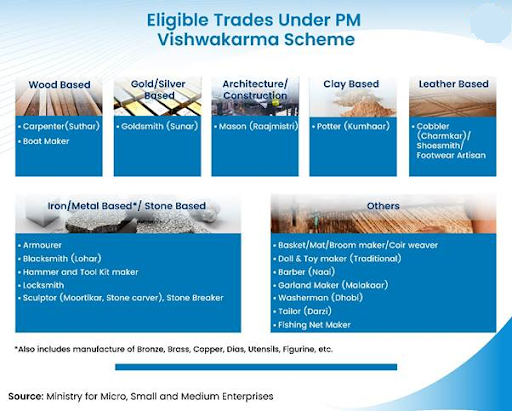
Supports 18 traditional trades (carpenters, masons, potters, tailors, cobblers, barbers, blacksmiths, goldsmiths, etc.).
Provides ID recognition, skill training, toolkit incentives, concessional loans, and market linkages.
Aims & Objectives
1. Recognition → PM Vishwakarma ID & certificate.
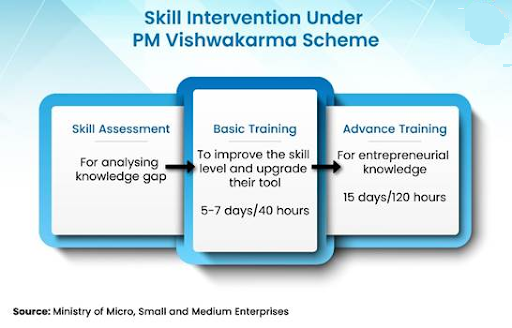
2. Skill Development → Basic + advanced training.
3. Financial Support → Loans up to ₹3 lakh at 5% interest.
4. Toolkit Incentives → ₹15,000 e-voucher.
5. Market Linkages → GeM, fairs, e-commerce, branding.
6. Heritage Preservation → Support guru-shishya tradition
Key Challenges
| Challenge Area | Issues | Data / Example |
|---|---|---|
| Economic | Limited global market access; raw material price fluctuations | Many artisans sell only in local markets; handloom exports stagnant at ~₹23,000 crore (2024) |
| Social | Awareness gaps in remote/tribal areas; gender disparity | Women form <30% of total beneficiaries despite being the majority in the handloom sector |
| Cultural | Threat from machine-made goods; youth leaving trades | Mass-produced pottery replacing terracotta crafts in West Bengal |
| Administrative | Uneven DPMU monitoring; duplication across schemes | CAG (2024) flagged overlaps with PMEGP & Mudra |
| Technological | Low digital literacy; weak e-commerce presence | Only 12% artisans on boarded on GeM despite incentives |
Way Forward for Inclusive Heritage
| Domain | Way Forward | Examples / Suggestions |
|---|---|---|
| Economic Inclusion | Expand collateral-free loans with flexible repayment; link artisans with Export Promotion Councils | Easier access to finance; connect with global buyers through EPCs |
| Social Empowerment | Create special women-focused artisan clusters; integrate SHGs with Vishwakarma beneficiaries | Handloom clusters in NE, mat makers in Assam; SHGs providing credit & collective marketing |
| Cultural Revitalization | Establish Heritage Craft Hubs in each state; promote youth apprenticeships under guru-shishya parampara | Craft hubs showcasing local heritage; apprenticeships blending tradition with innovation |
| Administrative Strengthening | Digitally integrate Vishwakarma portal with Udyam Assist; strengthen DPMUs with advanced tools | AI-based beneficiary tracking across 497 DPMUs |
| Technological & Market Linkages | Provide design upgradation via NID/NIFT; boost GeM onboarding, branding & ODOP campaigns | Modern designs, e-commerce penetration, stronger “One District, One Product” branding |
Conclusion
The PM Vishwakarma Scheme is more than an economic program — it is a civilisational tribute to India’s artisans, ensuring their dignity, recognition, and livelihood security. By blending heritage skills with modern technology, and fostering inclusive development across caste, gender, and region, the scheme can make Vishwakarmas true partners in India’s march towards Viksit Bharat 2047.
Prelims question:
Q. PM Vishwakarma Scheme is aimed at which of the following trades?
1. Carpenter
2. Mason (Raajmistri)
3. Tailor
4. IT Professionals
Options:
(a) 1, 2, and 3 only
(b) 2 and 4 only
(c) All four
(d) 1 and 4 only
Answer: A
Mains Question:
Q. Discuss the role of traditional artisans (Vishwakarmas) in preserving India’s cultural and craft heritage in the age of globalization.
(250 words)

- Europe’s AI Rules May Become India’s Opportunity - August 14, 2026
- Transparency as the Foundation of Trust in Medicine - August 14, 2026
- A Timely Reset for the Food Security Act: From Foodgrain Security to Nutrition Security - August 13, 2026

No Comments