


24 Sep India’s Manufacturing Momentum: Driving Growth Towards a $1 Trillion Economy
This article covers “Daily Current Affairs” and Topic details India’s Manufacturing Momentum: Driving Growth Towards a $1 Trillion Economy
SYLLABUS MAPPING:
GS-3- Economy- India’s Manufacturing Momentum: Driving Growth Towards a $1 Trillion Economy
FOR PRELIMS
What is the importance of manufacturing for India’s economy?
FOR MAINS
What are the key challenges facing India’s manufacturing sector, and how can they be addressed?
Why in the News?
India’s Manufacturing Sector: Contribution to the Economy
| Component | Contribution / Data (2025) | Examples / Notes |
|---|---|---|
| GDP Contribution | Manufacturing contributes significantly to GDP growth | Automotive industry: 7.1% of GDP; Textiles: 2.3% of GDP |
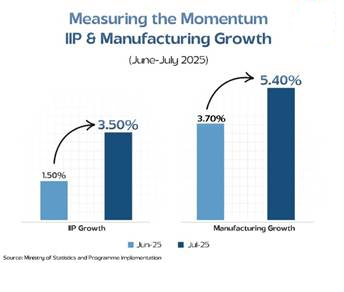
| Industrial Output | IIP grew 3.5% YoY in July; Manufacturing 5.4% YoY | Basic metals (+12.7%), Electrical equipment (+15.9%), Non-metallic minerals (+9.5%) |
| Exports | Merchandise exports: US$ 184.13 billion (Apr–Aug 2025); 2.52% YoY growth | Electronics, pharma, automobiles driving export growth |
| Employment | 17 crore jobs created in last decade; WPR 52.2%, Female WPR 32% | Skill India programmes training workforce for manufacturing |
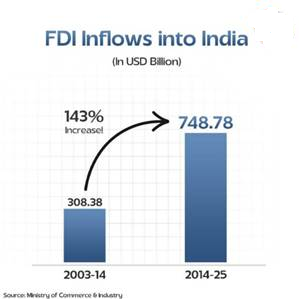
| FDI Inflows | Manufacturing FDI: US$ 19.04 billion FY24–25 | Maharashtra (39%), Karnataka (13%), Delhi (12%); Singapore top investor (30%) |
Way Forward: Recommendations & Solutions
Recommendations for Strengthening India’s Manufacturing Sector
| Challenge / Area | Recommendation / Solution | Committee / Example |
|---|---|---|
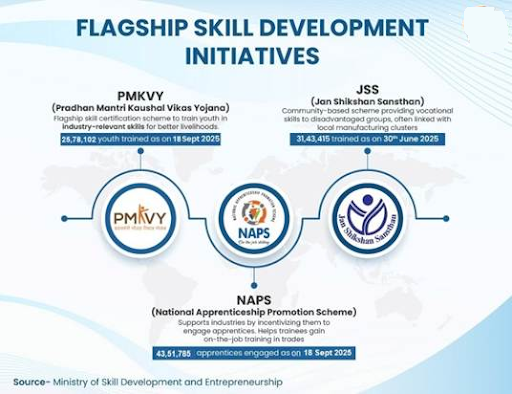
| Skill Development | Demand-driven training for modern manufacturing | Skill India Programme, National Skill Development Corporation (NSDC) |
| Infrastructure | Develop industrial corridors, PM MITRA parks, logistics integration | National Industrial Corridor Development Programme, PM GatiShakti |
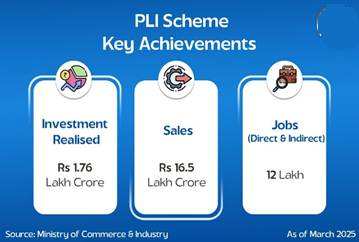
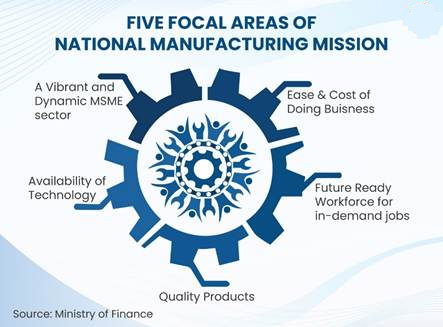
| Technology & Innovation | Promote clean-tech, digital manufacturing | National Manufacturing Mission (NMM), PLI schemes for electronics, EVs, pharma |
| Ease of Doing Business | Simplify compliance, reduce GST burden | GST 2.0, Startup India reforms |
| FDI & Investment | Attract global investors, strengthen policy certainty | PLI Scheme, National Manufacturing Mission |
| Export Competitiveness | Improve quality standards, scale up production | Electronics Manufacturing Clusters (EMCs), pharma hubs |
| Sustainability | Green manufacturing & net-zero alignment | Clean-tech under NMM, renewable energy integration |
Conclusion
India’s manufacturing sector is increasingly the backbone of its economic transformation, creating jobs, fostering innovation, and positioning the country as a global export and investment hub. With sustained policy support, skilled workforce development, technological adoption, and green manufacturing focus, India is on track to become a $1 trillion manufacturing economy by FY26, laying a solid foundation for a Viksit Bharat and sustainable industrial future by 2047
Prelims question:
Q. Consider the following statements regarding India’s Production Linked Incentive (PLI) Scheme:
The PLI scheme provides financial incentives linked directly to incremental production and sales.
1. It covers 14 key sectors, including electronics, pharmaceuticals, textiles, and drones.
2. The scheme aims to boost domestic manufacturing and reduce India’s dependence on imports.
3. PLI benefits are only available to companies in the public sector.
Which of the statements given above are correct?
(a) 1, 2, and 3 only
(b) 1 and 4 only
(c) 2 and 4 only
(d) 1, 2, 3, and 4
Answer: A
Mains Question:
Q. The Production Linked Incentive (PLI) scheme is a game-changer for India’s manufacturing sector. Discuss
(250 words)

- RBI’s Shrinking Real-Rate Cushion Amid Rising Inflation and Strong Demand - September 21, 2026
- India’s NGOs at a New Funding Crossroads - September 21, 2026
- Deep-Sea Discovery, Environmental Responsibility - September 19, 2026

No Comments