


26 Sep Satellite Internet in India: The Future of Internet Above Us
This article covers “Daily Current Affairs” and the Topic Satellite Internet in India: The Future of Internet Above Us
SYLLABUS MAPPING:
GS– 3 – Science & Technology- Satellite Internet in India: The Future of Internet Above Us
FOR PRELIMS
Why is satellite-based internet important for bridging the digital divide in India?
FOR MAINS
What are the advantages of LEO satellites over traditional geostationary satellites for internet connectivity?
Why in the News?
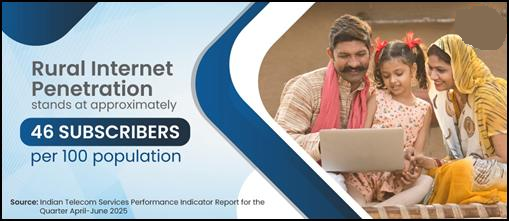
India’s digital landscape continues to expand rapidly, with 1,002.85 million internet subscribers reported in April–June 2025, reflecting its status as one of the fastest-growing digital nations. Despite this growth, internet penetration remains uneven, especially in remote regions, highlighting the need for satellite-based connectivity to complement existing networks and ensure inclusive digital access.
What is Satellite Internet?
Internet service provided via satellites in Geostationary Orbits (GSO) or Non-Geostationary Orbits (NGSO).
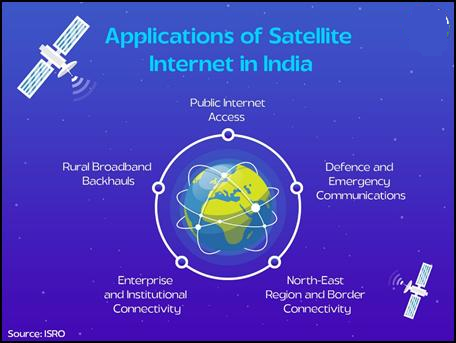
Supports the Digital India vision, offering connectivity to any location.
Crucial for remote and underserved regions where conventional internet cannot reach.
Regulatory Landscape for Satellite Internet
1. Space Sector Reforms (2020): Opened the sector for private participation.
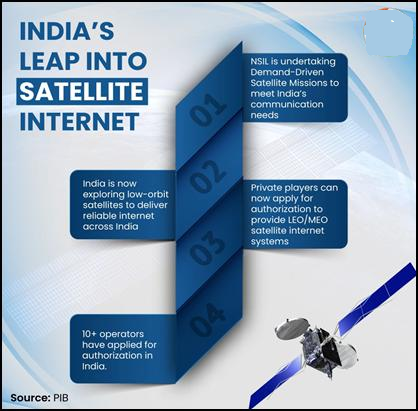
2. Indian Space Policy, 2023: Provides a level playing field for Non-Government Entities (NGEs).
3. Department of Telecommunications (DoT): Grants authorizations under Unified Licence Regime. Services include Commercial VSAT, GMPCS, complementing terrestrial networks. Telecommunications Act, 202,3 allows spectrum assignment and regulation of satellite services.
4. Telecom Regulatory Authority of India (TRAI): Recommendations in May 2025 for satellite spectrum assignment 5-year allocation, extendable by 2 years.
5. IN-SPACe: Interfaces between ISRO and private entities. Promotes and supervises non-government space activities.
6. New Space India Ltd. (NSIL): Commercial arm of ISRO; operates 15 in-orbit communication satellites. Manages demand-driven missions for DTH and broadband connectivity.
Transitioning Satellite Communication Landscape
1. Shift from Geostationary Satellites (GSAT) to LEO and MEO systems.
2. LEO satellites: 400–2,000 km altitude, low-latency, ideal for the internet.
3. MEO satellites: 8,000–20,000 km, larger coverage, slightly higher latency.
4. Policy reforms now allow up to 100% FDI, encouraging private participation.
5. Licensed private operators: Starlink, Jio Satellite Communication, OneWeb, among others.
Understanding the Satellite Communication Spectrum
Government Initiatives for Inclusive Digital Connectivity
1. Digital Bharat Nidhi (DBN): Expands broadband through 4G towers in rural areas. Funds projects in underserved regions.
2. Comprehensive Telecom Development Plan (CTDP)
Islands: Andaman & Nicobar capacity increased from 2 Gbps → 4 Gbps; Lakshadweep 318 Mbps → 1.71 Gbps.
North-East: 2,485 mobile towers serving 3,389 locations.
3. National Broadband Mission 2.0 (NBM 2.0): Extends broadband to remaining 1.7 lakh villages.
BharatNet Phase II: 2.14 lakh Gram Panchayats connected.
4. PM-WANI: Creates public Wi-Fi hotspots, over 3.73 lakh installed.
5. GIS-based Decision Support System (DSS) – MoES: Uses satellite and real-time data for early warning of extreme weather.
India’s Key Broadband-Based Satellites
Fleet of 19 communication satellites, including GSAT-19, GSAT-29, GSAT-11, GSAT-N2.
Supports:
High-speed broadband in underserved areas
In-flight connectivity
Defence networks
Disaster management
High-Throughput Satellites (HTS) with spot-beam technology ensure faster speeds and higher capacity.
India’s Key Broadband-Based Satellites
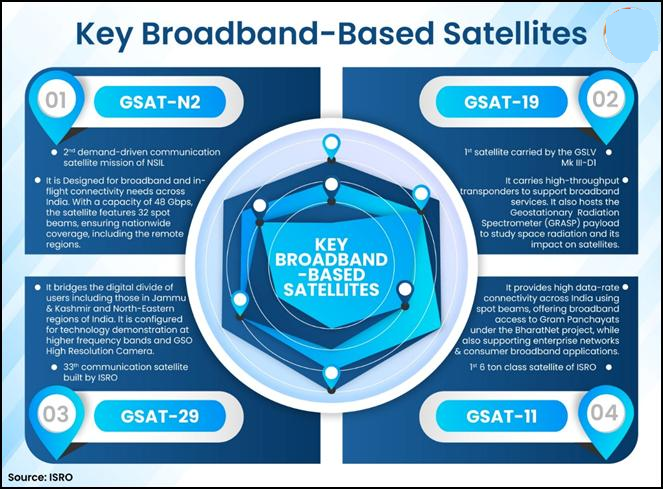
India’s broadband reach is steadily expanding through high-throughput satellites (HTS) developed by ISRO, which use advanced spot-beam technology to provide faster speeds and higher capacity. India has a fleet of 19 operational communication satellites, among which GSAT-19, GSAT-29, GSAT-11, and GSAT-N2 are specifically geared towards boosting India’s broadband services. These satellites are designed to enhance internet connectivity in underserved areas, support in-flight communication, defence networks and disaster management. Together, they form the backbone of satellite-based broadband infrastructure in India, complementing ground-based networks like BharatNet.
Conclusion
India’s satellite internet ecosystem is undergoing a transformative shift, combining LEO/MEO satellite systems, private sector participation, and robust policy support to bridge the digital divide. These initiatives support Digital India’s goals, strengthen socio-economic development, and enhance resilience in defence, disaster management, and education. By 2047, satellite connectivity is set to play a pivotal role in ensuring inclusive, high-speed internet access across all corners of the country, realizing the vision of Viksit Bharat.
Prelims question:
Q. Which of the following statements about India’s satellite internet initiatives is/are correct?
1. India has a fleet of 19 operational communication satellites including GSAT-19, GSAT-29, GSAT-11, and GSAT-N2.
2. LEO satellites operate at an altitude of 400–2,000 km and are ideal for low-latency internet.
3. The PM-WANI scheme is related to expansion of 5G services in urban areas only.
Select the correct answer:
(a) 1 and 2 only
(b) 2 and 3 only
(c) 1 and 3 only
(d) 1, 2 and 3
Answer: A
Mains Question:
Q. Discuss the significance of satellite-based internet in promoting inclusive digital connectivity, the role of private players and government initiatives, and the challenges in ensuring high-speed internet across remote areas.
(250 words)

- RBI’s Shrinking Real-Rate Cushion Amid Rising Inflation and Strong Demand - September 21, 2026
- India’s NGOs at a New Funding Crossroads - September 21, 2026
- Deep-Sea Discovery, Environmental Responsibility - September 19, 2026

No Comments