


29 Sep India–USA Ties: From Non-Alignment to Comprehensive Strategic Partnership
This article covers “Daily Current Affairs” and the India–USA Ties: From Non-Alignment to Comprehensive Strategic Partnership
SYLLABUS MAPPING:
GS-2- International Relations- India–USA Ties: From Non-Alignment to Comprehensive Strategic Partnership
FOR PRELIMS
What is the H-1B visa, and why is it significant for Indian professionals?
FOR MAINS
What are the likely effects on remittances and employment in India?
Why in the News?
U.S. President Donald Trump signed a proclamation increasing the H-1B visa processing fee by nearly 60 times to $1,00,000. The White House stated that the move aims to curb abuses that displace American workers and threaten national security. A brief concern was eased when Washington clarified that the revised fee would apply only to new applications from September 21 onwards, not to current visa holders or renewals.
What is the H-1B Visa?
The H-1B visa is a non-immigrant work visa issued by the United States.
It allows U.S. companies to employ foreign workers in specialty occupations requiring theoretical or technical expertise (IT, engineering, mathematics, medicine, etc.).
Indian IT professionals are the largest beneficiaries: every year, Indians account for 60–70% of total H-1B approvals.
The visa is valid for 3 years (extendable to 6 years) and often serves as a pathway to permanent residency
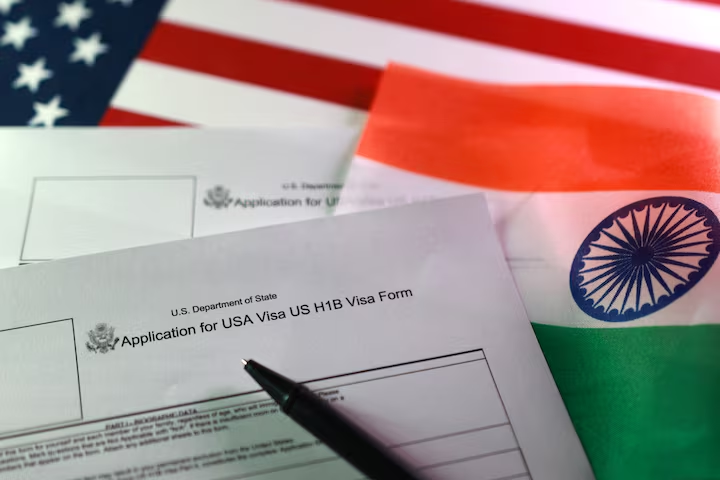
What is the U.S. decision?
The U.S. has decided to impose a one-time $100,000 fee on future H-1B visa applications.
This fee directly increases the cost of hiring Indian professionals by U.S. companies
Evolution of India–USA Ties
1. Cold War Era: India maintained non-alignment, while the US was aligned with Pakistan. Relations were cautious.
2. Post-1991 Liberalization: India’s economic reforms and globalization created space for stronger US–India trade and investment ties.
3. 2000s Strategic Partnership: The 2005 Civil Nuclear Deal marked a breakthrough, recognizing India as a responsible nuclear power.
4. Defence & Security: India is now a Major Defence Partner (2016), with foundational agreements (LEMOA, COMCASA, BECA) strengthening interoperability.
5. Technology & Innovation: Collaboration in IT, space (NASA–ISRO), AI, semiconductors, and clean energy has expanded.
6. Indo-Pacific Convergence: Both nations share interest in countering China’s assertiveness, visible in the Quad grouping.
7. People-to-People Links: With 4.5M+ Indian diaspora in the US, remittances, and H-1B professionals, human capital binds ties.
Likely Impact on India
1. Services Exports: India’s IT industry (Infosys, TCS, Wipro, etc.) earns ~$250 billion annually, of which the U.S. accounts for over 60%. Higher visa costs will reduce the competitiveness of Indian firms in the U.S. market.IT services exports may slow down in growth, especially in consulting and outsourcing.
2. Remittances: Indians working in the U.S. send back large remittances (over $120 billion annually, the world’s largest). Fewer H-1B workers → lower remittance inflows in the medium term.
3. Employment in India: If U.S. clients cut outsourcing deals due to costlier Indian labour, Indian IT companies may hire less, affecting youth employment in India’s IT sector. Domestic ripple effects: reduced income → lower consumption.
4. Alternative Markets Challenge: India is trying to expand IT services in Europe, Middle East, Africa, and Asia-Pacific, but these are still under development. Dependence on U.S. remains very high in the short run.
5. Bilateral Trade Tensions: This decision adds to trade frictions (like tariffs on goods, digital taxation issues). It may strain India–U.S. economic relations, especially as India pushes for more services exports access.
6. Macroeconomic Impact: Short-term: Manageable, since firms may absorb costs. Long-term: If restrictions persist, could impact GDP growth, exports, employment, and foreign exchange reserves.
7. Modi’s 2025 U.S. Visit & “Mission 500”: In February 2025, Prime Minister Narendra Modi visited the U.S. (Feb 12–15). During that visit, India and the U.S. launched “Mission 500”, a plan to raise bilateral trade to US $500 billion by 2030. They also discussed energy, defence, and tech cooperation during the bilateral meetings.
Current Challenges
1. Trade Tensions: Tariff disputes and new US measures like the proposed $100,000 H-1B fee affect Indian IT exports.
2. Geopolitical Divergences: India’s energy ties with Russia and cautious stance on global conflicts (Ukraine, West Asia) sometimes contrast with US expectations.
3. Protectionism: US tightening of visas and technology transfer restrictions could slow India’s services sector.
4. China Factor: While both align against China, their approaches differ — US is more military-forward, India prefers strategic autonomy.
Ways to Manage the Scenario
1. Institutional Dialogue: Expand 2+2 Ministerial dialogue and high-level summits to resolve trade and visa frictions.
Example: 2023 PM Modi–Biden State Visit announcing new semiconductor & defense collaborations.
2. Trade Rebalancing: Push for a limited trade deal covering IT services, agriculture, and digital trade rules.
3. Technology Partnerships: Deepen collaboration in semiconductors (Micron in Gujarat), critical minerals, and AI governance.
4. Defence Co-production: Expand Make in India–Make for World through joint fighter jet engines (GE–HAL deal) and drones.
5. Energy Cooperation: Diversify LNG, green hydrogen, and nuclear energy collaboration to reduce supply shocks.
6. People Mobility: Negotiate smoother visa and student pathways, ensuring Indian professionals continue contributing to the US economy.
7. Global South Cooperation: Align on climate finance, development assistance, and digital public infrastructure to present a united leadership.
Conclusion
India–US ties have matured into a comprehensive global strategic partnership. While short-term challenges like H-1B visa fees or tariff disputes may create friction, sustained dialogue, technology collaboration, and shared Indo-Pacific goals can anchor the relationship in the long run.
Prelims question:
Q.Consider the following statements regarding the H-1B visa:
1. It is a non-immigrant visa allowing foreign workers in specialty occupations.
2. Indians account for nearly 60–70% of H-1B visa approvals annually.
3. The visa is valid for 10 years.
Which of the above statements is/are correct?
(a) 1 only
(b) 1 and 2 only
(c) 2 and 3 only
(d) All of the above
Answer: B
Mains Question:
Q. Discuss the evolution of India–USA ties from the Cold War era to the present. Highlight major milestones in trade, defence, technology, and strategic partnerships.
(250 words)

- RBI’s Shrinking Real-Rate Cushion Amid Rising Inflation and Strong Demand - September 21, 2026
- India’s NGOs at a New Funding Crossroads - September 21, 2026
- Deep-Sea Discovery, Environmental Responsibility - September 19, 2026

No Comments