


11 Oct Shielding Citizens Online: India’s Response to Cyber Frauds
This article covers “Daily Current Affairs” and Topic details Shielding Citizens Online: India’s Response to Cyber Frauds
SYLLABUS MAPPING:
GS -3- Technology and Internal Security- Shielding Citizens Online: India’s Response to Cyber Frauds
FOR PRELIMS
What is the objective of the Financial Fraud Risk Indicator (FRI) launched by the DoT?
FOR MAINS
What role does CERT-In play in India’s cybersecurity framework?
Why in the News?
India’s cyberspace is witnessing a dramatic rise in cyber frauds, making cybersecurity a national priority. With over 86% of households now connected to the internet, the Digital India initiative has significantly expanded access to online services. However, this growth has also widened the attack surface for cybercriminals. Recent data from the National Cyber Crime Reporting Portal (NCRP) reveals a surge in cybersecurity incidents — from 10.29 lakh cases in 2022 to 22.68 lakh in 2024. As of February 28, 2025, cyber frauds worth ₹36.45 lakh have been reported, reflecting both the rising scale of threats and improved reporting mechanisms.
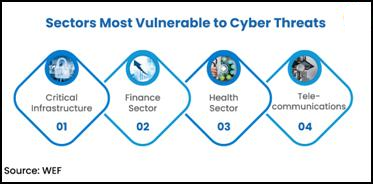
Tracking the Trends in Cyber Fraud
Cyber fraud is rapidly evolving, with scams no longer limited to one technique but spreading across a variety of methods that continuously adapt to new technologies and changing user habits. Identifying and analyzing these trends is essential to develop effective prevention strategies. The massive financial losses seen globally highlight the international scale of these crimes, often driven by organized criminal networks, including so-called “fraud factories” operating in parts of Southeast Asia.

Emerging Cyber Threats
Cybercriminals are increasingly using spoofing, AI-powered deep fakes, and phishing scams to trick users by posing as trusted sources or sending deceptive messages. These evolving tactics are making digital frauds more widespread and harder to detect. India’s popular payment system, UPI, has been targeted through compromised mobile numbers. To counter this, the Department of Telecommunications (DoT) launched the Financial Fraud Risk Indicator (FRI), which flags suspicious numbers as Medium, High, or Very High risk. Meanwhile, illegal online betting apps have emerged as another threat, luring users with fake promises of high returns. These scams have reportedly raked in over ₹400 crores in criminal profits.
India’s Cybersecurity Framework: Strengthening Digital Defences
As India rapidly digitizes, the government has put in place robust cybersecurity measures to protect its growing online population. With the internet now integral to daily life—powering business, education, banking, and access to public services—the need for a secure digital ecosystem has never been greater. To bolster frontline capabilities, over 1,05,796 police officers have been enrolled on the CyTrain portal, with more than 82,704 training certificates issued, enhancing cybercrime investigation skills across the country.
Key Cyber Laws Securing India’s Cyberspace
1. Information Technology Act, 2000: The cornerstone of India’s cyber law, this Act covers offences like identity theft, impersonation, online fraud, and distribution of obscene content. It also empowers authorities to block harmful websites and apps, helping curb digital financial crimes.
2. IT (Intermediary Guidelines and Digital Media Ethics Code) Rules, 2021: These rules enforce accountability on social media platforms, digital services, and online marketplaces. They address the misuse of emerging technologies, including AI, and require prompt removal of unlawful content.
3. Digital Personal Data Protection Act, 2023: This Act mandates the lawful and consent-based handling of personal data, enhancing privacy and security. It imposes strict responsibilities on data handlers to prevent unauthorized access or misuse, marking a significant step toward a safer digital India.
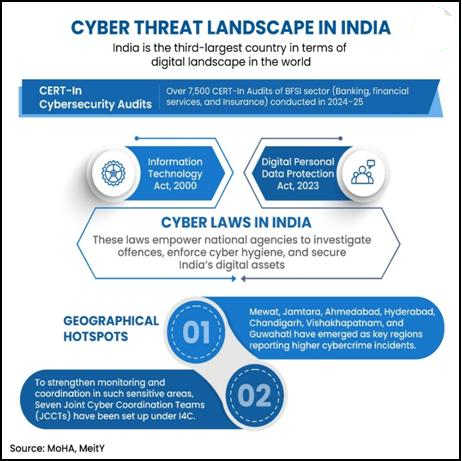
🇮🇳 India’s Cybersecurity Ecosystem at a Glance
| Initiative / Agency | Role / Objective | Key Highlights |
|---|---|---|
| CERT-In | National agency for cyber incident response | – 109 mock drills conducted (till Mar 2025) – 1,438 organizations participated |
| NCIIPC | Protects critical infrastructure (banking, power, telecom, transport) | – 24/7 monitoring – Sector-specific threat assessments and guidelines |
| I4C (Indian Cybercrime Coordination Centre) | Coordinates cybercrime investigations & builds LEA capacity | – 3,962 Skype IDs & 83,668 WhatsApp accounts blocked – Supports tools, training, and info-sharing |
| CFCFRMS | Portal for reporting financial cyber frauds | – ₹5,489 crore saved – 17.82 lakh complaints processed |
| Budget 2025 Allocation | Financial support for cybersecurity initiatives | – ₹782 crore allocated |
| Cybercrime Portal (cybercrime.gov.in) | Public reporting platform for cybercrimes | – Helpline 1930 for real-time fraud assistance – Focus on crimes against women & children |
| NM-ICPS | R&D mission promoting cybersecurity and AI innovations | – Supports tool & platform development – Boosts collaboration across sectors |
| CCPWC Scheme | Focuses on cybercrime prevention against women and children | – ₹132.93 crore funded – 33 labs set up – 24,600+ personnel trained |
| CCMP (Cyber Crisis Management Plan) | Ensures preparedness for cyberattacks & coordinated recovery | – 205 workshops conducted nationwide |
| Samanvaya Platform | Links cybercrime investigations across states using analytics | – 12,987 arrests made – 1.5+ lakh criminal linkages – 70,584 investigation assists |
| Sahyog Portal | Enables fast takedown of unlawful online content | – Centralized removal notices – Unified platform for all authorized agencies |
Cybersecurity Exercises
The Bharat National Cybersecurity Exercise 2025 was held from 21st July to 1st August, reinforcing India’s commitment to enhancing cyber resilience. The event gathered over 600 participants, including cybersecurity experts, regulators, and policymakers. The centerpiece was STRATEX, a simulated national cyber breach that tested real-time coordination and decision-making across agencies.
Cybersecurity Spotlight at India Mobile Congress 2025
At the upcoming 9th India Mobile Congress (IMC 2025), cybersecurity will be a major focus, underscoring India’s efforts to safeguard digital networks and emerging technologies. The event, themed “Innovate to Transform”, will be inaugurated by Prime Minister Shri Narendra Modi from October 8–11 at Yashobhoomi, New Delhi. IMC 2025 will host six global summits, including the Cybersecurity Summit and Bharat 6G Symposium, highlighting India’s leadership in next-generation digital technologies. Key themes include 6G, cybersecurity, satellite communications, AI, IoT, and telecom manufacturing. The congress is expected to attract over 1.5 lakh visitors, 7,000+ international delegates, and 400+ exhibitors, showcasing more than 1,600 cutting-edge use cases. With 100+ sessions and 800+ speakers, IMC 2025 will serve as a premier platform for global collaboration and innovation.
India’s Digital Momentum
As India celebrates its rapid 5G rollout, with 1.2 billion mobile subscribers and 970 million internet users, the focus on building secure, inclusive, and scalable digital ecosystems strengthens the country’s standing as a global hub for trusted and transformative digital infrastructure.
Forward Path: Cyber Awareness
To strengthen public awareness on cyber-crimes, the Government has taken a multi-platform outreach strategy.
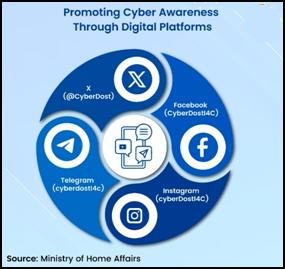
The government has rolled out citizen-focused awareness campaigns via radio, newspapers, and metro announcements to educate the public on cyber fraud prevention. To enhance national vigilance, the National Cyber Coordination Centre (NCCC), established by CERT-In, monitors existing and emerging cybersecurity threats to provide real-time situational awareness. Public engagement is further strengthened through Cyber Safety and Security Awareness Weeks conducted on the MyGov platform, encouraging active participation. A dedicated handbook for adolescents and students has also been released to promote safe digital practices among youth.
Conclusion
India is at the crossroads of digital transformation and cyber threats, where it has become both an iron pillar of progress and a magnet for cyber fraudsters. Realising the vision of Digital India, the government’s multi-layered cyber response team is facilitating fraud prevention and disrupting thousands of scam operations. Advanced forensics, big data analytics, and indigenous tools have bolstered national cyber resilience. Yet, securing India’s cyberspace is a shared responsibility where the government and citizens must act together in this combat against cyber frauds.
Prelims question:
Q. With reference to India’s cybersecurity initiatives, consider the following statements:
1. The Indian Cybercrime Coordination Centre (I4C) works under the Ministry of Home Affairs.
2. The Financial Fraud Risk Indicator (FRI) is a tool launched by the Ministry of Electronics and Information Technology (MeitY).
3. CERT-In is the national nodal agency for responding to cybersecurity incidents.
4. The CyTrain platform is designed to train judicial officers in cyber laws.
Which of the statements given above are correct?
(a) 1 and 3 only
(b) 1, 3 and 4 only
(c) 1, 2 and 3 only
(d) 1, 2, 3 and 4
Answer: C
Mains Question:
Q. With the rapid digitalisation of services under the Digital India initiative, cyber frauds have emerged as a major threat to citizens, institutions, and national security. Discuss the evolving nature of cyber frauds in India and critically evaluate the government’s multi-pronged strategy to tackle them.
(250 words)

- RBI’s Shrinking Real-Rate Cushion Amid Rising Inflation and Strong Demand - September 21, 2026
- India’s NGOs at a New Funding Crossroads - September 21, 2026
- Deep-Sea Discovery, Environmental Responsibility - September 19, 2026

No Comments