


18 Oct India’s Pulses Revolution 2.0: The Road to Self-Reliance and Farmers’ Prosperity
This article covers “Daily Current Affairs” and the Topic India’s Pulses Revolution 2.0: The Road to Self-Reliance and Farmers’ Prosperity
SYLLABUS MAPPING:
GS-3– Indian Economy & Agriculture0- India’s Pulses Revolution 2.0: The Road to Self-Reliance and Farmers’ Prosperity
FOR PRELIMS
What is the Mission for Aatmanirbharta in Pulses (2025–31)?
FOR MAINS
What are the challenges in achieving self-sufficiency in pulse production in India?
Why in the News?
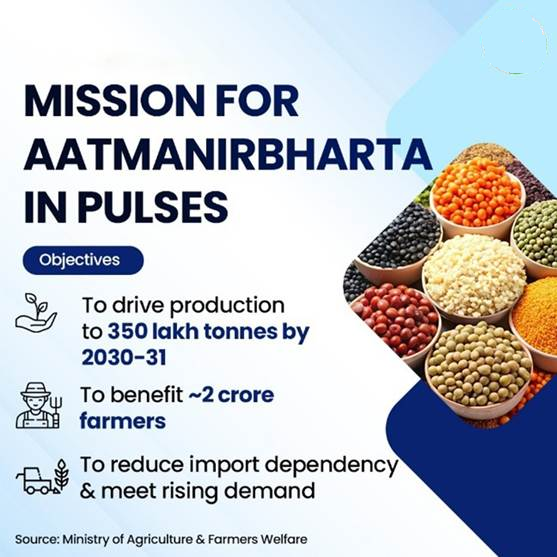
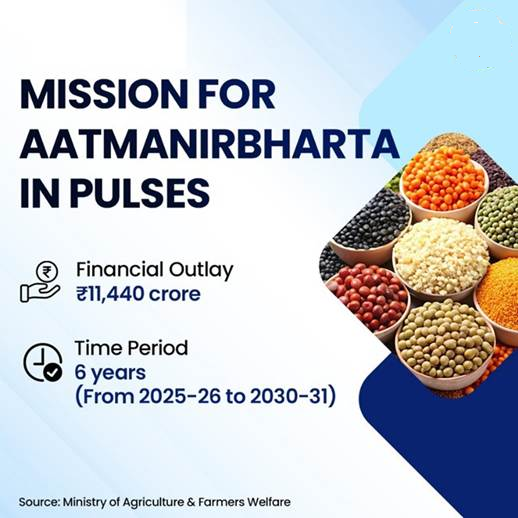
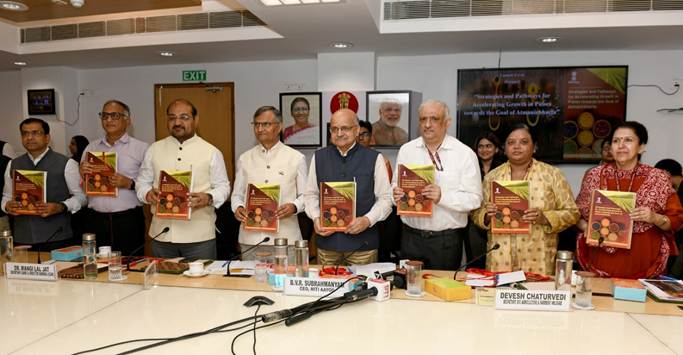
The Prime Minister of India launched the Mission for Aatmanirbharta in Pulses (2025–26 to 2030–31) on October 11, 2025, at the Indian Agricultural Research Institute (IARI), New Delhi. The mission, with a total outlay of ₹11,440 crore, aims to make India self-reliant in pulse production by scaling up output to 350 lakh tonnes and expanding the cultivation area to 310 lakh hectares by 2030–31. It also ensures 100% MSP procurement of Tur, Urad, and Masoor for four years, benefiting nearly 2 crore farmers through free seed distribution, quality inputs, and value chain support.
Background
India has made remarkable progress in pulse production over the past decade. Under the National Food Security and Nutrition Mission (NFSNM), output rose from 192.6 lakh tonnes in 2013–14 to 252.38 lakh tonnes in 2024–25 (3rd Advance Estimates) — a 31% increase.
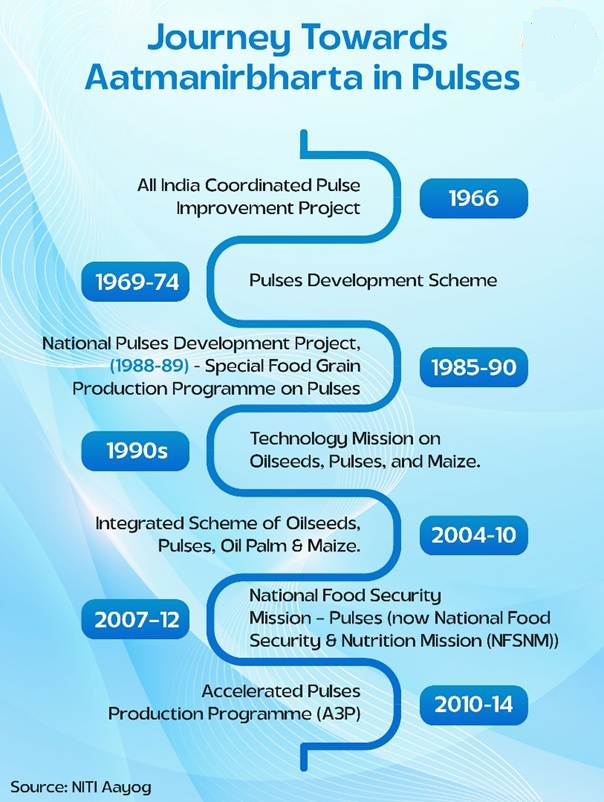
However, with domestic demand outpacing production, India still imported 47.38 lakh tonnes of pulses in 2023–24, even while exporting 5.94 lakh tonnes. This import dependence highlighted the urgent need for a structural shift toward self-sufficiency. To bridge this gap, the Government set an ambitious target to achieve complete Aatmanirbharta in pulses by December 2027, focusing on Tur (Arhar), Urad, and Masoor. The new Mission aligns with Vision 2047, emphasizing sustainable production, income assurance, and the use of modern, climate-resilient technologies to empower farmers Historically, India’s journey in pulse development includes initiatives such as the All India Coordinated Pulses Improvement Project (1966), Accelerated Pulses Production Programme (A3P, 2010–14), and the National Food Security Mission, which laid the foundation for productivity growth.
Objectives of the Mission
The Mission for Aatmanirbharta in Pulses (2025–31) aims to:
1. Achieve self-sufficiency in pulses and reduce import dependence.
2. Enhance farmers’ income through MSP assurance and market linkages.
3. Expand pulses area by 35 lakh hectares, especially in rice fallows and drylands.
4. Promote intercropping, crop diversification, and climate-resilient farming.
5. Develop and distribute high-yielding, pest-resistant, drought-tolerant varieties.
6. Strengthen the seed system through 126 lakh quintals of certified seeds and 88 lakh free seed kits.
Operational Strategy
1. State Implementation and Monitoring: States will prepare five-year rolling seed plans, monitored by ICAR. The SATHI Portal (seedtrace.gov.in) will ensure seed traceability and transparency.
2. Integrated Farm Support: Focus on soil health, balanced fertilizer use, mechanization, and plant protection. ICAR, KVKs, and State Departments will conduct large-scale field demonstrations.
3. Procurement and Price Assurance: Under PM-AASHA, NAFED and NCCF will ensure 100% procurement of Tur, Urad, and Masoor at MSP for four years. This guarantees timely payments, fair prices, and reduced market volatility.
4. Value Chain Development: Establish 1,000 processing and packaging units with ₹25 lakh subsidy per unit. Adopt a cluster-based model (as suggested by NITI Aayog) for efficient resource use and regional specialization.
SATHI Portal: The Digital Backbone
The Seed Authentication, Traceability & Holistic Inventory (SATHI) portal, developed by the Ministry of Agriculture and NIC, ensures a transparent and tamper-proof seed supply chain.
It automates the entire seed life cycle—from production and certification to sale and licensing—ensuring farmers receive authentic and high-quality seeds.
PM-AASHA: Price Assurance for Farmers
The Pradhan Mantri Annadata Aay Sanrakshan Abhiyan (PM-AASHA), launched in 2018, aims to provide income security for farmers growing pulses, oilseeds, and copra.
It includes:
1. Price Support Scheme (PSS): Direct procurement at MSP.
2. Price Deficiency Payment Scheme (PDPS): Compensation for price gaps.
3. Market Intervention Scheme (MIS): Stabilization for perishables.
The scheme, continued in 2024, complements the new Mission by ensuring remunerative returns and encouraging diversification toward pulses.
Recommendations from NITI Aayog (September 2025)
1. Expansion of pulses into rice fallows and cluster-based diversification.
2. The “One Block–One Seed Village” approach to boost local seed systems.
3. Promotion of FPO-based seed hubs for timely, high-quality seed supply.
4. Strengthening procurement centers and local processing units to minimize middlemen.
5. Integrating pulses into PDS and Mid-Day Meal schemes to enhance nutrition.
6. Adoption of mechanization, efficient irrigation, bio-fertilizers, and climate-resilient varieties.
7. Use of data-driven early warning systems and SATHI-based monitoring for real-time responsiveness.
Expected Outcomes by 2030–31
| Parameter | Target |
|---|---|
| Pulses Cultivation Area | 310 lakh hectares |
| Total Production | 350 lakh tonnes |
| Average Yield | 1,130 kg/ha |
| Farmers Benefited | Nearly 2 crore |
| Certified Seed Distribution | 126 lakh quintals |
| Free Seed Kits | 88 lakh |
| Processing Units | 1,000 (₹25 lakh subsidy per unit) |
Significance of the Mission
1. Nutritional Security: Increases protein intake and reduces malnutrition through enhanced pulse availability.
2. Economic Empowerment: Boosts rural incomes and provides stable returns through MSP-based procurement.
3. Import Substitution: Saves valuable foreign exchange by cutting dependence on imported pulses.
4. Sustainability: Improves soil fertility through nitrogen fixation and reduces environmental impact.
5. Employment Generation: Encourages agro-industries, processing units, and rural entrepreneurship.
6. Climate Resilience: Promotes drought-tolerant and pest-resistant varieties suited to changing climatic conditions.
Way Forward
1. Promote Research and Innovation: Strengthen ICAR and State Agricultural Universities for developing high-yielding, short-duration, and climate-resilient varieties of pulses.
2. Encourage Private Sector Participation: Foster public-private partnerships (PPP) in seed production, processing, and marketing to scale operations efficiently.
3. Expand Irrigation Infrastructure: Enhance micro-irrigation coverage and water-use efficiency in rainfed pulse-growing regions.
4. Strengthen Extension Services: Boost farmer awareness through KVKs, FPOs, and digital advisory systems for adoption of improved technologies.
5. Integrate Pulses in Food Schemes: Mainstream pulses into PDS, Mid-Day Meal, and ICDS to ensure nutritional security and stable domestic demand.
6. Leverage Digital Agriculture: Utilize tools like remote sensing, AI, and GIS-based monitoring for real-time crop forecasting and pest management.
7. Sustain Market Stability: Establish decentralized procurement networks and price stabilization funds to protect farmers during market fluctuations.
8. Encourage Crop Insurance Coverage: Ensure PMFBY coverage for pulses to mitigate weather and pest risks.
Conclusion
The Mission for Aatmanirbharta in Pulses represents a transformative step toward achieving nutritional self-sufficiency, farmers’ prosperity, and sustainable agriculture. By integrating science, policy, and farmer welfare, the Mission not only seeks to end import dependence but also to build a resilient agri-economy aligned with Viksit Bharat @2047.Through sustained implementation, India can truly become the “Global Hub for Sustainable Pulses Production”, ensuring both food security and farmer dignity.
Prelims question:
Q. With reference to the Mission for Aatmanirbharta in Pulses (2025–31), consider the following statements:
1. The mission aims to make India self-reliant in pulse production by 2030–31.
2. It ensures 100% MSP procurement of Tur, Urad, and Masoor for four years.
3. The SATHI portal is used for seed authentication and traceability.
4. It is implemented under the Ministry of Food Processing Industries.
Which of the statements given above are correct?
(a) 1, 2, and 3 only
(b) 1 and 3 only
(c) 2 and 4 only
(d) 1, 2, 3, and 4
Answer: A
Mains Question:
Q. The Mission for Aatmanirbharta in Pulses (2025–31) aims to transform India from a net importer to a self-reliant producer of pulses. Discuss its significance, operational strategies, and challenges, along with measures to ensure sustainable pulse production in India.
(250 words)

- Before New Taxes, Make Every Rupee Count: Fiscal Discipline and Outcome-Based Governance in Tamil Nadu - August 20, 2026
- A Palestinian State as the Foundation for Regional Peace - August 20, 2026
- A Vision for an Inclusive Bangladesh: Democracy, Minority Rights and India’s Neighbourhood - August 19, 2026

No Comments