


27 Oct Linguistic Inclusion in the Digital Era: India’s AI-Driven Transformation
This article covers “Daily Current Affairs” and Linguistic Inclusion in the Digital Era: India’s AI-Driven Transformation
SYLLABUS MAPPING:
GS- 2– Governance- Linguistic Inclusion in the Digital Era: India’s AI-Driven Transformation
FOR PRELIMS
What is meant by linguistic inclusion?
FOR MAINS
What is the significance of linguistic inclusion in achieving the goals of Digital India and NEP 2020?
Why in the News?
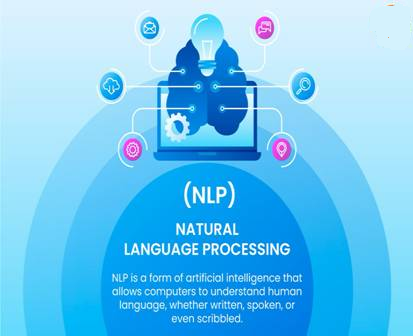
The Government of India is promoting linguistic inclusion in the digital ecosystem by integrating technologies like Artificial Intelligence (AI), Natural Language Processing (NLP), Machine Learning, and speech recognition to support India’s 22 Scheduled Languages and hundreds of regional dialects. These efforts aim to ensure that every citizen can access digital services, e-governance platforms, and online resources in their own language, thereby strengthening digital inclusion and participatory governance.
Key Platforms Driving Linguistic Inclusion
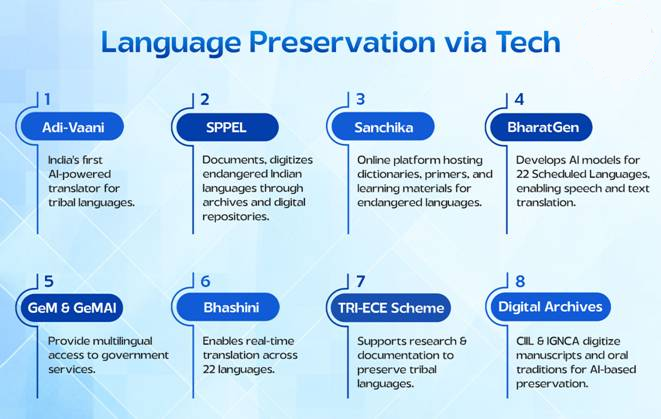
Artificial intelligence–driven language platforms and expansive digital repositories are transforming how India’s diverse languages are preserved, used, and evolved in the digital age. Initiatives such as Bhashini and BharatGen are enabling multilingual communication across governance, education, and healthcare, while innovative efforts like Adi-Vaani are bringing tribal and endangered languages into the mainstream digital ecosystem. Together, these initiatives ensure that India’s linguistic heritage is not only safeguarded but also made functional, dynamic, and future-ready.
Over the past decade, rapid advancements in Artificial Intelligence (AI), Natural Language Processing (NLP), and digital infrastructure have revolutionized efforts to document, digitize, and revitalize India’s linguistic diversity. These technologies facilitate large-scale language data collection, real-time translation, and speech recognition across hundreds of Indian languages and dialects—many of which were historically underrepresented. This digital transformation is bridging communication divides, promoting inclusive governance, and empowering citizens by making information and public services accessible in their native tongues. In essence, India’s multilingual AI ecosystem is reshaping the nation’s linguistic landscape, turning diversity into a strength for digital inclusion and equitable growth.
Adi-Vaani: AI for Tribal Language Inclusion
Key Platforms Driving Linguistic Inclusion in India
| Platform / Scheme | Year / Implementing Agency | Core Objective | Key Features & Technologies | Languages / Scope | Significance / Impact |
|---|---|---|---|---|---|
| Adi-Vaani | Founded in 2024 | Real-time translation and preservation of tribal languages | – Uses AI, Speech Recognition, and NLP – Combines AI precision with human linguistic expertise |
Santali, Bhili, Mundari, Gondi and other tribal languages | – Preserves oral linguistic traditions – Enables use in education, governance, and cultural documentation |
| Scheme for Protection and Preservation of Endangered Languages (SPPEL) | Launched in 2013 Ministry of Education; Implemented by CIIL, Mysuru |
Documentation and digital archiving of endangered languages (spoken by fewer than 10,000 people) | – Generates text, audio, video datasets – Supports AI & NLP-based language research |
Endangered and lesser-known Indian languages | – Provides linguistic data for AI platforms – Strengthens preservation and research capacity |
| Sanchika | Managed by CIIL, Mysuru | Centralized digital repository for Indian languages | – Aggregates dictionaries, primers, stories, and multimedia resources – Enables AI model training and translation development |
Scheduled and tribal languages | – Supports academic research, education, and AI-based innovation – Preserves cultural and linguistic narratives |
| BharatGen | National initiative leveraging SPPEL and Sanchika data | Develops AI models for multilingual translation and speech systems | – Builds text-to-text and text-to-speech models – Uses large Indian language datasets |
All 22 Scheduled Languages | – Powers multilingual apps in governance, education, healthcare – Enhances digital accessibility and inclusivity |
| GeM & GeMAI | GeM launched in 2016 by Ministry of Commerce & Industry | Streamline public procurement and make it linguistically inclusive | – GeMAI: AI-powered multilingual assistant using NLP & ML – Offers voice & text-based interaction |
Multiple Indian languages | – Enables multilingual navigation and transactions on GeM – Overcomes language barriers in government e-marketplace |
| Bhashini | Under National Language Translation Mission (NLTM) | Real-time AI translation across Indian languages for inclusive governance | – Uses Machine Translation, ASR, and NLU – Provides multilingual digital services |
22 Scheduled + tribal languages |
Key achievements
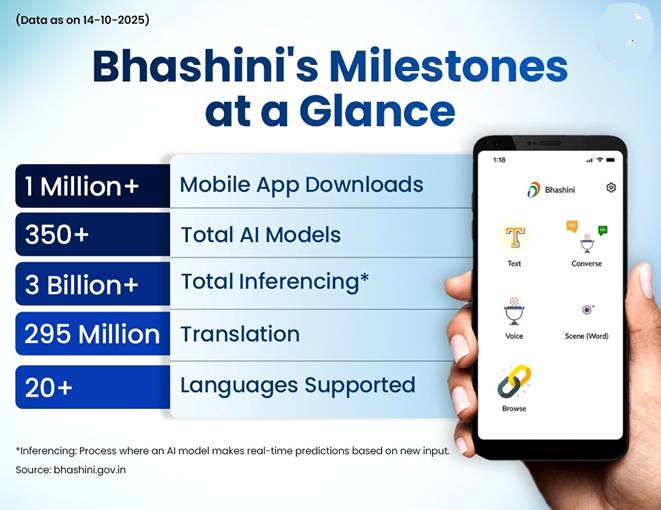
1. Sansad Bhashini: AI-Powered Parliamentary Translation
Part of the Bhashini platform under the National Language Translation Mission (NLTM).
Enables real-time AI translation of parliamentary debates and discussions.
Promotes citizen engagement by making parliamentary proceedings accessible in multiple Indian languages.
Strengthens transparency and linguistic inclusion in governance and democratic discourse.
2. Tribal Research, Information, Education, Communication and Events (TRI-ECE) Scheme
Implemented by the Ministry of Tribal Affairs.
Supports innovative research and documentation to preserve tribal languages and cultures.
Develops AI-based translation tools that convert English/Hindi text and speech into tribal languages, and vice versa.
Integrates Machine Learning, Speech Recognition, and NLP for real-time translation and digital preservation.
Encourages community participation through Tribal Research Institutes and language experts to ensure accuracy and cultural sensitivity.
Plays a critical role in digital empowerment of tribal communities and revitalization of endangered languages.
3. Digital Archives and Academic Collaboration
Institutions like the Central Institute of Indian Languages (CIIL) and the Indira Gandhi National Centre for the Arts (IGNCA) collaborate with Bhashini.
Focus on digitizing ancient manuscripts, folk literature, and oral traditions.
These digital archives create rich datasets for AI and NLP systems, linking cultural heritage with modern technology.
Strengthens India’s capacity for cultural preservation, AI-driven translation, and academic research.
4. Empowering Education Through AI-Driven Multilingual Platforms
Artificial Intelligence is transforming education by making learning more inclusive, accessible, and linguistically diverse.
Aligns with the National Education Policy (NEP) 2020, which promotes education in the mother tongue or regional language up to Grade 5, and preferably till Grade 8 and beyond.
Ensures that every learner can access knowledge in their native language, improving comprehension and retention.
a. e-KUMBH Portal
Developed by the All India Council for Technical Education (AICTE).
Provides free access to technical books and study materials in multiple Indian languages.
Supports NEP 2020’s goal of promoting higher education in regional languages.
b. Anuvadini App
An indigenous AI-based multilingual translation tool developed by AICTE.
Translates engineering, medical, law, undergraduate, postgraduate, and skill-development books into Indian languages. Translated content is hosted on the e-KUMBH portal, expanding access to technical education in native tongues.
c. National Translation Mission (NTM)
Facilitates translation of knowledge texts into Indian languages.
Promotes linguistic equity and knowledge dissemination across regions.
d. National Mission on Manuscripts (NMM)
Works on preserving and digitizing ancient Indian manuscripts.
Bridges traditional knowledge with modern digital preservation techniques.
e. SWAYAM Platform
Acts as a digital backbone for multilingual online education.
As of mid-2025, over 5 crore learners enrolled.
Government aims to make all school and higher education materials digitally available in Indian languages within three years.
5. Impact on Education and Linguistic Inclusion
AI-based translation and learning platforms help schools, universities, and ed-tech firms deliver localized educational content.
Enhances teacher-aid tools, e-learning modules, and comprehension among students.
Fosters linguistic equity, ensuring no learner is left behind due to language barriers.
Reinforces India’s linguistic diversity while promoting a digitally inclusive knowledge ecosystem.
6. Technology Behind the Transformation
India’s multilingual digital revolution is powered by advanced AI and computational linguistics tools designed for India’s linguistic complexity.
Key Technologies:
Automatic Speech Recognition (ASR): Converts spoken Indian languages into accurate text for transcription and voice-based applications.
Text-to-Speech (TTS): Generates natural, intelligible speech outputs in native languages.
Neural Machine Translation (NMT): Provides context-aware, real-time translation between Indian languages.
Natural Language Understanding (NLU): Enables AI systems to understand intent, meaning, and sentiment in local languages.
Transformer-based Architectures (IndicBERT, mBART): Pre-trained AI models for accurate translation and understanding.
Corpus Development and Data Curation: Involves creating large, representative datasets from manuscripts, folklore, and educational texts to train AI models.
Conclusion
India’s journey toward linguistic inclusion in the digital era is redefining its social and governance fabric. By blending AI innovation with cultural preservation, the country is ensuring that its linguistic plurality becomes a driver of empowerment, not exclusion. Through initiatives like Bhashini, Adi-Vaani, SPPEL, TRI-ECE, and AICTE’s e-KUMBH, India is transforming its languages into engines of knowledge, connectivity, and equitable digital growth.
Prelims question:
Q. Which of the following platforms is India’s first AI-driven initiative for the real-time translation and preservation of tribal languages?
(a) Bhashini
(b) Adi-Vaani
(c) BharatGen
(d) Sanchika
Answer: B
Mains Question:
Q. Discuss how Artificial Intelligence and digital language platforms are promoting linguistic inclusion and participatory governance in India. Evaluate their role in preserving India’s linguistic heritage while fostering digital empowerment.
(250 words)

- A Vision for an Inclusive Bangladesh: Democracy, Minority Rights and India’s Neighbourhood - August 19, 2026
- Employment Guarantee in Limbo: What the VB-G RAM G Transition Means for Rural India - August 19, 2026
- India Is Losing West Asia, but It Is Not Too Late - August 17, 2026

No Comments