


01 Nov From Learning to Earning: Empowering Farmers through Skill Development
This article covers “Daily Current Affairs” and From Learning to Earning: Empowering Farmers through Skill Development
SYLLABUS MAPPING
GS-3 – Indian Economy, Agriculture- From Learning to Earning: Empowering Farmers through Skill Development
FOR PRELIMS
What role does technology play in farmer skill development?
FOR MAINS
What are the main schemes that train farmers and rural youth in India?
Why in the News?
The Government of India has recently emphasized “Farmer Empowerment through Skill Development” as a key pillar of its Viksit Bharat@2047 vision, aligning with the goals of Doubling Farmers’ Income and Atmanirbhar Krishi (Self-Reliant Agriculture). The Ministry of Agriculture and Farmers Welfare, along with the Ministry of Skill Development and Entrepreneurship, has intensified efforts to strengthen farm-based skill training, modernize Krishi Vigyan Kendras (KVKs), and expand programs like Skill Training of Rural Youth (STRY) and Sub-Mission on Agricultural Mechanization (SMAM).
This renewed focus aims to bridge the knowledge gap among farmers, promote technology adoption, and enhance rural livelihoods through capacity building, making farmers not just producers but innovators and entrepreneurs in the agricultural value chain.
1. Skill Training of Rural Youth (STRY): Building Human Capital in Villages
The Skill Training of Rural Youth (STRY) programme has emerged as a cornerstone of rural skilling efforts. Designed to provide short-term, practical training of around seven days, STRY equips rural youth and farmers with hands-on skills in agriculture and allied sectors such as horticulture, dairy, fisheries, and animal husbandry. It specifically targets youth aged 18 years and above, including women farmers, aiming to promote both wage and self-employment.
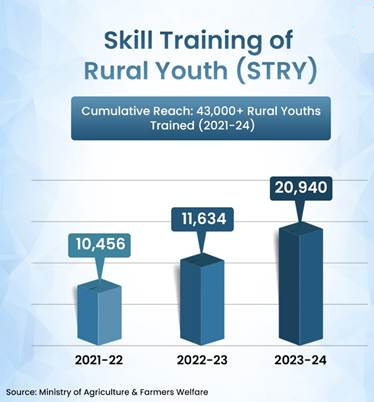
Integrated under the Agricultural Technology Management Agency (ATMA) cafeteria, STRY ensures synergy with state-led extension systems and local agro-climatic priorities. Between 2021 and 2024, over 43,000 youth were trained, with an additional 8,761 trained up to December 2024. The increasing outreach reflects growing rural participation and rising interest in agriculture as a viable career. By fostering entrepreneurship and local skill ecosystems, STRY is creating a generation of self-reliant farmers who drive innovation and employment in rural India.
2. Sub-Mission on Agricultural Mechanization (SMAM): Expanding Mechanization Access
To complement skill development, the Government has prioritized agricultural mechanization through the Sub-Mission on Agricultural Mechanization (SMAM), a component of the Rashtriya Krishi Vikas Yojana (RKVY). SMAM focuses on expanding mechanization to small and marginal farmers and regions with low farm power availability. It promotes Custom Hiring Services, enabling farmers to rent machinery without incurring high ownership costs.
Between 2021 and 2025, SMAM trained 57,139 farmers through capacity-building workshops, demonstrations, and Information-Education-Communication (IEC) activities. It also ensures quality assurance via performance testing and certification of equipment. By enhancing awareness, efficiency, and mechanization literacy, SMAM is bridging the technological gap between large and small farms, thus improving productivity and reducing drudgery in rural livelihoods.
3. Strengthening Knowledge on Soil, Resources, and Value Chains
A crucial dimension of skilling lies in resource management and value-chain awareness. The Soil Health Card Scheme, launched to promote scientific nutrient management, has transformed soil intelligence at the farm level. As of July 2025, over 25.17 crore Soil Health Cards have been distributed, alongside 93,000 farmer trainings and 6.8 lakh demonstrations. These have encouraged balanced fertilizer use, improved soil fertility, and sustainable crop planning.
Simultaneously, the Formation and Promotion of Farmer Producer Organizations (FPOs) has institutionalized collective learning. With 10,000 FPOs registered, farmers are now receiving structured training in agri-business management, market linkages, and the use of digital platforms like e-NAM and GeM. These initiatives are fostering a culture of collective entrepreneurship, market access, and value-chain integration among smallholders.
4. Embedding Skilling within National Frameworks: PMKVY 4.0
The Pradhan Mantri Kaushal Vikas Yojana (PMKVY 4.0) (2022–26) marks a significant step toward mainstreaming agricultural skills within the national skilling architecture. Recognizing agriculture as a priority sector, PMKVY integrates it within India’s flagship Skill India Mission. Training is imparted through accredited centres, skill hubs, and PM Kaushal Kendras under multiple components such as short-term courses (300–600 hours), Recognition of Prior Learning (RPL), and special projects.
Since its inception in 2015 till June 2025, more than 1.64 crore individuals have been trained and 1.29 crore certified across sectors, including agriculture and allied activities. This convergence ensures that agricultural skills are recognized, standardized, and aligned with national employability frameworks — a critical shift toward professionalizing rural occupations.
5. Sector-Specific Missions for Skill and Capacity Building
(a) Mission for Integrated Development of Horticulture (MIDH): The MIDH promotes holistic growth of horticulture through a comprehensive approach covering fruits, vegetables, spices, flowers, and bamboo. Under its Human Resource Development (HRD) programme, 9.73 lakh farmers have been trained from 2014–15 to 2023–24. These trainings enhance knowledge on post-harvest management, protected cultivation, and high-value horticulture practices, enabling diversification and better returns.
(b) Rashtriya Gokul Mission (RGM): Implemented under the Rashtriya Pashudhan Vikas Yojana (2021–26), RGM focuses on the development and conservation of indigenous bovine breeds. The initiative has trained and equipped 38,736 Multi-purpose Artificial Insemination Technicians in Rural India (MAITRIs) to deliver doorstep insemination and breeding services. This not only improves livestock productivity but also creates rural employment and technical expertise at the grassroots.
(c) Pradhan Mantri Kisan SAMPADA Yojana (PMKSY): The PMKSY aims to strengthen India’s food processing infrastructure and supply chains. Under its “Human Resources and Institutions” component, it emphasizes R&D, promotional activities, and skill development across the food value chain — from floor workers to quality control supervisors. As of June 2025, 1,601 projects have been approved and 1,133 completed, benefitting over 34 lakh farmers. This initiative links farm-level production with industry requirements, boosting both incomes and employment in the agri-food ecosystem.
6. Multi-Dimensional Impact
The convergence of these programmes has produced multi-layered benefits:
1. Enhanced employability and entrepreneurship among rural youth.
2. Increased adoption of mechanization and modern practices across smallholdings.
3. Improved soil health and sustainable resource use.
4. Strengthened value-chain linkages through FPOs and agri-business skilling.
5. Mainstreaming of agricultural skills within national and global frameworks.
6. Together, these initiatives have elevated agriculture from a subsistence activity to a knowledge-driven enterprise, positioning rural India for inclusive growth.
Conclusion
India’s agricultural transformation is deeply rooted in skill development, technological adoption, and institutional capacity building. From STRY’s rural youth training to SMAM’s mechanization outreach, from Soil Health Cards to PMKVY’s national skilling integration, every initiative contributes to empowering farmers as informed decision-makers and agri-entrepreneurs.
Prelims question:
Q. Consider the following schemes:
1. Skill Training of Rural Youth (STRY)
2. Sub-Mission on Agricultural Mechanization (SMAM)
3. Pradhan Mantri Kaushal Vikas Yojana (PMKVY)
4. Rashtriya Gokul Mission (RGM)
Which of the above schemes primarily aim at developing the skill base and capacity of farmers in India?
(a) 1, 2 and 3 only
(b) 1, 3 and 4 only
(c) 2, 3 and 4 only
(d) 1, 2, 3 and 4
Answer: D
Mains Question:
Q. “Skilling farmers and rural youth is key to achieving self-reliant and technology-driven agriculture in India.” Discuss the role of government initiatives in promoting farmer empowerment through skill development and capacity building.
(250 words)

- Before New Taxes, Make Every Rupee Count: Fiscal Discipline and Outcome-Based Governance in Tamil Nadu - August 20, 2026
- A Palestinian State as the Foundation for Regional Peace - August 20, 2026
- A Vision for an Inclusive Bangladesh: Democracy, Minority Rights and India’s Neighbourhood - August 19, 2026

No Comments