


06 Nov 22nd India–US MCG Meeting: Advancing Defence Integration and Regional Security in the Indo-Pacific
This article covers “Daily Current Affairs” and From 22nd India–US MCG Meeting: Advancing Defence Integration and Regional Security in the Indo-Pacific
SYLLABUS MAPPING
GS– 2– International Relations- 22nd India–US MCG Meeting: Advancing Defence Integration and Regional Security in the Indo-Pacific
FOR PRELIMS
What is the India–US Military Cooperation Group (MCG)?
FOR MAINS
What were the key outcomes of the 22nd MCG meeting held in Hawaii in 2025?
Why in the News?
The 22nd meeting of the India–US Military Cooperation Group (MCG), held in Hawaii on November 3–4, 2025, marked another milestone in the deepening strategic and defence partnership between the two nations. The high-level meeting underscored the commitment of both countries to enhance interoperability, joint preparedness, and defence industrial cooperation, while reaffirming their shared vision for a free, open, and secure Indo-Pacific region.
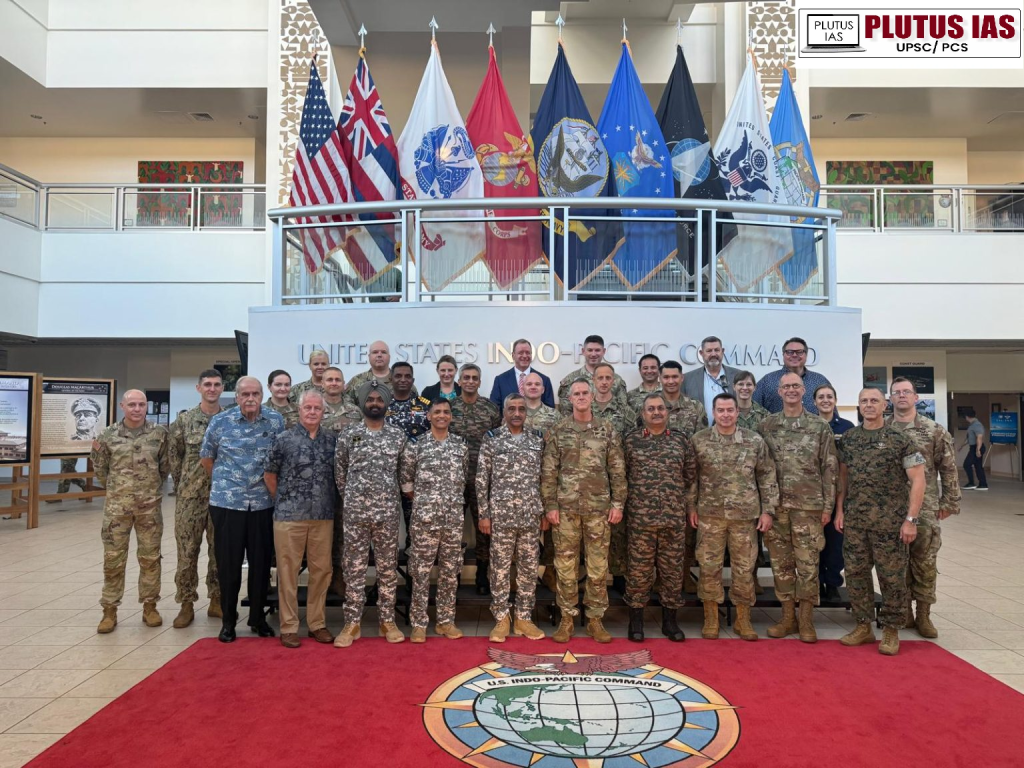
Overview of the 22nd MCG Meeting
The meeting was co-chaired by Air Marshal Ashutosh Dixit, Chief of Integrated Defence Staff (CISC), representing India, and Lieutenant General Joshua M. Rudd, Deputy Commander, US Indo-Pacific Command, representing the United States. The discussions focused on enhancing operational cooperation, defence industrial collaboration, and strategic coordination to address emerging regional and global challenges.
According to the Headquarters of Integrated Defence Staff (HQ IDS), the meeting emphasized strengthening joint military planning, logistics interoperability, and technology sharing to build a more resilient security architecture. Both nations reaffirmed their shared commitment to maintaining a free, open, and rules-based Indo-Pacific, underpinned by respect for international law and sovereignty.
Background and Context
The India–US Military Cooperation Group (MCG) serves as an institutional mechanism under the India–US Defence Framework Agreement, which guides cooperation across all three services—Army, Navy, and Air Force. The 21st MCG meeting, held in New Delhi in November 2024, had laid the foundation for deeper collaboration in capacity building, training exchanges, and defence industry cooperation.
Over the past decade, India–US defence ties have evolved from a buyer-seller relationship to a comprehensive strategic partnership, involving technology co-development, joint exercises, and supply chain integration. Foundational agreements like LEMOA (Logistics Exchange Memorandum of Agreement), COMCASA (Communications Compatibility and Security Agreement), and BECA (Basic Exchange and Cooperation Agreement) have further institutionalized military cooperation and secure information sharing.
Key Areas of Discussion
1. Operational and Strategic Cooperation: Both sides discussed increasing the scale and frequency of joint military exercises, such as Yudh Abhyas, Malabar, and Cope India, to enhance interoperability and tactical coordination.
2. Defence Industrial Collaboration: The meeting focused on advancing joint research, co-development, and co-production of critical defence technologies under the Initiative on Critical and Emerging Technologies (iCET) and the Defence Technology and Trade Initiative (DTTI).
3. Capacity Building and Training: Expansion of officer exchange programs, joint war-gaming, and simulation-based training was discussed to improve human resource capabilities and operational synergy.
4. Maritime Domain Awareness: Enhanced information sharing and joint monitoring mechanisms were reviewed to ensure freedom of navigation and maritime security in the Indo-Pacific.
5. Logistics and Infrastructure Integration: Both sides emphasized leveraging logistics agreements to support cross-service access, repair, and replenishment at each other’s facilities, thereby improving rapid deployment and operational reach.
Recent Defence Engagements
The growing synergy between the two militaries was demonstrated in the India–US joint military exercise held in September 2025, one of the largest bilateral army drills. The exercise involved a 450-member Indian Army contingent led by a Madras Regiment battalion, training alongside US forces in combined manoeuvres, counterterrorism operations, and peacekeeping missions. This showcased enhanced tactical interoperability and mutual trust between the two armed forces.
Strategic Significance of the MCG
1. Institutionalized Defence Dialogue: Strengthens continuous engagement and policy coordination between the Indian and US militaries.
2. Enhanced Interoperability: Promotes operational compatibility through joint exercises and logistics support mechanisms.
3. Technology and Industrial Cooperation: Encourages co-development of advanced defence technologies, supporting India’s Atmanirbhar Bharat (self-reliant defence ecosystem).
4. Maritime Security and Indo-Pacific Stability: Reinforces efforts to maintain a rules-based order and counterbalance aggressive posturing in the Indo-Pacific.
5. Comprehensive Strategic Partnership: Advances shared democratic values, counterterrorism cooperation, and regional security priorities.
6. Humanitarian and Disaster Response: Builds coordinated frameworks for HADR (Humanitarian Assistance and Disaster Relief) operations and crisis response.
Way Forward
1. Deepen Defence Industrial Integration: Expand technology co-production and innovation in advanced domains such as cyber, AI, and unmanned aerial systems.
2. Expand Maritime Cooperation: Strengthen joint naval operations, submarine rescue capabilities, and real-time information exchange to secure sea lanes of communication.
3. Enhance Tri-Service Coordination: Conduct more integrated Army–Navy–Air Force exercises to achieve greater jointness and operational efficiency.
4. Leverage Start-up Ecosystems: Encourage start-up and private-sector collaboration for defence innovation under frameworks like iCET.
5. Regional and Multilateral Partnerships: Integrate India–US defence cooperation with broader QUAD, ASEAN, and Indo-Pacific partnerships to address regional contingencies.
6. Strengthen Defence Supply Chains: Develop resilient and trusted supply chains to reduce dependency and ensure strategic autonomy.
7. Sustain High-Level Engagements: Institutionalize frequent dialogues between defence leaders to adapt to emerging geopolitical and technological challenges.
Conclusion
The 22nd India–US Military Cooperation Group (MCG) meeting symbolizes the steady transformation of India–US defence relations from transactional cooperation to a strategic and technological partnership. Through enhanced military interoperability, joint training, and defence industrial collaboration, both nations are shaping a secure, resilient, and rules-based Indo-Pacific. As India and the US continue to align their defence and strategic priorities, the MCG remains a vital pillar of their shared commitment to global peace, stability, and prosperity.
Prelims question:
Q. With reference to the India–US Military Cooperation Group (MCG), consider the following statements:
1. It serves as an institutional mechanism under the India–US Defence Framework Agreement.
2. It focuses exclusively on maritime security cooperation.
3. The 22nd MCG meeting was held in Hawaii in November 2025.
Which of the statements given above are correct?
(a) 1 and 2 only
(b) 1 and 3 only
(c) 2 and 3 only
(d) 1, 2 and 3
Answer: B
Mains Question:
Q. Discuss the significance of the India–US Military Cooperation Group (MCG) in strengthening bilateral defence partnership and maintaining stability in the Indo-Pacific region
(250 words)

- Europe’s AI Rules May Become India’s Opportunity - August 14, 2026
- Transparency as the Foundation of Trust in Medicine - August 14, 2026
- A Timely Reset for the Food Security Act: From Foodgrain Security to Nutrition Security - August 13, 2026

No Comments