


08 Nov Bridging the Justice Gap: The Role of Legal Services Authorities in Empowering Citizens
This article covers “Daily Current Affairs” and From Bridging the Justice Gap: The Role of Legal Services Authorities in Empowering Citizens
SYLLABUS MAPPING
GS– 2 – Polity and Governance- Bridging the Justice Gap: The Role of Legal Services Authorities in Empowering Citizens
FOR PRELIMS
What is National Legal Services Day?
FOR MAINS
What role do Lok Adalats play in providing speedy and affordable justice in India?
Why in the News?
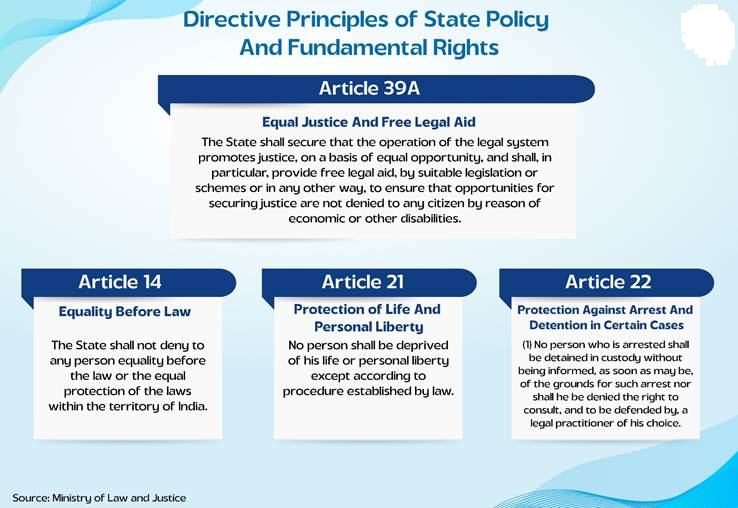
India, the world’s largest democracy, guarantees equal rights and protection under the law to all citizens. However, many still struggle to access legal services due to poverty, illiteracy, and lack of awareness.
To address this, the Legal Services Authorities Act, 1987 established bodies to provide free and competent legal aid to the disadvantaged. Since the Act came into force on November 9, 1995, this day is observed annually as National Legal Services Day.
It is in the news as the day is being celebrated across the country with legal awareness camps and outreach programmes organised by NALSA and State Legal Services Authorities. New digital initiatives and helpline services have also been launched to make justice more accessible and affordable.
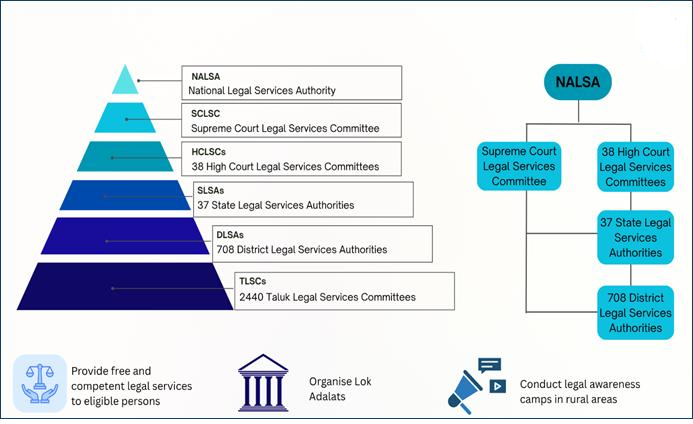
Legal Services Authorities
The Legal Services Authority Act, 1987, established legal aid organisations nationwide to ensure that no citizen suffering from economic or other barriers is denied an equal opportunity for getting justice.
The act established a three-tier system to provide free and competent legal services:
National Legal Services Authority (headed by the Chief Justice of India)
State Legal Services Authorities (headed by the Chief Justice of High Court)
District Legal Services Authorities (headed by the District Judge)
Legal aid is funded by the central and state governments and donations through a three-tier funding structure:
Central funding or donations to the Central Authority through the National Legal Aid Fund
Central or State Government funding or other contributions to the State Authority through the State Legal Aid Fund
State Government funding or other donations to the District Authority through the District Legal Aid Fund
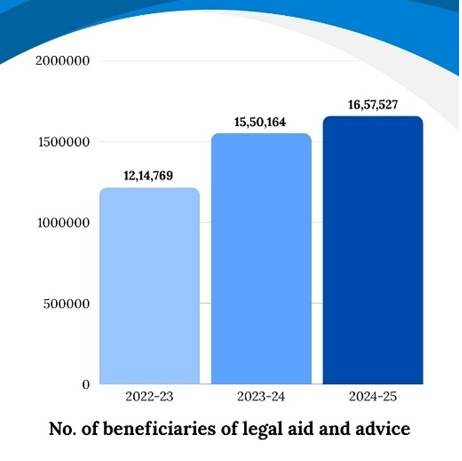
The number of people who benefited from free legal aid in the past three years has risen. From 2022-23 to 2024-25, over 44.22 lakh people benefited from the legal aid and advice given by the Legal Services Authorities.
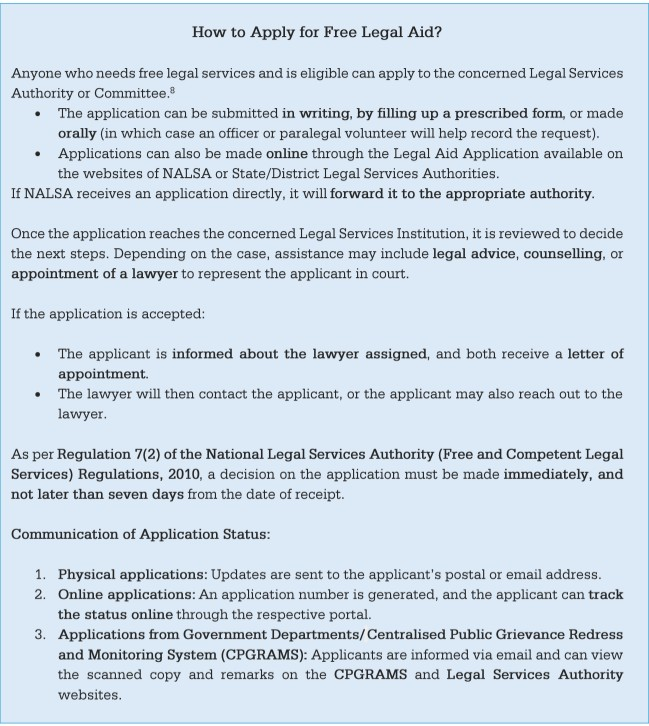
Anyone who needs free legal services and is eligible can apply to the concerned Legal Services Authority or Committee.
The application can be submitted in writing, by filling up a prescribed form, or made orally (in which case an officer or paralegal volunteer will help record the request).
Applications can also be made online through the Legal Aid Application available on the websites of NALSA or State/District Legal Services Authorities.
If NALSA receives an application directly, it will forward it to the appropriate authority.
Once the application reaches the concerned Legal Services Institution, it is reviewed to decide the next steps. Depending on the case, assistance may include legal advice, counselling, or appointment of a lawyer to represent the applicant in court.
If the application is accepted:
The applicant is informed about the lawyer assigned, and both receive a letter of appointment.
The lawyer will then contact the applicant, or the applicant may also reach out to the lawyer.
As per Regulation 7(2) of the National Legal Services Authority (Free and Competent Legal Services) Regulations, 2010, a decision on the application must be made immediately, and not later than seven days from the date of receipt.
Communication of Application Status:
Physical applications: Updates are sent to the applicant’s postal or email address.
Online applications: An application number is generated, and the applicant can track the status online through the respective portal.
Applications from Government Departments/ Centralised Public Grievance Redress and Monitoring System (CPGRAMS): Applicants are informed via email and can view the scanned copy and remarks on the CPGRAMS and Legal Services Authority websites.
Lok Adalats
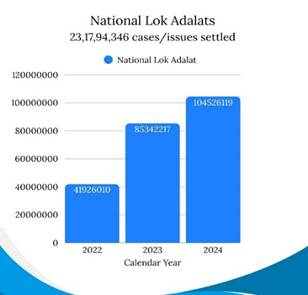
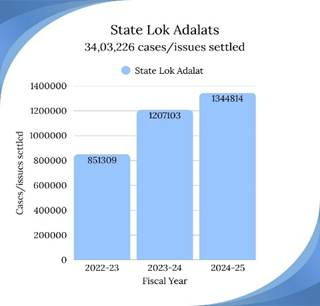
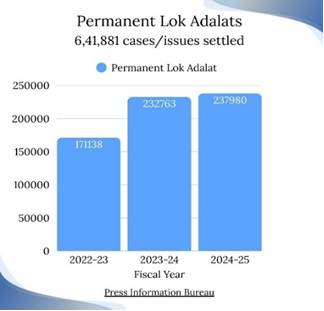
The Act also established Lok Adalats and Permanent Lok Adalats, which are alternate dispute redressal forums organised by the legal authorities above. The forums settle pending disputes or cases or those at the pre-litigation stage amicably.From 2022-23 to 2024-25 over 23.58 crore cases were resolved through the state, permanent and national Lok Adalats.
Legal Aid Defense Counsel System (LADCS) Scheme
The LADCS scheme by NALSA provides free legal defense in criminal cases for eligible beneficiaries under the Legal Services Authorities Act, 1987.
As on September 30, 2025, 668 districts have a functional LADCS office.
Over 7.86 lakh cases out of the 11.46 lakh assigned cases were disposed by the LADCs from 2023-24 to 2025-26 (till September, 2025).
The approved financial outlay of LADCs scheme is Rs. 998.43 crore for the fiscal years 2023-24 to 2025-26.
Designing Innovative Solutions for Holistic Access to Justice
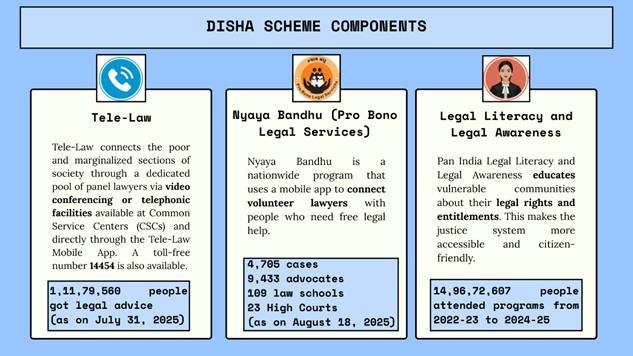
Modern technology is helping people access the legal system easily and affordably, too. About 2.10 crore people (as on February 28, 2025) were given pre-litigation advice, pro bono services, and legal representation and awareness through the DISHA scheme, which has been implemented from 2021-2026. It is funded by the Government of India and has an outlay of Rs. 250 crore.
Legal Awareness Programmes
Many people are unaware of their rights and legal procedures. NALSA conducts various legal awareness programmes on laws related to children, labourers, disaster victims and other marginalised sections of society. The authorities also prepare booklets and pamphlets in simple language, which are distributed among people. From 2022-23 to 2024-25, over 13.83 lakh legal awareness programmes were organised by the Legal Services Authorities and about 14.97 crore people attended them. The Department of Justice runs the Legal Literacy and Legal Awareness programme (LLLAP) under DISHA. Various regional implementing agencies state such as the Sikkim State Women commission and the Arunachal Pradesh SLSA run the programme. Through the programme, the department developed communication materials in 22 scheduled languages and dialects of the northeastern states. Doordarshan also collaborated with the ministry and aired 56 legal awareness TV programmes in six languages, reaching over 70.70 lakh people. 21 webinars on socio-legal issues were aired on government social media channels from 2021 to 2025. Overall, the LLLAP reached over 1 crore people.
Fast Track and Other Courts
Fast-track courts (FTCs) were established for the speedy trial of heinous crimes and civil cases related to women, children, senior citizens, disabled persons, and property cases pending for more than five years—while the 14th Finance Commission recommended 1,800 FTCs during 2015-20, 865 FTCs are currently functional as of June 30, 2025.
A centrally sponsored scheme launched in October 2019 established Fast Track Special Courts (FTSCs) dedicated to victims of serious sexual offenses, including those under the Protection of Children from Sexual Offences (POCSO) Act; as of June 30, 2025, 725 FTSCs including 392 exclusive POCSO courts are functional in 29 states and union territories and have disposed of 3,34,213 cases since inception.
The scheme, which began in 2019-20 with an initial allocation of Rs. 767.25 crore (Rs. 474 crore from the Nirbhaya Fund), has been extended twice, with the latest extension up to March 31, 2026, at an outlay of Rs. 1,952.23 crore (Rs. 1,207.24 crore from Nirbhaya Fund).
Training
The National Judicial Academy regularly conducts academic programmes for judges and legal-aid functionaries, providing them with the latest legal knowledge, practical skills, and deeper understanding of challenges faced by vulnerable groups to advance equal access to justice.
NALSA runs the Para-legal Volunteers Scheme to provide legal training to volunteers from diverse backgrounds, who are trained to act as intermediaries between people and legal services institutions. The legal authorities train these volunteers in the constitutional vision of justice, basics of criminal law, labour laws, law for juveniles, and laws for protection of women and senior citizens.
To strengthen capacity-building for legal aid personnel serving marginalised communities, NALSA has developed 4 Training Modules specifically for Legal Services Lawyers and Para-Legal Volunteers (PLVs), and Legal Services Institutions across the country conduct training programmes for panel lawyers and PLVs from time to time—from 2023-24 to May 2024, state legal authorities organised 2,315 such training programmes across India, ensuring that legal assistance is effectively provided to those who cannot afford legal representation.
Conclusion
India’s legal system strives to make justice accessible to all. Removing barriers to justice is inherent in the Indian constitution.
The nationwide network of free legal aid, supported by Lok Adalats, fast-track courts, legal awareness programmes allow for quick and easy dispute resolution. Legal aid and outreach programmes on legal awareness have also reached crores of Indians, ensuring that even the most vulnerable sections of society can access their fundamental right to justice without constraints.
Prelims question:
Q. Which of the following statements about the DISHA scheme is correct?
1. It is funded by the Government of India.
2. It aims to provide legal awareness, pre-litigation advice, and pro bono services.
3. It has an outlay of ₹250 crore.
Select the correct answer:
A. 1 and 2 only
B. 2 and 3 only
C. 1 and 3 only
D. 1, 2 and 3
Answer: D
Mains Question:
Q. Discuss the significance of the Legal Services Authorities in ensuring access to justice for all. How have schemes like LADCS, DISHA, and fast-track courts strengthened this goal?
(250 words)

- Europe’s AI Rules May Become India’s Opportunity - August 14, 2026
- Transparency as the Foundation of Trust in Medicine - August 14, 2026
- A Timely Reset for the Food Security Act: From Foodgrain Security to Nutrition Security - August 13, 2026

No Comments