


10 Nov ISRO Launches India’s Heaviest Communication Satellite: A Shining Milestone of Aatmanirbhar Bharat
This article covers “Daily Current Affairs” and From ISRO Launches India’s Heaviest Communication Satellite: A Shining Milestone of Aatmanirbhar Bharat
SYLLABUS MAPPING
GS-3–Science & Technology- ISRO Launches India’s Heaviest Communication Satellite: A Shining Milestone of Aatmanirbhar Bharat
FOR PRELIMS
What are the benefits of launching a new communication satellite for India?
FOR MAINS
What is the significance of using LVM3 for heavy satellite launches?
Why in the News?
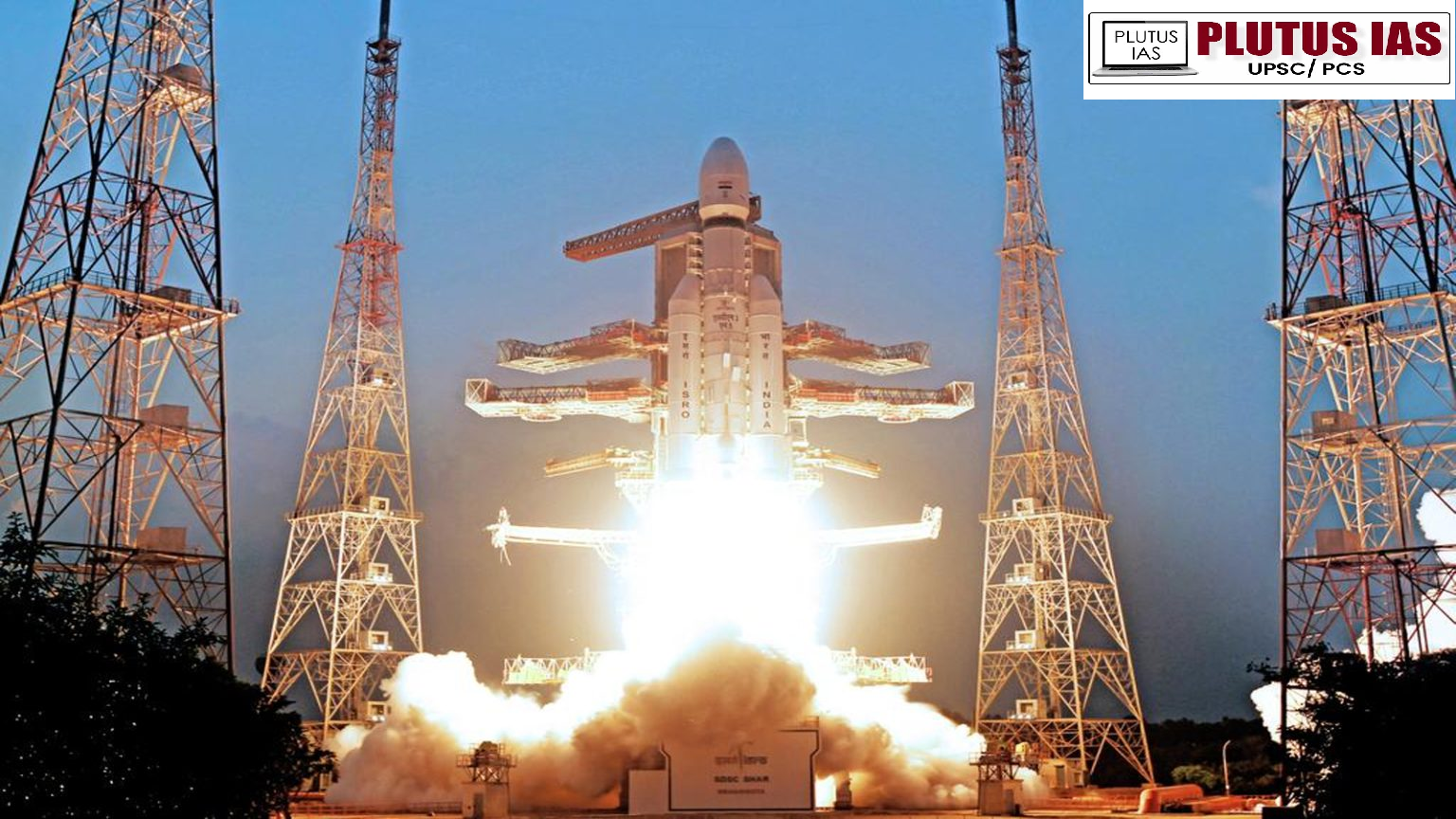
On November 9, 2025, the Indian Space Research Organisation (ISRO) successfully launched the Indian Navy’s advanced communication satellite GSAT-7R (CMS-03), marking a major milestone in India’s defence preparedness and space capabilities. The satellite was launched onboard the LVM3-M5 (Baahubali) rocket from the Satish Dhawan Space Centre, Sriharikota, at 5:26 PM, and was placed precisely into its intended orbit.
This mission reinforces India’s growing technological prowess and strengthens the Navy’s network-centric warfare, real-time communication, and maritime domain awareness across the Indian Ocean Region.
What is GSAT-7R (CMS-03)?
GSAT-7R, also known as CMS-03, is India’s heaviest indigenously developed multi-band military communication satellite, weighing 4,410 kg. Designed to provide secure communication for the Indian Navy, it offers:
1. Multi-band communication capabilities
2. Coverage across India and adjoining oceanic region
3. Minimum 15-year operational life
4. Advanced payloads and state-of-the-art technologies for maritime operations
CMS-03 is part of the GSAT-7 series, which includes GSAT-7 (Rukmini) and GSAT-7A, enhancing India’s tri-services communication framework.
Launch Vehicle: LVM3-M5 (Baahubali)
The mission used ISRO’s heaviest rocket, LVM3-M5, capable of lifting large payloads to Geosynchronous Transfer Orbit (GTO). In this mission:
1. The rocket carried its heaviest-ever payload: 4,410 kg
2. It surpassed its standard 4,000 kg GTO capacity
3. The success marked 100% reliability, with all eight LVM3 missions successful
4. This vehicle is also earmarked for ISRO’s upcoming Gaganyatri-2 mission.
Mission Significance of GSAT-7R (CMS-03)
| Aspect | Details |
|---|---|
| 1. Strengthening Naval Communication | • Provides uninterrupted, encrypted links for warships, submarines, maritime aircraft, and command centres. • Enhances network-centric warfare and real-time decision-making. |
| 2. Enhancing Maritime Domain Awareness (MDA) | • Expands monitoring across the Indian Ocean Region (IOR). • Supports strategic surveillance, anti-piracy missions, disaster response, and protection of maritime trade routes. |
| 3. Boost to Indigenous Defence Technology | • Strengthens India’s capability in heavy communication satellite development. • Advances indigenous cryogenic engine technology. • Improves precision in upper-stage operations, supporting Aatmanirbhar Bharat. |
| 4. Expanding India’s Space Capabilities | • Demonstrates reliable heavy-lift launch performance. • Incorporates advanced communication payloads. • Enables multi-orbit mission flexibility, elevating India’s global space standing. |
| 5. Support for Joint Military Operations | • Integrates with tri-services defence networks. • Enhances inter-service communication, secure data exchange, and real-time battlefield awareness. |
Significance
1. Strengthened Strategic Security: GSAT-7R enhances India’s naval communication architecture across vast oceanic territories, improving strategic reach in the Indian Ocean Region (IOR).
2. Superior Maritime Domain Awareness: The satellite boosts surveillance, reconnaissance, and early-warning capabilities, essential for protecting trade routes and deterring hostile activities.
3. Indigenous Technological Advancement: Demonstrates India’s growing expertise in multi-band communication satellites and advanced cryogenic engine technology.
4. Enhanced Network-Centric Warfare: Provides secure, real-time, high-bandwidth communication to warships, submarines, and aircraft, enabling swift and coordinated operations.
5. Reinforced Launch Vehicle Reliability: Validates the LVM3’s record as a dependable heavy-lift launcher, paving the way for future missions including Gaganyatri-2.
6. Support for Defence Modernisation: Strengthens India’s self-reliant military communication ecosystem, aligning with Aatmanirbhar Bharat and long-term strategic goals.
7. Boost to India’s Space Power Projection: Positions India as a rising global space power capable of deploying complex, defence-oriented satellite missions.
Way Forward
1. Expand Tri-Services Communication: Deploy dedicated satellites for Army and Air Force integration to build a unified defence communication grid.
2. Advance Indigenous Cryogenic Engines: Improve multi-burn, re-ignition, and multi-orbit capabilities for greater operational flexibility.
3. Develop Space-Based ISR Capabilities: Create advanced satellites for intelligence, surveillance, and reconnaissance to enhance maritime vigilance.
4. Strengthen Maritime Cybersecurity: Upgrade encryption systems and secure communication protocols to prevent cyber threats and electronic warfare attacks.
5. Promote Public–Private Collaboration: Encourage Indian startups and private companies to co-develop defence satellites and payload technologies.
6. Build Redundancy & Resilience: Develop backup satellite systems and orbital assets to ensure uninterrupted military communication during conflicts.
7. Enhance International Maritime Partnerships: Use improved space-based communication to strengthen interoperability with friendly navies in joint exercises and operations.
Conclusion
The successful launch of GSAT-7R (CMS-03) marks a defining moment in India’s pursuit of space and defence self-reliance. By strengthening the Navy’s communication and surveillance capabilities, ISRO has further solidified India’s maritime security posture. The mission not only reflects technological excellence but also symbolizes India’s steady rise as a global space leader under the vision of Aatmanirbhar Bharat.
Prelims question:
Q. Consider the following statements regarding GSAT-7R (CMS-03):
1. It is India’s heaviest communication satellite launched to date.
2. The satellite was launched by ISRO’s LVM3-M5 vehicle.
3. CMS-03 is designed to provide communication services only over the Indian landmass.
Which of the statements given above is/are correct?
(a) 1 and 2 only
(b) 2 and 3 only
(c) 1 and 3 only
(d) 1, 2 and 3
Answer: A
Mains Question:
Q. Discuss the significance of GSAT-7R (CMS-03) in strengthening India’s naval communication and maritime security. How does the mission reflect India’s progress toward Aatmanirbhar Bharat in the space and defence sectors? (250 words)

- RBI’s Shrinking Real-Rate Cushion Amid Rising Inflation and Strong Demand - September 21, 2026
- India’s NGOs at a New Funding Crossroads - September 21, 2026
- Deep-Sea Discovery, Environmental Responsibility - September 19, 2026

No Comments