


13 Nov Building a Sustainable Energy Future: India’s Green Hydrogen Initiatives
This article covers “Daily Current Affairs” and From Building a Sustainable Energy Future: India’s Green Hydrogen Initiatives
SYLLABUS MAPPING
GS-3- Energy & Environment – Building a Sustainable Energy Future: India’s Green Hydrogen Initiatives
FOR PRELIMS
What is the main aim of the SIGHT Programme?
FOR MAINS
What is the purpose of the Green Hydrogen Certification Scheme of India (GHCI)?
Why in the News?
India’s energy transition is entering a decisive phase, as the country reduces its dependence on fossil fuels and increases domestic clean energy production. This is in line with its vision of becoming a developed nation by 2047 and achieving Net Zero by 2070. In this transition, Green hydrogen, has emerged as a clean, scalable fuel alternative that can decarbonize hard-to-abate sectors, reduce import dependence on fossil fuels, and support India’s goals for energy security and industrial growth.
The Indian government launched the National Green Hydrogen Mission (NGHM) in 2023, as an umbrella programme that aims to establish a Green Hydrogen ecosystem and catalyse a systemic response to the opportunities and challenges in this sector.
Understanding Green Hydrogen
1. Hydrogen is emerging as the fuel of the future because it produces only water when burnt, emitting no carbon dioxide. However, hydrogen’s environmental credentials depend on how it is produced:
2. Grey Hydrogen: Derived from natural gas or coal, emitting CO₂.
3. Blue Hydrogen: Produced from fossil fuels but with carbon capture and storage (CCS).
4. Green Hydrogen: Generated through electrolysis of water using renewable energy sources like solar and wind, making it entirely carbon-free.
As per Government standards, hydrogen qualifies as “green” if lifecycle emissions are below 2 kg CO₂ equivalent per kg of hydrogen. It can also be produced through biomass conversion, provided the same threshold is met.
Vision and Objectives of the Mission
The National Green Hydrogen Mission envisions making India the global leader in clean hydrogen production and technology development. Its major objectives include:
1. Reducing dependence on fossil fuel imports and improving energy security.
2. Enhancing industrial competitiveness through low-carbon manufacturing.
3. Decarbonising key sectors such as steel, fertilizers, and transport.
4. Creating a green technology ecosystem with R&D, skill development, and innovation.
5. Building export capability for hydrogen and its derivatives like green ammonia and methanol.
Mission Targets and Scale
By 2030, India aims to:
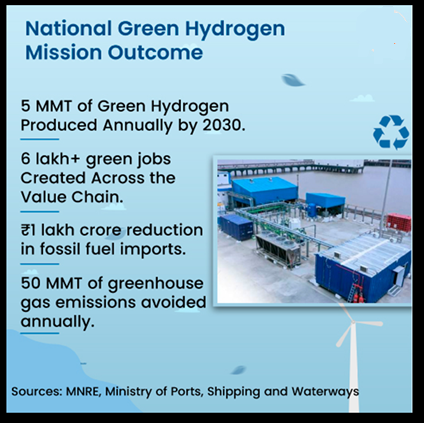
1. Produce 5 million tonnes of green hydrogen annually.
2. Install 125 GW of additional renewable energy capacity dedicated to hydrogen production.
3. Attract ₹8 lakh crore in investments and create over 6 lakh jobs.
4. Reduce fossil fuel imports by ₹1 lakh crore per year.
5. Avoid 50 million metric tonnes of CO₂ emissions annually.
As of May 2025, 19 companies have been allocated an annual green hydrogen production capacity of 8.62 lakh tonnes, and 15 firms have been awarded 3,000 MW of electrolyzer manufacturing capacity.
Mission Architecture and Funding
| Component | Allocation (₹ crore) | Focus Area |
|---|---|---|
| Strategic Interventions for Green Hydrogen Transition (SIGHT) | 17,490 | Electrolyzer manufacturing & hydrogen production incentives |
| Pilot Projects | 1,466 | Demonstration in industrial, transport & shipping sectors |
| Research & Development | 400 | Technology innovation and cost reduction |
| Other Components | 388 | Skill building, awareness, and coordination |
Four Key Pillars of Implementation
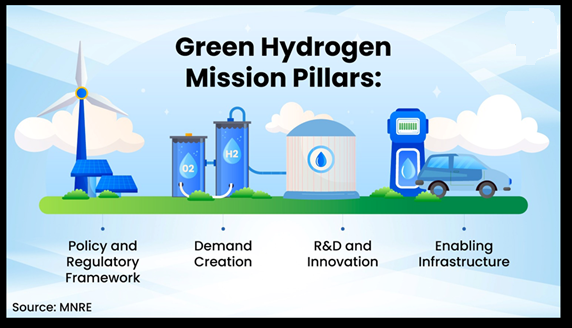
1. Policy and Regulatory Framework: Enabling laws, energy access mechanisms, and grid integration measures to make hydrogen production cost-competitive.
2. Demand Creation: Mandating gradual replacement of fossil-based hydrogen in industries with green hydrogen.
3. R&D and Innovation: Supporting technology development across the hydrogen value chain.
4. Infrastructure and Ecosystem Development: Creating hydrogen hubs, transport infrastructure, and export facilities.
Major Schemes and Initiatives under the National Green Hydrogen Mission (NGHM)
| Initiative / Scheme | Key Features | Implementing / Nodal Agency | Budget / Support |
|---|---|---|---|
| (i) SIGHT Programme (Strategic Interventions for Green Hydrogen Transition) |
• Flagship incentive mechanism promoting domestic manufacturing of electrolyzers. • Supports production and supply of green hydrogen for sectors like fertilizer, refinery, and mobility. |
Ministry of New and Renewable Energy (MNRE) | ₹17,490 crore |
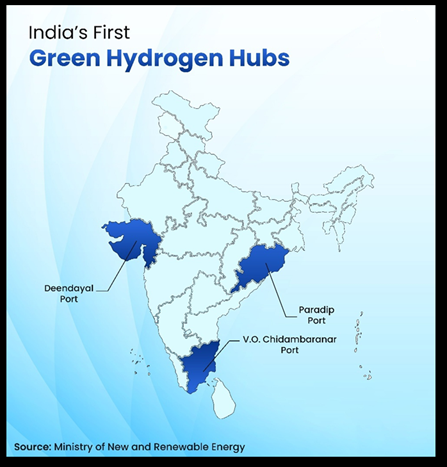
| (ii) Green Hydrogen Hubs | • Development of integrated hydrogen ecosystems at major ports. • Deendayal (Gujarat), V.O. Chidambaranar (Tamil Nadu), and Paradip (Odisha) designated as hubs for production, storage, consumption, and export. |
Ministry of Ports, Shipping and Waterways | — |
| (iii) Green Hydrogen Certification Scheme of India (GHCI) | • Ensures lifecycle emission-based certification for transparency and credibility. • Establishes framework for “Green Hydrogen” labelling and tracking. |
Bureau of Energy Efficiency (BEE) – Nodal authority for accrediting certifying agencies | Launched April 2025 |
| (iv) Strategic Hydrogen Innovation Partnership (SHIP) | • Public–private R&D consortium promoting collaboration between government, academia, and industry. • Supports 23 ongoing R&D projects and start-ups (up to ₹5 crore each). • Second phase (2025) under EU–India Trade and Technology Council with 30+ joint projects. |
MNRE with public-private R&D entities | ₹400 crore (R&D fund) + ₹100 crore (for start-ups) |
Sectoral Implementation Pathways
1. Industrial Applications
Fertilizers: Green ammonia auctions for 7.24 lakh tonnes per annum at ₹55.75/kg.
Petroleum Refineries: Replacing grey hydrogen in refining processes.
Steel: Five pilot projects underway to assess hydrogen-based direct reduction processes.
2. Mobility and Transport
Road Transport: ₹208 crore pilot with 37 hydrogen buses/trucks and 9 refueling stations across 10 routes.
Shipping:
India’s first port-based hydrogen project at V.O. Chidambaranar Port (Sept 2025) with a 10 Nm³/hr facility.
Green Methanol Bunkering (₹42 crore) project to enable a Kandla–Tuticorin Green Shipping Corridor.
High-Altitude Mobility (Leh): World’s highest-altitude hydrogen mobility project (3,650 m) — 5 hydrogen buses and fueling station, cutting 350 MT CO₂/year and generating 230 MT oxygen, equivalent to 13,000 trees planted.
Building Global Partnerships
1. World Hydrogen Summit 2024 (Rotterdam): India inaugurated its first India Pavilion, showcasing investment opportunities.
2. EU–India Collaboration: Over 30 joint proposals under the Trade and Technology Council.
3. India–UK Standards Partnership (Feb 2025): Harmonising global hydrogen safety and standardisation norms.
4. Germany (H2Global): MoU between SECI and H2Global Stiftung (Nov 2024) for market-based export mechanisms.
5. Singapore (Sembcorp Industries): MoUs (Oct 2025) with Indian ports to build integrated production and export hubs.
Challenges Ahead
1. High Production Cost: Green hydrogen currently costs ₹250–300 per kg, higher than grey hydrogen.
2. Infrastructure Gaps: Limited hydrogen pipelines, storage facilities, and refueling stations.
3. Technological Dependence: Electrolyzer manufacturing is still nascent in India.
4. Water Requirement: Electrolysis demands substantial freshwater, necessitating integration with desalination in coastal areas.
5. Safety and Awareness: Hydrogen’s flammability calls for robust safety protocols and trained personnel.
Way Forward
1. Scaling Domestic Manufacturing: Promote indigenous electrolyzer technologies through Production Linked Incentives.
2. Focus on Cost Reduction: Invest in R&D for low-cost catalysts, advanced storage materials, and efficient renewable integration.
3. Regional Hydrogen Clusters: Establish coastal and inland industrial hubs linked with logistics and ports.
4. Public–Private Collaboration: Strengthen SHIP to connect academia, startups, and industries.
5. International Market Integration: Build long-term export contracts with Europe and Asia.
6. Inclusive Skill and Safety Framework: Develop specialised training and certification programs for technicians and engineers.
Conclusion
The National Green Hydrogen Mission stands at the intersection of climate action, industrial policy, and national self-reliance. Leveraging one of the world’s most competitive renewable energy ecosystems, India is charting a path toward a low-carbon, technology-driven, and globally connected energy future.
By fostering innovation, creating jobs, reducing emissions, and positioning India as a green hydrogen powerhouse, the Mission exemplifies the nation’s commitment to a sustainable, secure, and self-sufficient future a true embodiment of “Viksit Bharat @2047” powered by clean energy.
Prelims question:
Q. With reference to the National Green Hydrogen Mission (NGHM), consider the following statements:
1. The Bureau of Energy Efficiency (BEE) is the nodal authority for certifying “Green Hydrogen” production facilities.
2. The SIGHT Programme provides incentives for both manufacturing of electrolyzers and production of green hydrogen.
3. All Green Hydrogen Hubs in India are located in inland industrial clusters.
Which of the statements given above is/are correct?
(a) 1 and 2 only
(b) 2 and 3 only
(c) 1 and 3 only
(d) 1, 2, and 3
Answer: A
Mains Question:
Q. Discuss the objectives, key initiatives, and challenges of India’s National Green Hydrogen Mission (NGHM). How can the Mission contribute to India’s goal of achieving Net Zero by 2070?
(250 words)

- RBI’s Shrinking Real-Rate Cushion Amid Rising Inflation and Strong Demand - September 21, 2026
- India’s NGOs at a New Funding Crossroads - September 21, 2026
- Deep-Sea Discovery, Environmental Responsibility - September 19, 2026

No Comments