


17 Nov Modernising Media Governance: National Press Day and Key Institutional Reforms
This article covers “Daily Current Affairs” and From Modernising Media Governance: National Press Day and Key Institutional Reforms
SYLLABUS MAPPING
GS 2 → Governance → Government Policies & Interventions – Modernising Media Governance: National Press Day and Key Institutional Reforms
FOR PRELIMS
What steps has the Government of India taken to modernise media governance through digital platforms like the Press Sewa Portal?
FOR MAINS
What is the significance of National Press Day in India?
Why in the News?
On November 16, India celebrates National Press Day, honouring the essential role of a free and responsible press in our society. The media is often referred to as the fourth pillar of democracy, playing a crucial role in shaping public opinion, driving development, and holding power to account. As a powerful tool for progress, it is essential that the press remains free from bias and upholds its duty to inform and educate the masses. For years, the media has been at the forefront, safeguarding the interests of millions and fostering transparency.

Celebrating Excellence: Awards and Souvenir
National Press Day is marked by the National Awards for Excellence in Journalism, which honour exemplary contributions in various fields of reporting. The prestigious Raja Ram Mohan Roy Award is the highest recognition presented on this occasion.
A commemorative Souvenir, featuring goodwill messages, expert articles, and profiles of awardees, is also released, reflecting both achievements and challenges in the media sector.
Strengthening Media Governance: Institutions and Reforms
India’s media governance framework is anchored in robust statutory bodies, modernised regulations, technological reforms, and welfare initiatives. Together, these mechanisms aim to uphold press freedom while promoting responsible journalism.
Press Registrar General of India (PRGI)
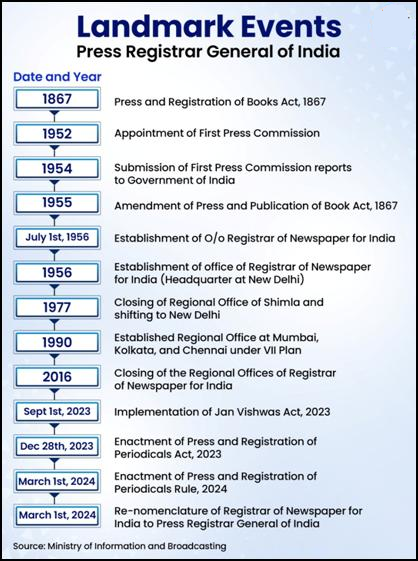
Originally established as the Registrar of Newspapers for India (RNI) in 1956, the body has been restructured under the Press and Registration of Periodicals Act, 2023 (PRP Act) and renamed PRGI. It oversees periodical registration and ensures a streamlined regulatory environment for print publications.
The PRGI’s roots lie in the recommendations of the First Press Commission, which recognised the crucial role of newspapers during the freedom struggle and their continuing importance in nurturing democracy.
Recent Initiatives
2023: Report on fair representation of the LGBTQ+ community.
2023: Guidelines for reporting natural disasters, emphasising sensitivity and accuracy.
Continuous updates to the Norms of Journalistic Conduct, which form the ethical code for print media.
International collaboration through MoUs with press councils in Indonesia, Nepal, Bangladesh, and Sri Lanka.
Internship programmes (SIP/WIP) to train future journalists and promote awareness on press independence.
Under Section 14, the PCI may warn, admonish, or censure media houses found violating ethical norms.
Modernising Media Regulation: PRP Act, 2023 & Press Sewa Portal
The Press and Registration of Periodicals Act, 2023 replaces the colonial Press and Registration of Books Act, 1867, marking a major reform in print media regulation. Implemented from 1 March 2024, the Act brings:
Key Features
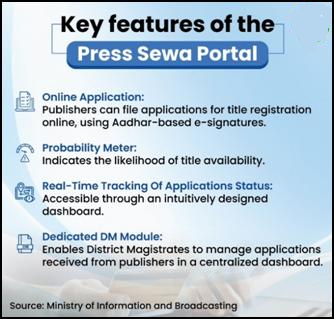
1. Fully online system for title allotment and registration
2. Elimination of physical interfaces and reduced compliance burden
3. Decriminalisation of procedural lapses
4. Transparent and integrated workflows
5. Renaming of RNI as PRGI
The Press Sewa Portal operationalises these changes with end-to-end automation:
Digital Transformation Highlights
1. Over 40,000 publishers onboarded
2. 37,000 annual statements filed
3. 3,000 printing presses registered within 6 months
4. QR-coded digital certificates
5. Direct Payment Gateway and e-sign facilities
6. Real-time tracking and chatbot-based grievance redressal
This marks a significant step toward a technology-driven, accountable, and efficient media regulatory ecosystem.
Capacity Building: Indian Institute of Mass Communication (IIMC)
Established in 1965 with UNESCO support, the IIMC has evolved into a premier institute for media education and training. It offers PG Diploma programmes, specialised short-term courses, and international journalism training.
Important milestones include:
1. Launch of the Journalism Programme for Developing Countries (1969)
2. Regional expansion across Jammu, Amravati, Aizawl, Kottayam, and Dhenkanal
3. MoU with SLBSRSV (2017) for Sanskrit Journalism
4. Training of over 15,000 media professionals across 700+ courses
5. Recognition as a Deemed-to-be University in 2024, enabling degree and doctoral programmes
Supporting Journalists: Welfare and Labour Laws
Journalist Welfare Scheme (JWS)
Revised in 2019, it provides:
Up to ₹5 lakh for death or permanent disability
Up to ₹3 lakh for treatment of major ailments
Up to ₹2 lakh for accident-related treatment
Working Journalists Act, 1955
Regulates:
Working conditions
Leave entitlements
Wage fixation through Wage Boards
EPF & ESI Benefits
EPF Act applies to newspaper establishments since 1956
Extended to private electronic media in 2007
Media personnel earning up to ₹21,000/month are eligible for ESI benefits
These frameworks ensure labour rights and social security for media professionals.
Conclusion
National Press Day underscores the indispensable role of a free, fair, and responsible press in safeguarding India’s democratic ethos. As the fourth pillar of democracy, the media not only informs citizens but also ensures transparency, accountability, and social awareness. Recent reforms—such as the PRP Act 2023, the Press Sewa Portal, and the strengthening of institutions like the PCI, PRGI, and IIMC—reflect India’s commitment to modernising media governance while upholding ethical standards. Welfare measures further protect journalists’ rights and well-being, acknowledging their contribution to nation-building. Going forward, continuous capacity-building, digital adaptation, and ethical, inclusive journalism will remain essential to preserving the credibility and vitality of India’s media landscape.
Prelims question:
Q. With reference to media governance in India, consider the following statements:
1. The Press and Registration of Periodicals (PRP) Act, 2023 replaces the Press and Registration of Books Act, 1867.
2. The Press Registrar General of India (PRGI) was earlier known as the Registrar of Newspapers for India (RNI).
3. The National Awards for Excellence in Journalism are presented by the Indian Institute of Mass Communication (IIMC).
4. The Journalist Welfare Scheme (JWS) provides financial assistance to journalists in cases of death, disability, and major illnesses.
How many of the above statements are correct?
(a) Only one
(b) Only two
(c) Only three
(d) All four
Answer: C
Mains Question:
Q. National Press Day highlights the importance of a free and responsible media in a democratic society. Discuss the evolution of India’s media governance framework, recent regulatory reforms, and welfare measures for journalists.
(250 words)

- Europe’s AI Rules May Become India’s Opportunity - August 14, 2026
- Transparency as the Foundation of Trust in Medicine - August 14, 2026
- A Timely Reset for the Food Security Act: From Foodgrain Security to Nutrition Security - August 13, 2026

No Comments