Green Maritime Transition in India: Aligning Port-Led Growth with Climate Commitments

Green Maritime Transition in India: Aligning Port-Led Growth with Climate Commitments

This article covers “Daily Current Affairs” and From  Green Maritime Transition in India: Aligning Port-Led Growth with Climate Commitments

SYLLABUS MAPPING  

GS-3- Environment & Infrastructure-Green Maritime Transition in India: Aligning Port-Led Growth with Climate Commitments

FOR PRELIMS

What challenges do Indian ports face in balancing rapid expansion with environmental protection?

FOR MAINS

What is meant by Green Maritime development in India?

Why in the News? 
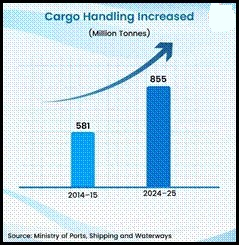
India’s ports are in the news due to record cargo handling of 855 million tonnes in FY 2024–25 and their expanding role under Sagarmala and PM Gati Shakti in supporting Atmanirbhar Bharat. However, rapid port expansion has intensified concerns over air and water pollution, GHG emissions, and damage to fragile coastal ecosystems such as mangroves and coral reefs. At the same time, India is aligning its maritime sector with its climate commitments under the NDCs and global targets set by the International Maritime Organization, including a 40% reduction in CO₂ emissions by 2030. This dual push for port-led growth and environmental sustainability has brought India’s ports sector into policy and public focus.

Green Maritime Policy Framework in India

Background and Rationale

The Green Maritime approach in India has evolved to align maritime development with national sustainability priorities, global climate commitments, and Health, Safety and Environment (HSE) standards. With ports emerging as critical economic gateways, there is a growing emphasis on making port operations safer, cleaner, energy-efficient, and environmentally sustainable.

Green Maritime Policy Framework in India

Policy / Initiative Year Purpose / Role Key Features / Targets
Indian Ports Act, 2025 2025 Legal foundation for green and sustainable port governance • Replaces colonial Indian Ports Act, 1908
• Mandates compliance with global green maritime norms
• Strengthens environmental safeguards, pollution control & disaster preparedness
• Institutionalises eco-friendly port operations
• Aligns with international conventions like MARPOL and Ballast Water Management Convention
Maritime India Vision (MIV) 2030 2021 Medium-term strategic blueprint for maritime sector growth • Identifies 150 initiatives for coordinated development
• Focus on Safe, Sustainable & Green Maritime Sector
• Renewable energy adoption
• Reduction of air emissions
• Water optimisation & wastewater reuse
• Solid waste management
• Zero-accident safety programmes
• Centralised digital monitoring systems
Maritime Amrit Kaal Vision 2047 2023 Long-term roadmap aligned with India@100 • Investment of nearly ₹80 lakh crore
• Covers ports, coastal shipping, inland waterways, shipbuilding & green shipping
• Over 300 actionable initiatives
• Targets India as a global maritime & shipbuilding hub
• Sustainability as the core pillar of maritime expansion
Harit Sagar: Green Port Guidelines 2023 Operational framework for green port implementation Carbon Emission Reduction (per ton cargo):
• 30% by 2030
• 70% by 2047Renewable Energy Share:
• 60% by 2030
• 90% by 2047 (New Mangalore Port achieved 100% solar by 2025)Electrification of Port Equipment:
• 50% by 2030
• 90% by 2047

Green Cover:
• 20% by 2030
• 33% by 2047

Shore-to-Ship Power:
• Phased rollout; EXIM vessels by 2025

Water Management:
• 100% wastewater reuse
• 20% reduction in freshwater consumption by 2030

Status of Implementation: Key Green Interventions under Maritime India Vision (MIV) 2030

Intervention Area Key Measures / Actions Implementation Status & Best Practices
1. Renewable Energy Adoption • Rooftop & floating solar PV
• Onshore & offshore wind via PPP
• Tidal energy pilots (Gulf of Cambay & Kutch: 8,000–12,000 MW potential)
• Steady progress at Kandla, Tuticorin, Mormugao, JNPA
Best Practice: Mormugao Port’s ‘Harit Shrey’ scheme (2023) offering Green Ship Incentives through Environmental Ship Index (ESI)
2. Air Quality Improvement • Electrification of cranes, forklifts & cargo equipment
• LNG bunkering for cleaner fuel
• Shore-to-ship power supply
• Dust suppression systems & green buffers
Mumbai Port: Shore power installations
Paradip Port: Dust suppression, LED lighting, oil spill response systems & large-scale plantation
3. Optimising Water Use & Green Cover • Sewage & wastewater treatment plants
• Recycling of oily waste
• Strengthening oil spill monitoring
• Use of atomisers & mist cannons
• Reduced freshwater consumption
• Expansion of mangroves & green belts through CSR initiatives
4. Solid Waste Management • Waste segregation, recycling & scientific disposal
• Alignment with Swachh Bharat Mission
• Compliance with National Action Plan for Green Shipping
• Infrastructure upgrades such as roads, sheds, sanitation facilities & dustbins
• Improved port cleanliness & hygiene
5. Dredged Material Recycling • Reuse for land reclamation, construction, beach nourishment & habitat creation • Initial target of 30% recycling, scalable via PPP
Best Practices: Mundra, Paradip & Visakhapatnam ports
6. Zero Accident Safety Programme • Risk assessment
• Equipment safety & hazardous material handling
• Safety culture, training & process re-engineering
Case Study: V.O. Chidambaranar Port declared Zero Fatal Accident Zone (2019–21) through PPE enforcement, mock drills, inspections & training
7. Occupational Health at Ports • Address physical, chemical, ergonomic & psychosocial risks
• Periodic medical monitoring
• 24×7 emergency services
Mumbai Port Trust: Operates a 200-bed hospital; developing a 600-bed super-specialty hospital under PPP
8. Real-Time Centralised Monitoring • National digital dashboard
• Uniform HSE indicators across ports
• Real-time tracking of emissions, safety & health data
• Enhances transparency, regulatory compliance & evidence-based policymaking

In this context, examine the Green Maritime Policy Framework in India. Discuss its key initiatives, achievements, and challenges in transforming Indian ports into sustainable and climate-resilient infrastructure.

Initiatives like Sagarmala Programme, Harit Sagar, Harit Nauka, and Green Tug Transition Programme (GTTP)etc provides practical roadmap for decarbonising shipping through green finance, regulations, technology, and collaboration, balancing sustainability with economic growth.

Major Government-Led Green Initiatives for Sustainable Maritime Growth

1. Flagship & Sectoral Green Initiatives

Initiative Objective Key Features / Targets
Sagarmala Programme Transform India into a global maritime leader with green logistics • Core pillar of MIV 2030 & Maritime Amrit Kaal Vision 2047
• Focus on lowering logistics cost, faster trade & job creation
840 projects worth ₹5.8 lakh crore by 2035
272 projects (₹1.41 lakh crore) completed
217 projects (₹1.65 lakh crore) under implementation
Vadhavan Greenfield Major Port (Maharashtra) Develop next-generation green mega port • Approved June 2024
• Developed by VPPL (JNPA + MMB)
• Total cost ₹76,220 crore
• Core infra: ₹38,976 cr (incl. dredging & reclamation via PPP)
• Terminals & commercial infra: ₹37,244 cr (PPP)
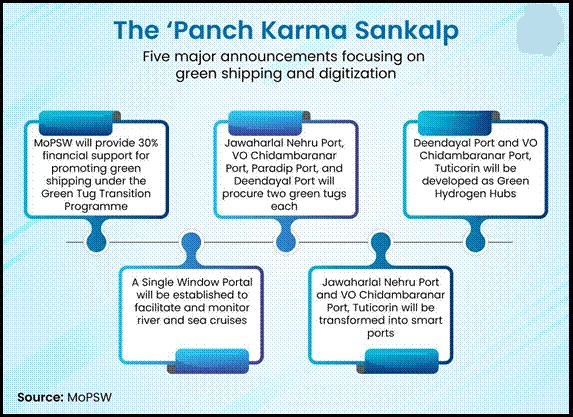
Green Tug Transition Programme (GTTP) Replace fossil-fuel harbour tugs with green alternatives • Part of ‘Panch Karma Sankalp’
• Promotes Green Hybrid Tugs
• Adoption of Methanol, Ammonia, Hydrogen
• Strong alignment with Make in India & indigenous shipbuilding
Harit Nauka (Green Vessel) Initiative Decarbonise inland waterway transport • Launched for inland vessels
• Target: 100% Green Vessels by 2047
• Standardised green vessel designs
• Financial assistance & ecosystem creation
• Promotes safe, affordable, green passenger transport
• Boosts indigenous shipbuilding
National Green Hydrogen Mission (2023) Make India a global green hydrogen hub • Target: 5 MTPA green hydrogen by 2030
• Investment: ₹8 lakh crore
• Jobs: 6 lakh
• Import savings: ₹1 lakh crore
• Focus: production, pilots, electrolysers, R&D, skills
Kandla, Paradip, Tuticorin to be developed as Green Hydrogen hubs
Green Shipping by SCI Decarbonise shipping fleet 2 SCI vessels identified for retrofit
• To run on green methanol / hydrogen-based fuels by 2027

2. Sustainable MoUs Driving Green Maritime Growth (2025)

Area Key MoUs / Developments
Overall Framework • MoU Exchange Ceremony “Samudra Se Samriddhi” at Bhavnagar (19 Sept 2025)
27 MoUs, investments ₹66,000+ crore
• Focus on ports, green mobility, tourism, energy, shipbuilding, finance
Green Urban Water Transport IWAI–Bihar Govt MoU for ₹908 crore Patna Water Metro
• Electric ferries & modern terminals
Green Shipbuilding Infrastructure Mazagaon Dock–Guidance Tamil Nadu: Greenfield shipyard at Thoothukudi
• Green shipbuilding clusters in AP, Odisha, Gujarat, Maharashtra, TN
Eastern Maritime Capacity GRSE MoUs with IPRCL, SCI, SMPK, Modest Shipyard
• Focus on greenfield yards, tug development & ship repair
Green Maritime Finance Sagarmala Finance Corporation Ltd MoUs with NaBFID, IIFCL, Neo Fund, Climate Fund Managers
• Mobilisation of equity, debt & climate finance for green shipping & logistics

3. India’s International Green Maritime Pacts

Country Green Maritime Cooperation Areas
Denmark • Joint work plan on green & digital maritime
• Centre of Excellence in Green Shipping
• Cooperation on green fuels, ship recycling, energy efficiency
Norway • Green shipping
• Ship recycling
• Maritime training & security
Russia • Cooperation on Northern Sea Route
• Efficient, lower-emission Arctic shipping
Malta • Green shipping
• Cruise & port infrastructure
• IMO initiatives & shipping registry best practices
Singapore Green & Digital Shipping Corridor
• Low-emission technologies & digitalisation
Netherlands • Maritime cooperation
Green Digital Sea Corridor for sustainable port growth

Conclusion

India stands poised at the threshold of a transformative maritime era – one that harnesses its vast coastline, growing industrial capacity and strategic position to not only advance trade and connectivity but also cement a legacy of sustainability and resilience. Through visionary programmes, legislative reforms and green-shipping initiatives, the country is rewiring its maritime ecosystem for the future: cleaner ports, low-emission fleets, smart infrastructure and inclusive opportunity. As India charts its course toward 2047, it is doing so not just as a rising maritime power, but as a responsible steward of the seas, a globally competitive economy and a partner committed to the well-being of the planet.

Prelims question:

Q.  With reference to the Harit Sagar: Green Port Guidelines (2023), consider the following statements:

1. They align with India’s Nationally Determined Contributions (NDCs) and COP26 commitments.
2. They mandate ports to achieve more than 60% renewable energy usage by 2030.
3. They aim to provide shore-to-ship power supply to all EXIM vessels by 2025.
4. They seek 100% reuse of wastewater and reduction in freshwater consumption.
Which of the statements given above are correct?
(a) 1, 2 and 3 only
(b) 1, 2 and 4 only
(c) 1, 2, 3 and 4
(d) 2 and 4 only

Answer: C

Mains Question:

QIn this context, examine the Green Maritime Policy Framework in India. Discuss its key initiatives, achievements, and challenges in transforming Indian ports into sustainable and climate-resilient infrastructure.

                                                                                                                                                                                                                                                                                                                                                                                                                                                                                                                                                                                                                                                                                                                                                                                                                                                                                                                                                      (250 words)

No Comments

Post A Comment