Rising Demand and Import Dependence
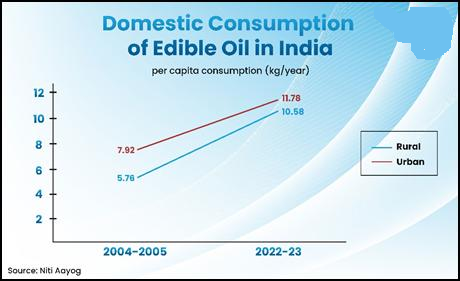
India’s per capita consumption of edible oils has increased sharply over the last two decades due to rising incomes, urbanisation, dietary diversification, and population growth. Rural per capita consumption rose from 5.76 kg/year in 2004–05 to 10.58 kg/year in 2022–23, while urban consumption increased from 7.92 kg/year to 11.78 kg/year over the same period. This represents an 83.68% rise in rural and 48.74% rise in urban consumption.
In contrast, domestic production remains constrained. During 2023–24, India produced around 12.18 million tonnes of edible oils, meeting only about 44% of total domestic demand. Although import dependence has declined modestly from 63.2% in 2015–16 to about 56.25% in 2023–24, imports still stood at 15.66 million tonnes, making India one of the world’s largest edible oil importers. This dependence not only strains foreign exchange reserves but also transmits global price shocks directly to Indian consumers.
Historical Context and Structural Constraints
India achieved near self-sufficiency during the Yellow Revolution of the 1990s, driven by the Technology Mission on Oilseeds (TMO), which combined price support, research investment, and import substitution policies. However, post-WTO commitments led to a gradual reduction in import tariffs and price support, while consumption continued to grow faster than domestic production.
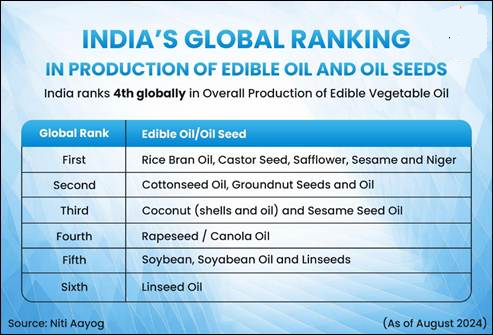
Globally, edible oil growth has been driven largely by soybean, palm, and rapeseed oils. India ranks as the fourth-largest oilseed economy after the USA, China, and Brazil, accounting for 15–20% of global oilseed area, but only 6–7% of global vegetable oil production, reflecting low yields and productivity gaps. Limited irrigation, rainfed dependence, poor seed replacement rates, and fragmented value chains have constrained output growth.
India’s Oilseed Production Landscape
Oilseeds occupy a central place in Indian agriculture, accounting for 14.3% of gross cropped area, contributing 12–13% of dietary energy, and around 8% of agricultural exports. India produces nine major oilseeds—groundnut, soybean, rapeseed-mustard, sunflower, sesame, safflower, niger, castor, and linseed.
However, nearly 76% of oilseed cultivation is rainfed, making production highly vulnerable to climate variability. Geographically, production is concentrated in a few states—Rajasthan, Madhya Pradesh, Gujarat, and Maharashtra—which together contribute over 77% of total output, increasing regional concentration risks.
NMEO – Oil Palm: Leveraging High Yield Potential
Oil palm is the highest oil-yielding crop, producing nearly five times more oil per hectare than traditional oilseeds. It yields both palm oil and palm kernel oil, used for food and industrial purposes.
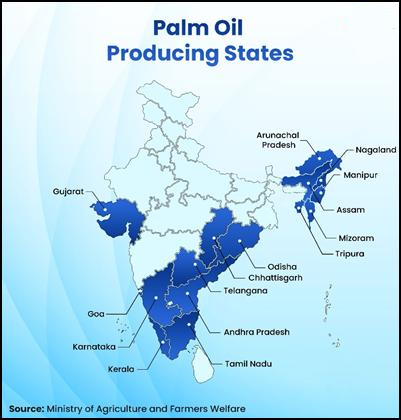
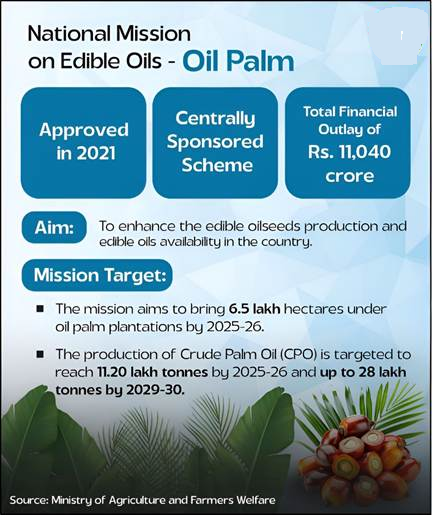
Approved in 2021 as a Centrally Sponsored Scheme with a total outlay of ₹11,040 crore, NMEO-OP focuses on area expansion, productivity enhancement, and assured farmer returns. Andhra Pradesh and Telangana currently account for nearly 98% of production, while significant expansion is being pursued in the North-Eastern states, leveraging their agro-climatic potential.
Key interventions include:
1. Expansion to 6.5 lakh hectares by 2025–26
2. Targeting 11.2 lakh tonnes of CPO by 2025–26 and 28 lakh tonnes by 2029–30
3. Establishment of seed gardens and nurseries to ensure quality planting material
4. Promotion of drip irrigation, intercropping during the gestation period, and rejuvenation of old plantations
A major innovation is the Viability Price (VP) mechanism, which assures farmers a minimum price for Fresh Fruit Bunches (FFBs) linked to international CPO prices, protecting them from global volatility. Assistance for planting material has been raised significantly, enhancing farmer incentives.
NMEO – Oilseeds: Revitalising Traditional Crops
Launched in 2024 for the period 2024–25 to 2030–31 with an outlay of ₹10,103 crore, NMEO-OS targets traditional oilseeds and secondary sources such as cottonseed, rice bran, coconut, and tree-borne oilseeds.
The mission aims to:
1. Increase oilseed area from 29 million ha to 33 million ha
2. Raise production from 39 million tonnes to nearly 70 million tonnes
3. Improve yields from 1,353 kg/ha to over 2,100 kg/ha
4. Achieve 72% self-sufficiency in edible oils by 2030–31 (with NMEO-OP)
Core strategies include:
1. Value Chain Clusters (600+ clusters covering over 10 lakh ha annually)
2. Free distribution of high-quality seeds, GAP training, and digital advisories
3. Expansion into rice and potato fallows, intercropping, and crop diversification
4. Strengthening post-harvest infrastructure for better oil extraction and recovery
Digital tools like the SATHI portal and Krishi Mapper ensure seed traceability, real-time monitoring, and data-driven governance, while Krishi Sakhis and SHGs provide last-mile extension support.
Research, Technology and Seed Systems
The ICAR plays a central role through All India Coordinated Research Projects (AICRPs) and flagship initiatives on hybrid development and gene editing. Between 2014 and 2025, over 430 high-yielding varieties and hybrids were released across oilseed crops. Efforts to improve Seed Replacement Rate (SRR) and Varietal Replacement Rate (VRR) are critical to realising genetic gains. Seed hubs, breeder seed production, and public-private partnerships are being expanded to ensure timely access to quality seeds.
Complementary Policy Support
NMEO is reinforced by broader policy measures:
1. MSP increases and procurement under PM-AASHA
2. PMFBY crop insurance coverage for oilseeds
3. Higher customs duties on crude and refined edible oils to protect domestic producers
4. Awareness campaigns promoting healthy and balanced oil consumption
These measures aim to balance farmer incentives, consumer interests, and trade stability.
India remains heavily dependent on imports to meet its edible oil requirements despite being one of the world’s largest producers of oilseeds. In this context, examine the structural challenges in India’s edible oil sector and critically analyse how the National Mission on Edible Oils (NMEO) seeks to address them.
Challenges and Sustainability Concerns
1. Land Availability and Competing Land Use: Expansion of oil palm and oilseed cultivation faces constraints due to limited availability of suitable land and competition with food crops, forests, and ecologically sensitive areas, especially in the North-Eastern region.
2. High Water Requirement and Irrigation Stress: Oil palm is a water-intensive crop, requiring assured irrigation. In water-stressed regions, its expansion may aggravate groundwater depletion and create long-term sustainability concerns if micro-irrigation is not effectively implemented.
3. Environmental and Biodiversity Concerns: Large-scale monoculture plantations risk biodiversity loss, soil degradation, and ecosystem disruption, particularly when expansion occurs near forested or fragile landscapes without robust environmental safeguards.
4. Climate Vulnerability of Rainfed Oilseeds: Nearly three-fourths of oilseed cultivation remains rainfed, making production highly vulnerable to climate variability, erratic monsoons, heat stress, and pest outbreaks, which can undermine productivity gains.
5. Farmer Adoption and Economic Risks: Long gestation periods (4–5 years for oil palm), limited awareness, access to quality planting material, and price uncertainties may discourage small and marginal farmers despite assured pricing mechanisms.
6. Processing, Storage, and Value Chain Gaps: Inadequate oil extraction units, poor post-harvest infrastructure, and weak market linkages reduce oil recovery efficiency and farmer returns, limiting the full impact of production-side interventions under NMEO.





No Comments