PESA Mahotsav 2025: Celebrating Tribal Self-Governance
The Ministry of Panchayati Raj (MoPR) will organise PESA Mahotsav 2025 in Visakhapatnam, Andhra Pradesh (23–24 December 2025), commemorating the enactment of the PESA Act.
Objectives:
1. Celebrate tribal culture, sports, and cuisine
2. Showcase traditional games such as Chakki Khel, Puli Meka, Mallakhamba, Gedi Doud
3. Promote awareness about tribal rights and self-governance
4. Provide a national platform for tribal communities to preserve and promote their heritage
Government Initiatives for Effective Implementation of PESA Act
| Area of Intervention |
Key Initiatives & Measures |
| Capacity Building |
• National and regional PESA conferences conducted
• Two rounds of Master Trainer programmes (2024–25) in 7 anchor states
• Over 1 lakh elected representatives and officials trained |
| Digital Governance |
• Launch of PESA–Gram Panchayat Development Plan (GPDP) Portal (September 2024)
• Enables hamlet-wise planning and bottom-up governance
• Facilitates convergence of Central & State Finance Commission grants, Centrally Sponsored Schemes, State schemes, and other funds |
| Institutional Support |
• Establishment of a dedicated PESA Cell in the Ministry of Panchayati Raj (MoPR)
• PESA manuals translated into regional and tribal languages (Santhali, Gondi, Bhili, Mundari)
• Creation of Centres of Excellence (CoEs) in central universities
• First CoE set up at Indira Gandhi National Tribal University, Amarkantak |
| Awareness Building |
• 24 December declared as ‘PESA Day’
• National-level PESA event organised in Ranchi (2024) |
PESA in Action: Success Stories and Best Practices
1. Empowered Gram Sabha and Livelihood Generation – Khamdhogi, Chhattisgarh
Formation of Gram Sabha under Chhattisgarh PESA Rules, 2022
Mandatory participation of one man and one woman from each household
Initiatives in forest produce, fisheries, bamboo rafting
Result: Increased incomes, collective action, and sustainable livelihoods
2. Integrating Customary Practices – Rarang, Himachal Pradesh
Community-led Chilgoza pine nut harvesting
Equal benefit-sharing among households
Forest department consultation made mandatory
Result: Preservation of traditions with economic equity
3. Minor Minerals Management – Vadagudem, Telangana
Tribal Sand Mining Cooperative Society
Rs. 40 lakh annual revenue
Funds invested in education, health, and infrastructure
Result: Economic empowerment and local development
4. Resisting Displacement – Bhim Talai, Rajasthan
Gram Sabha resolution against eviction from wildlife sanctuary
Legal backing under PESA and Panchayati Raj Act
Result: Protection of land rights and cultural continuity
Conclusion
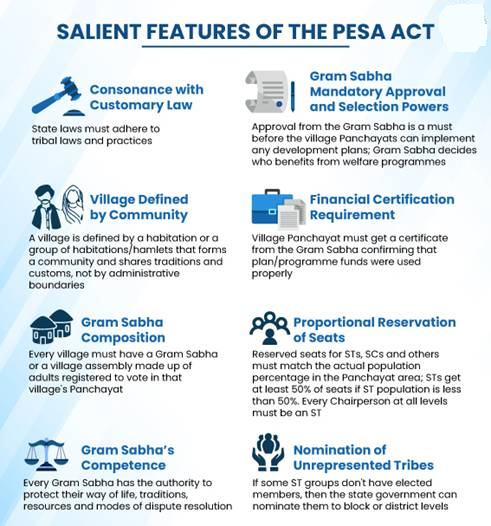
The PESA Act represents a transformative shift from top-down development to community-led governance in India’s Scheduled Areas. Through initiatives such as PESA Mahotsav, capacity-building, digital planning tools, and institutional support, the Government of India particularly the Ministry of Panchayati Raj, is reinforcing the constitutional promise of tribal self-rule. By empowering Gram Sabhas, preserving traditional institutions, and promoting sustainable resource management, PESA strengthens inclusive development, social justice, and democratic deepening, ensuring that tribal communities remain active architects of their own future.
Prelims question:
Q. With reference to the Panchayats (Extension to Scheduled Areas) Act, 1996 (PESA), consider the following statements:
1. PESA extends the provisions of the 73rd Constitutional Amendment to Fifth Schedule Areas with suitable modifications.
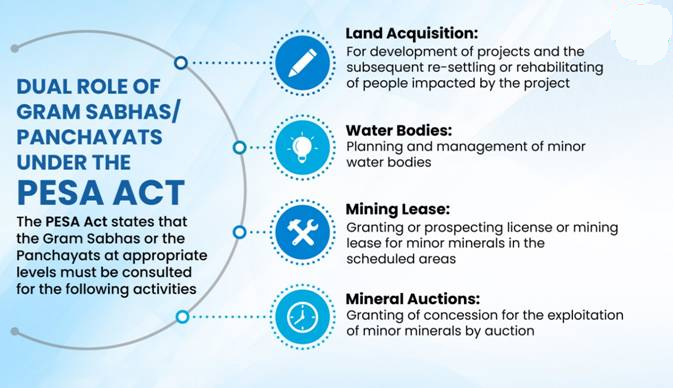
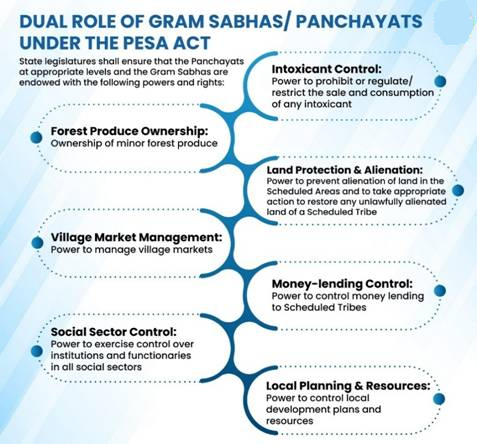
2. Under PESA, the Gram Sabha has primacy over Panchayats in matters related to land acquisition and minor forest produce.
3. State legislatures are free to dilute PESA provisions to suit local administrative requirements.
4. Consultation with Gram Sabha is mandatory before granting concessions for minor minerals in Scheduled Areas.
Which of the statements given above are correct?
(a) 1, 2 and 4 only
(b) 1 and 3 only
(c) 2 and 3 only
(d) 1, 2, 3 and 4
Answer: A





No Comments