Industrial parks have emerged as a cornerstone of India’s evolving industrial and innovation strategy. Developed through collaboration between the Union Government, State Governments, and the private sector, industrial parks are reshaping India’s manufacturing landscape by enabling investment-led growth, technological upgrading, and employment generation. As the State transitions from a regulator to a facilitator, industrial parks are becoming vital instruments for building a globally competitive, resilient, and sustainable industrial economy.
Concept and Salient Features of Industrial Parks
An industrial park is a planned, demarcated zone developed for industrial use, equipped with shared infrastructure and common services to support multiple enterprises. These parks reduce transaction costs, enhance productivity, and promote agglomeration economies.
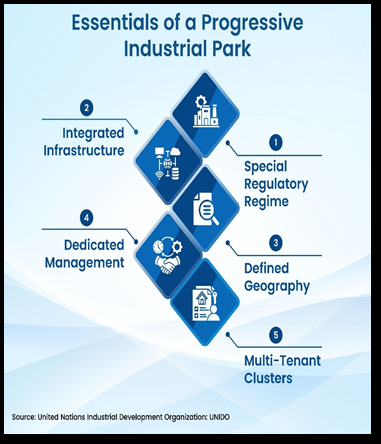
Key Building Blocks:
1. Special regulatory regime: Liberal labour norms, simplified land-use rules, and FDI-friendly policies
2. Integrated infrastructure: Power, water, roads, telecom, waste management, testing labs, logistics, and single-window clearances
3. Defined geography: Master-planned land with uniform standards
4. Dedicated governance: Single authority for approvals, compliance, and long-term development
5. Multi-tenant clustering: Encourages collaboration, innovation, and scale efficiencies
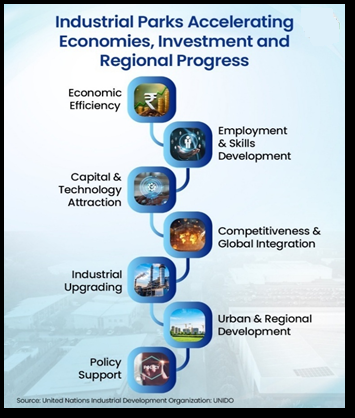
Economic Dimension: Engines of Growth and Competitiveness
Industrial parks improve economic efficiency by spatially integrating capital, labour, technology, and infrastructure. Cluster-based development enhances productivity, supports industrial upgrading, and strengthens India’s participation in global value chains (GVCs).
They:
1. Attract domestic and foreign investment
2. Enable technology and knowledge spillovers
3. Support MSMEs through shared facilities
4. Act as growth poles for urban and regional development
India’s rising FDI inflows—USD 43.76 billion during April–August 2025–26—underscore the role of industrial parks as anchors of investment-led growth.
Employment and Social Dimension
Industrial parks are major drivers of employment generation and skill development, improving wages and labour participation. They also promote social well-being through:
1. Worker housing and social infrastructure
2. Health and safety mechanisms
3. Gender-sensitive facilities and inclusive workplaces
4. Engagement with trade unions and local communities
This strengthens social capital, reduces regional disparities, and enhances community trust.
Environmental and Sustainability Dimension
Modern industrial parks increasingly integrate sustainable and green practices:
1. Compliance with environmental laws
2. Monitoring of air, noise, light, soil, and groundwater pollution
3. Resource efficiency audits and cleaner technologies
4. Biodiversity-sensitive land use planning
5. Climate risk mitigation and efficient land utilisation
Governance and Institutional Dimension of Industrial Parks
| Aspect / Initiative |
Key Features |
Significance for Governance & Industry |
| Coordinated Governance Model |
Dedicated park authorities for approvals, compliance, and planning |
Ensures regulatory certainty, investor facilitation, and long-term sustainability |
| Plug-and-Play Industrial Parks |
• ₹2,500 crore allocation (Union Budget 2025–26)
• Ready-to-use, industry-specific infrastructure
• 306 operational parks; 20 more under NICDC |
Reduces project gestation period, improves ease of doing business, boosts industrial readiness |
| India Industrial Land Bank (IILB) |
• DPIIT-led GIS-based digital platform
• Covers 4,523 industrial parks over ~7.7 lakh hectares |
Enhances transparency, land availability visibility, and informed investor decision-making |
| Industrial Park Rating System (IPRS) |
• Performance-based assessment framework
• IPRS 3.0 (2025) includes sustainability, logistics, digitalisation, skill linkages, tenant feedback |
Promotes competition among states, quality benchmarking, and evidence-based policymaking |
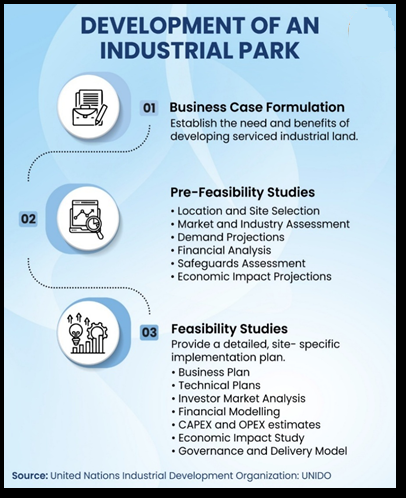
Industrial Park Rating System (IPRS)
The Industrial Park Rating System (IPRS) is a national framework to assess the performance and quality of industrial parks and business districts in India. It is based on four assessment pillars and helps investors, developers, and policymakers make informed decisions. The system encourages industrial parks to improve infrastructure, services, sustainability, and ease of doing business.
IPRS goes beyond ranking by providing detailed feedback reports, which act as roadmaps for upgrading facilities and improving operational efficiency. It also promotes knowledge sharing and healthy competition among States and Union Territories.
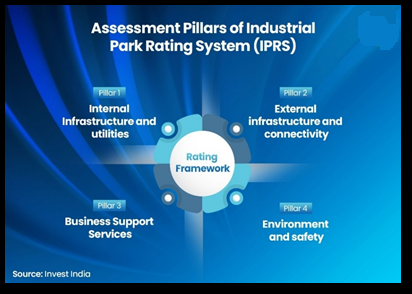 According to the IPRS 2.0 Top Rated Parks Report:
1. 41 parks were classified as ‘Leaders’, having strong infrastructure and stable industrial activity.
2. 90 parks were identified as ‘Challengers’, showing rapid improvement and growth potential.
3. 185 parks were recognised as ‘Aspirers’, indicating early-stage parks with scope for future development.
These classifications enhance transparency for investors and support evidence-based policymaking.
In September 2025, IPRS 3.0 was launched to further strengthen India’s industrial ecosystem. Building on earlier versions, it introduced new parameters such as sustainability, green infrastructure, logistics connectivity, digitalisation, skill linkages, and tenant feedback, reflecting India’s shift towards competitive and sustainable industrial development.
Ease of Doing Business and Policy Reforms
Industrial parks are central to India’s Ease of Doing Business agenda:
1. National Business Reforms Action Plan (BRAP)
2. GST unification
3. tartup India and DPIIT recognition
4. RoDTEP for export competitiveness
5. Large-scale compliance reduction and decriminalisation
Regional and Spatial Development Dimension
Industrial parks function as regional growth hubs, catalysing:
1. Urban expansion
2. Infrastructure development
3. Balanced regional industrialisation
States such as Gujarat, Maharashtra, Tamil Nadu, Telangana, and Andhra Pradesh have leveraged industrial parks to attract manufacturing and logistics investments.
Global and Strategic Dimension
Globally, industrial parks enhance India’s position as a preferred manufacturing and investment destination. As competition for FDI intensifies and the global economy shifts towards green and circular production models, India’s industrial parks are upgrading infrastructure, sustainability standards, and service delivery to align with global best practices.
Conclusion
Industrial parks lie at the heart of India’s industrial transformation. Their planned design, shared infrastructure, and coordinated governance foster productivity, innovation, employment, and sustainability. Government initiatives such as plug-and-play parks, the India Industrial Land Bank, and the Industrial Park Rating System reflect a sustained commitment to industrial excellence. As India navigates intensifying global competition and transitions towards a green industrial future, continuously upgrading industrial parks will be crucial for deepening value chains, enhancing investor confidence, and integrating India more effectively into global manufacturing networks.
Prelims question:
Q. With reference to industrial parks in India, consider the following statements:
1. Industrial parks promote agglomeration economies by providing shared infrastructure and common services.
2. Plug-and-play industrial parks aim to reduce project gestation periods by offering ready-to-use industrial infrastructure.
3. The India Industrial Land Bank (IILB) is a GIS-enabled platform developed by NITI Aayog to map industrial land across India.
Which of the statements given above are correct?
(a) 1 and 2 only
(b) 2 and 3 only
(c) 1 and 3 only
(d) 1, 2 and 3
Answer: A





No Comments