


12 Jan National Youth Day 2026: Empowering India’s Youth as Partners in Nation-Building
This articlecovers “Daily Current Affairs” and From National Youth Day 2026: Empowering India’s Youth as Partners in Nation-Building
SYLLABUS MAPPING
GS-2- Governance and Constitution- National Youth Day 2026: Empowering India’s Youth as Partners in Nation-Building
FOR PRELIMS
What is National Youth Day? Why is it celebrated in India?
FOR MAINS
What role does skill development play in empowering youth?
Why in the News?
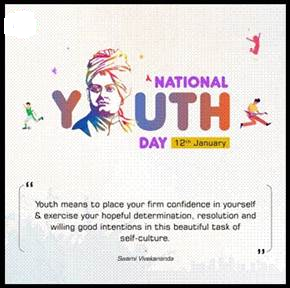
National Youth Day 2026 is being observed on 12 January across India to commemorate the birth anniversary of Swami Vivekananda, whose ideals of youth-led nation-building, character formation, and self-confidence continue to guide India’s development discourse. The day has gained renewed policy relevance in the context of India’s demographic advantage, with over 65% of the population below 35 years, and the government’s long-term vision of Viksit Bharat @2047. This year, National Youth Day is in the news due to the government’s intensified focus on youth as key stakeholders in governance and development, reflected in the expansion and convergence of youth-centric initiatives under the Ministry of Youth Affairs and Sports, in coordination with other ministries. Programmes promoting skill development, entrepreneurship, civic engagement, digital literacy, fitness, and national service are being highlighted as instruments to transform the demographic dividend into a productive and inclusive growth engine.
Youth Engagement, Leadership and Civic Participation
Mera Yuva Bharat (MY Bharat)
A flagship institutional innovation, Mera Yuva Bharat (MY Bharat) is an autonomous, technology-driven platform under the Ministry of Youth Affairs and Sports. Launched by the Prime Minister on 31 October 2023, it embodies the spirit of “Yuva Shakti se Jan Bhagidari” by connecting youth with opportunities for volunteering, experiential learning, leadership, and skill development.
As of November 2025, over 2.05 crore youth registrations have been recorded, with more than 14.5 lakh volunteering opportunities created. MY Bharat integrates 16,000+ youth clubs and 60,000+ institutional partners, including government bodies, educational institutions, NGOs, and private sector players. The platform’s digital tools—such as verified digital IDs, opportunity matching, and real-time impact dashboards—enable transparent and measurable civic participation.
The launch of the MY Bharat Mobile App (October 2025) further strengthened outreach through multilingual support, AI-driven chatbots, voice-assisted navigation, digital certificates, and smart CV builders, making youth engagement mobile-first and inclusive.
To deepen digital empowerment, MY Bharat 2.0 was initiated through an MoU with the Digital India Corporation in June 2025. The upgraded platform integrates career services, mentorship hubs, and Fit India modules, reinforcing youth readiness for future challenges.
National Service and Youth Leadership Platforms
National Service Scheme (NSS)
Since its launch in 1969, the National Service Scheme (NSS) has remained a cornerstone of youth-led community service. Today, NSS spans 657 universities and over 20,000 colleges, engaging nearly 3.9 million volunteers annually. Through programmes such as National Integration Camps, adventure training, and social awareness drives, NSS fosters social responsibility, national integration, and leadership.
Viksit Bharat Young Leaders’ Dialogue (VBYLD)
Reimagined from the National Youth Festival, the Viksit Bharat Young Leaders’ Dialogue has emerged as a national platform for youth-driven policy ideas and innovation. The second edition (January 2026, Bharat Mandapam) brings together nearly 3,000 participants, including international delegates. Anchored in a four-stage challenge process, the initiative reflects the transition from symbolic youth participation to substantive policy engagement.
Education, Skills and Employability
Skill India Mission
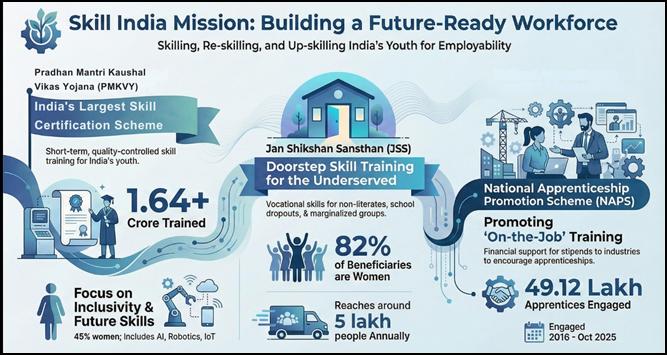
Launched in 2015, the Skill India Mission has empowered over 6 crore Indians, addressing skill gaps through PMKVY, JSS, NAPS, and ITI-based training. The restructured Skill India Programme (2022–26) integrates these schemes under a unified framework with an outlay of ₹8,800 crore.
PMKVY, the backbone of short-term skilling, has trained over 1.64 crore candidates by October 2025, with a growing focus on emerging technologies such as AI, robotics, drones, and IoT. The evolution to PMKVY 4.0 marks a shift towards on-the-job training and industry-linked pathways, enhancing employability and inclusion.
PM-SETU and ITI Reforms
Launched in October 2025, PM-SETU aims to modernise 1,000 government ITIs with an investment of ₹60,000 crore, aligning vocational education with global industry standards. Its hub-and-spoke model, coupled with industry management, represents a structural reform in India’s skilling architecture.
Entrepreneurship and Economic Empowerment
Youth empowerment is incomplete without economic opportunity.
1. Startup India has recognised nearly 2 lakh startups, decentralising innovation to Tier-II and Tier-III cities.
2. The Startup India Seed Fund Scheme addresses early-stage funding gaps through a national incubator network.
3. Pradhan Mantri MUDRA Yojana, completing a decade in 2025, has sanctioned over 53 crore collateral-free loans, nurturing grassroots entrepreneurship.
4. The newly announced Pradhan Mantri Viksit Bharat Rozgar Yojana (₹1 lakh crore) aims to generate 3.5 crore jobs, directly linking youth employment with national growth.
Health, Fitness and Holistic Well-being
1. Recognising that human capital thrives on well-being, the Government has adopted a holistic health approach.
2. The Fit India Movement promotes active lifestyles through mass participation initiatives.
3. Rashtriya Kishor Swasthya Karyakram (RKSK) addresses adolescent health across nutrition, mental health, substance misuse, and NCD prevention.
4. The Youth Spiritual Summit and Kashi Declaration (2025) underscore a youth-led movement for mental wellness and drug-free living, integrating spiritual values with social responsibility.
Conclusion
As India marks National Youth Day 2026, the message is unambiguous: the nation’s future is being shaped by the energy, innovation, and commitment of its youth. From classrooms and campuses to startups, villages, armed forces, and volunteer platforms, young Indians are no longer passive recipients of policy—they are drivers of transformation. Inspired by Swami Vivekananda’s ideals, India’s youth empowerment framework combines opportunity with responsibility, growth with character, and ambition with service. As the country advances towards 2047, India’s youth stand not merely as inheritors of the future—but as its architects and custodians.
link: Best ias coaching in delhi Best ias coaching in delhi
Prelims question:
Q. With reference to Mera Yuva Bharat (MY Bharat), consider the following statements:
1. It is an autonomous, technology-driven platform under the Ministry of Youth Affairs and Sports.
2. It aims to connect youth with opportunities for volunteering, leadership development, and experiential learning.
3. MY Bharat 2.0 integrates career services, mentorship hubs, and Fit India modules.
4. Participation in MY Bharat is restricted only to students enrolled in higher educational institutions.
Which of the statements given above are correct?
(a) 1, 2 and 3 only
(b) 1 and 4 only
(c) 2 and 3 only
(d) 1, 2, 3 and 4
Answer: A
Q. Discuss the role of recent government initiatives in strengthening youth engagement, leadership, and nation-building in the context of Viksit Bharat @2047.
(250 words)

- Before New Taxes, Make Every Rupee Count: Fiscal Discipline and Outcome-Based Governance in Tamil Nadu - August 20, 2026
- A Palestinian State as the Foundation for Regional Peace - August 20, 2026
- A Vision for an Inclusive Bangladesh: Democracy, Minority Rights and India’s Neighbourhood - August 19, 2026

No Comments