


12 Jan PSLV-C62 / EOS-N1 Mission: India’s Commercial Leap and Commitment to Sustainable Space Operations
This articlecovers “Daily Current Affairs” and From PSLV-C62 / EOS-N1 Mission: India’s Commercial Leap and Commitment to Sustainable Space Operations
SYLLABUS MAPPING
GS– 3- Science & Technology- PSLV-C62 / EOS-N1 Mission: India’s Commercial Leap and Commitment to Sustainable Space Operations
FOR PRELIMS
What is a Sun-Synchronous Orbit and why is it useful?
FOR MAINS
What is the role of NSIL in India’s space sector?
Why in the News?
The Indian Space Research Organisation (ISRO) commenced the 22.5-hour countdown for the launch of PSLV-C62, scheduled at 10:18 AM on 12 January 2026, from the First Launch Pad, Satish Dhawan Space Centre (SDSC-SHAR), Sriharikota. This mission marks ISRO’s first launch of 2026 and carries the Earth Observation Satellite EOS-N1 along with 13 co-passenger satellites into a Sun-Synchronous Orbit (SSO). The mission is being executed by NewSpace India Limited (NSIL), ISRO’s commercial arm.
Mission Overview
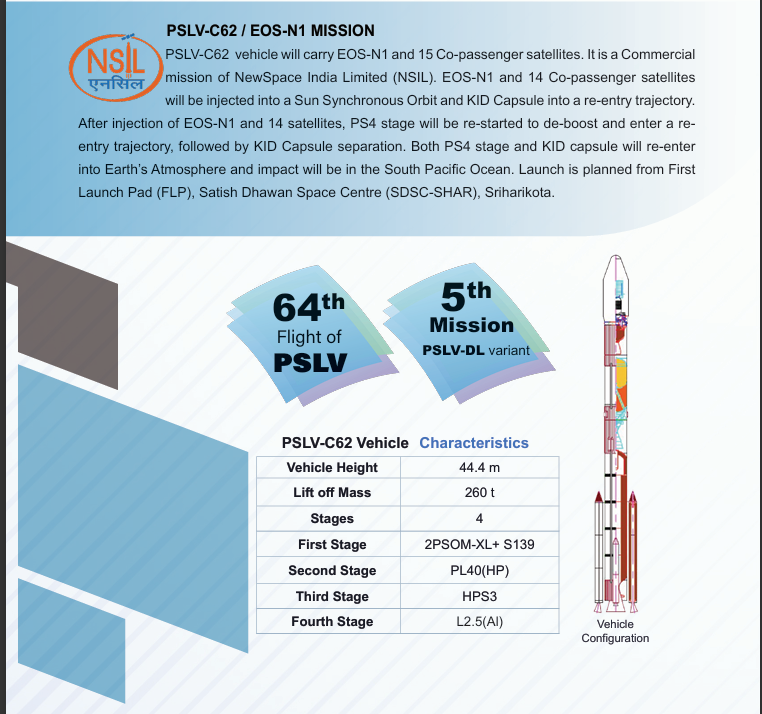
1. Launch Vehicle: PSLV-C62 (PSLV-DL variant)
2. Lift-off Mass: ~260 tonnes
3. Total Satellites: 14 (1 primary + 13 co-passengers)
4. Orbit: Sun-Synchronous Orbit (~505 km altitude)
5. Launch Time: 10:18 AM, 12 January 2026
6. Commercial Operator: NewSpace India Limited (NSIL)
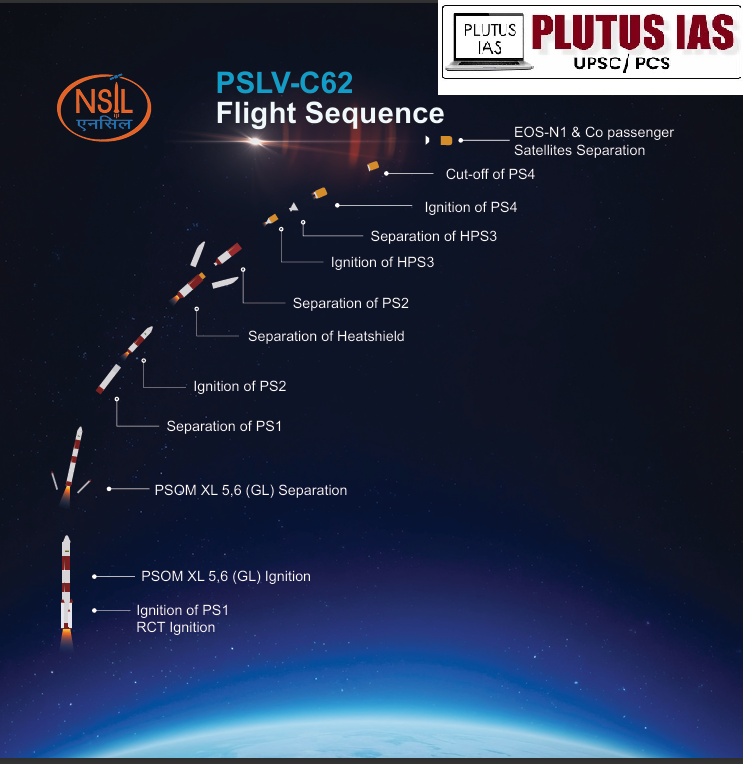
The mission will first deploy EOS-N1, jointly developed by Thailand and the United Kingdom, followed by the sequential separation of 13 co-passenger satellites about 17 minutes after lift-off.
Technical Significance of PSLV-C62
PSLV-C62 is the 64th flight of PSLV and the 5th mission of the PSLV-DL configuration, which uses two strap-on solid boosters for enhanced payload capability. The four-stage architecture combines solid and liquid propulsion systems, ensuring precision orbital insertion. A key feature of this mission is the restart of the PS4 stage for controlled de-orbiting, along with the deployment of a re-entry KID capsule, highlighting ISRO’s growing focus on space sustainability and debris mitigation
The PSLV-C62 / EOS-N1 mission highlights India’s growing technological capability, commercial orientation, and commitment to sustainable space operations. Discuss the significance of this mission in the context of India’s space reforms and emerging global space economy
EOS-N1 enhances Earth observation capacity for:
1. Environmental monitoring
2. Urban planning
3. Agriculture and resource management
4. Disaster management and climate studies
Sun-synchronous orbit ensures consistent lighting conditions, improving data accuracy and repeatability.
International and Commercial Dimensions
1. Satellites onboard originate from India, Thailand, the UK, Brazil, Nepal, and Europe, reflecting global confidence in PSLV.
2. NSIL’s role underscores India’s shift from state-centric launches to a commercial launch ecosystem.
3. The mission strengthens India’s position in the small and medium satellite launch market, where reliability and cost efficiency are critical.
Institutional and Policy Significance
1. Aligns with India’s Space Reforms (2020 onwards) encouraging private participation.
2. Supports IN-SPACe and NSIL-led commercialisation.
3. Contributes to the objectives of the Indian Space Policy 2023, which emphasises:
Commercialisation
International cooperation
Space sustainability
Strategic and National Importance
1. Reinforces India’s status as a trusted space partner.
2. Enhances dual-use space capabilities, supporting civilian and strategic applications.
3. Demonstrates resilience after the PSLV-C61 anomaly (May 2025), restoring confidence in launch systems.
PSLV’s Legacy
With 63 successful missions, PSLV has launched landmark missions such as:
1. Chandrayaan-1
2. Mars Orbiter Mission (Mangalyaan)
3. Aditya-L1
PSLV remains the workhorse of India’s space programme, especially for Earth observation and commercial payloads.
Way Forward
1. Acceleration of Reusable Launch Vehicle (RLV) Programmes: Greater investment in reusable launch systems will significantly reduce launch costs, improve mission frequency, and enhance India’s long-term competitiveness in the global space market.
2. Promotion of Small Launch Vehicles (SSLVs): Focus on SSLVs will cater to the growing global demand for small satellites and constellations, positioning India as a preferred launch destination for NewSpace companies.
3. Expansion of Commercial Launch Services through NSIL: Strengthening NewSpace India Limited (NSIL) will enable effective monetisation of ISRO’s capabilities, boost foreign exchange earnings, and project India as a reliable commercial launch provider.
4. Deepening Public–Private Partnerships (PPP): Enhanced collaboration with private startups in satellite manufacturing, launch services, and downstream applications will accelerate innovation, generate employment, and build a robust space ecosystem.
5. Strengthening Space Sustainability and Debris Mitigation Norms: Adoption of global best practices in space situational awareness, debris tracking, and end-of-life disposal will ensure the long-term sustainability of outer space activities.
6. Promotion of Indigenous Space Technology and Supply Chains: Encouraging domestic production of critical components will reduce import dependence, strengthen strategic autonomy, and support the ‘Atmanirbhar Bharat’ vision in the space sector.
7. Capacity Building and International Cooperation: Investing in skilled human resources and expanding international partnerships will enhance India’s leadership role in peaceful, secure, and cooperative use of outer space.
Conclusion
The PSLV-C62 / EOS-N1 mission represents more than a routine satellite launch. It reflects India’s technological maturity, commercial ambition, and responsible space behaviour. As India advances towards becoming a leading global space economy, missions like PSLV-C62 demonstrate how reliable launch systems, international cooperation, and policy reforms together shape India’s space future.
Prelims question:
Q. With reference to the PSLV-C62 / EOS-N1 mission, consider the following statements:
1. PSLV-C62 uses the PSLV-DL configuration with two strap-on solid boosters.
2. EOS-N1 has been placed in a Geostationary Transfer Orbit to support communication services.
3. The mission includes a PS4 stage restart for controlled de-orbiting to address space debris concerns.
4. NewSpace India Limited (NSIL) is the commercial operator executing the mission.
Which of the statements given above are correct?
(a) 1, 3 and 4 only
(b) 1 and 4 only
(c) 2 and 3 only
(d) 1, 2, 3 and 4
Answer: A
Q. The PSLV-C62 / EOS-N1 mission highlights India’s growing technological capability, commercial orientation, and commitment to sustainable space operations. Discuss the significance of this mission in the context of India’s space reforms and emerging global space economy
(250 words)

- RBI’s Shrinking Real-Rate Cushion Amid Rising Inflation and Strong Demand - September 21, 2026
- India’s NGOs at a New Funding Crossroads - September 21, 2026
- Deep-Sea Discovery, Environmental Responsibility - September 19, 2026

No Comments