


21 Jan India–AI Impact Summit 2026: Institutional Framework, Strategic Vision, and Developmental Outcomes
This article covers “Daily Current Affairs” and From India–AI Impact Summit 2026: Institutional Framework, Strategic Vision, and Developmental Outcomes
SYLLABUS MAPPING
GS-3- Science & Technology- India–AI Impact Summit 2026: Institutional Framework, Strategic Vision, and Developmental Outcomes
FOR PRELIMS
What is the India–AI Impact Summit 2026?
FOR MAINS
What are the seven Chakras identified under the India–AI Impact Summit 2026?
Why in the News?
Artificial Intelligence (AI) has emerged as a key enabler of India’s development trajectory, strengthening governance, improving public service delivery, and supporting inclusive growth at scale. India’s approach to AI aligns with the vision of Viksit Bharat @2047, emphasising people-centric, development-oriented, and responsible AI deployment. India’s linguistic and cultural diversity provides a comparative advantage in building multilingual and multimodal AI systems, making AI more accessible for governance and public services.
Significance of Artificial Intelligence (AI) for India
Artificial Intelligence (AI) has emerged as a transformative force with the potential to accelerate India’s economic growth, strengthen governance, and improve the quality of life of citizens. India’s AI vision is firmly anchored in the principles of People, Planet, and Progress, ensuring that technological advancement remains inclusive, sustainable, and development-oriented.
AI for People: Inclusive Growth and Social Empowerment
AI-enabled solutions are empowering citizens by expanding access to essential services. In healthcare, AI supports telemedicine, remote diagnostics, and early disease detection, particularly benefiting rural and underserved regions. AI-driven personalized learning platforms are revolutionizing education by adapting content to individual learner needs and overcoming linguistic barriers through real-time translation. In the financial sector, AI enhances digital security through fraud detection, enables inclusive credit access, and improves customer service via intelligent chatbots. Together, these applications democratize access to services and reduce socio-economic disparities.
AI for Planet: Sustainability and Resource Efficiency
AI is playing a crucial role in promoting environmentally sustainable practices, especially in agriculture and natural resource management. Precision farming techniques, crop-yield prediction, pest surveillance, and drone-based crop monitoring help optimize inputs such as water, fertilizers, and pesticides, reducing environmental stress. Satellite imagery and AI-based climate models aid in weather forecasting and disaster preparedness, contributing to climate-resilient development. These applications align AI deployment with India’s sustainability and climate commitments.
AI for Progress: Governance, Productivity, and Innovation
AI is strengthening governance and public service delivery by enhancing efficiency, transparency, and responsiveness. AI-assisted translation of court judgments into regional languages improves access to justice. Smart city solutions powered by AI optimize traffic management, waste disposal, and public safety. In daily life, AI-driven platforms in mobility, food delivery, and digital services improve efficiency and user experience, reflecting a shift toward accessible and citizen-centric technology across both rural and urban India.
Sector-wise Applications of AI in India
AI in Healthcare
AI is improving healthcare access and outcomes, especially in areas with limited medical infrastructure. AI-enabled diagnostic tools support early detection of diseases such as tuberculosis and cancer through medical image analysis. Automated blood and urine testing accelerates diagnosis and treatment. Telemedicine platforms, chatbots, and symptom checkers connect rural patients with doctors, reducing travel costs and wait times. Predictive analytics aids in disease outbreak forecasting, while AI-driven drug discovery and personalized medicine enhance affordability and treatment effectiveness for chronic illnesses.
AI in Agriculture and the Rural Economy
AI enables data-driven decision-making in agriculture, enhancing productivity and farmer incomes. Weather forecasting, pest prediction, and irrigation advisories guide farmers through mobile-based platforms. AI-powered drones monitor crop health and reduce post-harvest losses. Market intelligence and price prediction models help farmers respond to demand-supply dynamics. Initiatives such as Kisan E-Mitra and tools like Mossum GPT provide real-time, localized agricultural information in regional languages, strengthening rural livelihoods.
AI in Education and Learning
AI is making education more personalized, inclusive, and accessible. Adaptive learning platforms tailor content to individual learning paces, benefiting both slow learners and advanced students. AI-powered language translation removes linguistic barriers by converting content into regional languages. Intelligent tutoring systems provide instant feedback and 24/7 learning support. National platforms like DIKSHA leverage AI to deliver relevant educational content to diverse learner groups across the country.
AI in Finance and Commerce
AI strengthens financial inclusion, security, and service efficiency. Real-time fraud detection systems safeguard digital payments. AI-based alternative credit scoring expands access to loans for unbanked and underserved populations. Banking chatbots provide round-the-clock assistance for routine services, reducing operational costs and improving customer experience. AI-driven personalization enables tailored financial products and advisory services.
AI in Governance and Public Services
AI enhances the efficiency, accessibility, and transparency of public administration. Automated processing reduces delays in welfare scheme delivery and application approvals. In the judiciary, AI supports case management, legal research, and language translation, improving access to justice. AI-enabled smart governance tools support evidence-based policymaking and efficient resource allocation.
Foundational Pillars: The Three Sutras and Seven Chakras Driving Global Collaboration for AI Impact
The India–AI Impact Summit 2026 seeks to advance a people-centric, impact-oriented approach to Artificial Intelligence, placing emphasis on delivering measurable social, economic, and developmental outcomes. The Summit recognises that AI’s transformative potential can be fully realised only through multilateral cooperation, shared responsibility, and inclusive governance.
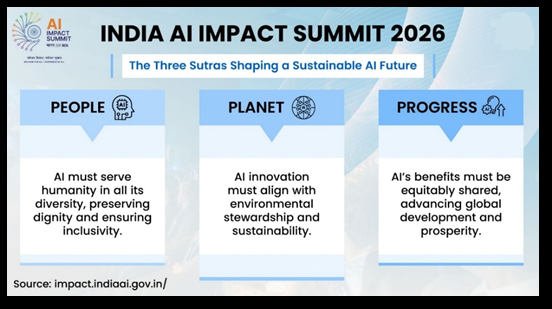
The Three Sutras: Guiding Principles for Collective AI Action
The Summit is anchored in three foundational pillars, referred to as “Sutras”—a Sanskrit term signifying guiding principles or essential threads that bind wisdom with action. These Sutras provide the philosophical and operational framework for global collaboration in AI, defining how innovation can be responsibly harnessed for collective benefit, equity, and sustainability. Together, they reflect India’s civilisational ethos of Vasudhaiva Kutumbakam—the world as one family—applied to the age of Artificial Intelligence.
The Seven Chakras: Pathways for Multilateral AI Cooperation
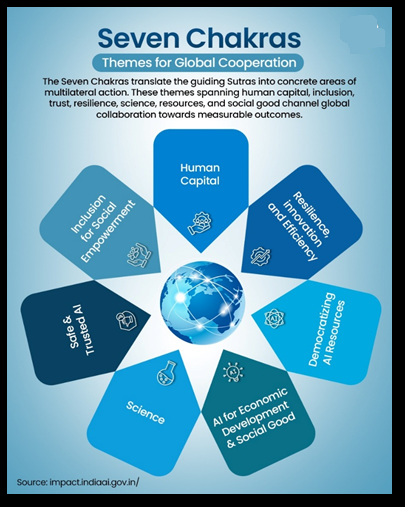
Building upon the Sutras, the Summit’s deliberations are structured around seven “Chakras”, representing key domains of global cooperation that channel collective efforts towards inclusive, ethical, and sustainable AI-driven development.
1. Human Capital: This chakra focuses on building an equitable AI skilling and reskilling ecosystem, with emphasis on workforce readiness, lifelong learning, and targeted capacity building. For India, it strengthens preparedness for the AI-driven economy while aligning skill development with national priorities such as demographic dividend utilisation and employment generation.
2. Inclusion for Social Empowerment: This chakra emphasises inclusive participation through shared AI solutions and scalable deployment models, ensuring that AI benefits reach the most marginalised communities. For India, it supports the delivery of citizen-centric AI applications, strengthens last-mile service delivery, and advances digital inclusion across rural and urban contexts.
3. Safe and Trusted AI: This chakra focuses on translating global principles of responsible AI into practical, interoperable governance and safety frameworks. For India, it reinforces domestic AI governance, enables secure deployment across public digital platforms, builds public trust, and ensures that innovation proceeds without compromising ethical standards, transparency, or accountability.
4. Resilience, Innovation, and Efficiency: This chakra addresses the environmental and resource challenges posed by large-scale AI systems, including energy consumption and infrastructure concentration that risk widening the global AI divide. For India, it promotes sustainable AI adoption, ensuring that AI-led growth remains environmentally responsible, resource-efficient, and socially equitable.
5. Science: This chakra highlights AI’s potential to accelerate scientific discovery while correcting systemic inequities in access to data, compute power, and research infrastructure. For India, it strengthens domestic research ecosystems, accelerates breakthroughs in health, agriculture, and climate science, and positions India as an active contributor to global scientific advancement.
6. Democratizing AI Resources: This chakra envisions a globally equitable AI ecosystem, where access to foundational enablers—such as data, compute, models, and platforms—is affordable and widely available. For India, it expands opportunities for startups, researchers, academia, and public institutions, enabling fair participation in global AI value chains and innovation networks.
7. AI for Economic Growth and Social Good: This chakra explores strategies to harness AI for truly inclusive economic growth, identifying and scaling high-impact use cases that simultaneously drive productivity, employment, and social welfare. For India, it supports AI applications that serve as global exemplars of technology-led development aligned with social good.
AI Impact Events at the India–AI Impact Summit 2026
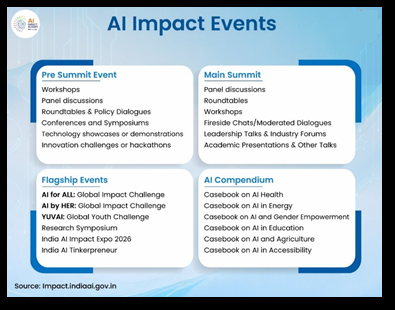
The objectives of the India–AI Impact Summit 2026 are operationalised through a series of AI Impact Events, designed to translate vision into action. These events provide structured platforms to showcase Indian AI initiatives, sectoral use cases, and institutional frameworks, while facilitating peer learning, international benchmarking, and policy feedback. Together, they ensure that the Summit delivers tangible outcomes beyond dialogue.
Pre-Summit Engagements
Pre-Summit Events
As part of the preparatory process, Pre-Summit Events have been organised in India and abroad to enable early consultations and focused thematic discussions. These engagements bring together governments, academia, research institutions, industry, startups, and civil society, fostering convergence on priorities and expectations ahead of the Summit.
Regional AI Conferences
To align national AI priorities with regional realities, eight Regional AI Conferences are being held between October 2025 and January 2026 across Meghalaya, Gujarat, Odisha, Madhya Pradesh, Uttar Pradesh, Rajasthan, Kerala, and Telangana, in partnership with respective state governments.
These conferences identify region-specific AI use cases, policy inputs, and capacity gaps, ensuring that the Summit agenda reflects India’s diverse developmental needs. Insights from these deliberations will directly inform the outcomes of the India–AI Impact Summit 2026.
Flagship AI Impact Initiatives
The India–AI Impact Summit 2026 is supported by a set of core government institutions responsible for policy formulation, programme implementation, ecosystem development, and digital infrastructure creation. Their involvement provides administrative leadership, technical expertise, and institutional continuity, ensuring that the Summit is firmly anchored in existing national initiatives and capable of translating deliberations into actionable and scalable outcomes.
Ministry of Electronics and Information Technology (MeitY)
The Ministry of Electronics and Information Technology (MeitY) provides overall policy direction for artificial intelligence and digital technologies in India. MeitY anchors the Summit within national priorities related to AI, electronics manufacturing, digital governance, and trusted technology adoption. Its leadership ensures inter-ministerial coordination, alignment with state governments, and seamless integration of Summit outcomes with ongoing national programmes, regulatory frameworks, and digital public infrastructure initiatives.
IndiaAI Mission
The IndiaAI Mission is the flagship national mission driving AI development in India. It shapes the core themes of the Summit, including AI compute infrastructure, high-quality datasets, indigenous AI models, skilling and reskilling, and startup and innovation support. Through the Mission, the Summit highlights the Government of India’s commitment to promoting safe, responsible, inclusive, and development-oriented AI, while strengthening domestic capabilities across the AI value chain.
Software Technology Parks of India (STPI)
The Software Technology Parks of India (STPI) plays a critical role in enabling the participation of startups, MSMEs, and innovators in the Summit. STPI provides incubation support, technical infrastructure, mentorship, and industry linkages, leveraging its extensive nationwide network of centres. Its involvement ensures wider regional representation, supports the scaling of AI-driven enterprises, and connects Indian innovators with global markets, investors, and export opportunities, thereby strengthening India’s position in the global digital economy.
Digital India Initiative
The Digital India Initiative provides the foundational framework for large-scale AI adoption in the country. Its emphasis on digital public platforms, inclusion, transparency, and citizen-centric governance is reflected across the Summit’s themes and deliberations. Digital India ensures that AI solutions showcased and discussed at the Summit align with national objectives of accessible service delivery, public trust, data-driven governance, and technology-enabled inclusion at scale.
Expected Outcomes of the Summit
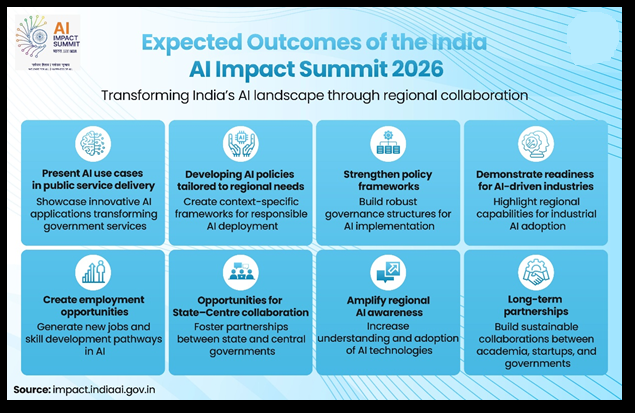
The India–AI Impact Summit 2026 is expected to deliver focused, outcome-driven results aligned with India’s development priorities. The Summit will emphasise practical AI deployment, policy coherence, and institutional coordination to support effective implementation across government and industry. Key outcomes include strengthening AI governance and regulatory frameworks, assessing regional preparedness for AI-led industrial and economic growth, and promoting skill development and workforce transition for the AI-enabled economy. The Summit will also enhance awareness and understanding of AI applications, while fostering sustained partnerships among government, academia, startups, industry, and international stakeholders to enable responsible, inclusive, and scalable growth of the AI ecosystem.
Conclusion
The India–AI Impact Summit 2026 positions Artificial Intelligence as a strategic enabler of India’s development journey. By consolidating learnings from national, regional, and global engagements, the Summit identifies practical pathways for deploying AI across governance, public service delivery, research, and industry. It advances the objectives of Digital India by strengthening the role of AI in digital public infrastructure, platform-based service delivery, and data-driven decision-making across sectors. Simultaneously, the Summit reinforces India’s pursuit of technological self-reliance by emphasising domestic capabilities in compute infrastructure, datasets, talent development, and indigenous innovation—aligning AI-led growth with the vision of a digitally empowered, inclusive, and resilient India.
Best ias coaching in delhi Best ias coaching in chandigarh
Prelims question:
Q. With reference to the India–AI Impact Summit 2026, consider the following statements:
1. It is the first global Artificial Intelligence summit to be hosted in the Global South.
2. The Summit is anchored on three foundational principles referred to as ‘Sutras’ and structured around seven thematic ‘Chakras’.
3. The IndiaAI Mission focuses exclusively on private sector–led AI innovation without government involvement.
4. One of the objectives of the Summit is to promote responsible, inclusive, and development-oriented deployment of AI.
Which of the statements given above are correct?
(a) 1, 2 and 4 only
(b) 1 and 3 only
(c) 2 and 4 only
(d) 1, 2, 3 and 4
Answer: A
Q. Artificial Intelligence is increasingly shaping India’s development strategy in governance, economy, and public service delivery. In this context, examine the significance of the India–AI Impact Summit 2026 and evaluate how its ‘Three Sutras’ and ‘Seven Chakras’ framework can contribute to inclusive and sustainable development.
(250 words)

- Europe’s AI Rules May Become India’s Opportunity - August 14, 2026
- Transparency as the Foundation of Trust in Medicine - August 14, 2026
- A Timely Reset for the Food Security Act: From Foodgrain Security to Nutrition Security - August 13, 2026

No Comments