


22 Jan Groundwater Governance in India: From Over-Exploitation to Sustainable Water Security
This article covers “Daily Current Affairs” and From Groundwater Governance in India: From Over-Exploitation to Sustainable Water Security
SYLLABUS MAPPING
GS- 3- Environment & Ecology- Groundwater Governance in India: From Over-Exploitation to Sustainable Water Security
FOR PRELIMS
What is groundwater?
FOR MAINS
What are the key priorities for effective groundwater management as suggested by UNESCO?
Why in the News?
Groundwater constitutes nearly 99% of the Earth’s liquid freshwater and provides immense social, economic, and environmental benefits, particularly in enhancing climate resilience. In India, groundwater forms the backbone of agriculture and drinking water security, meeting nearly 62% of irrigation requirements, 85% of rural drinking water needs, and about 50% of urban demand. However, rapid population growth, intensification of agriculture, industrial expansion, and accelerating urbanisation have exerted unprecedented pressure on groundwater systems.
Understanding Groundwater Systems
Groundwater refers to freshwater that percolates through soil and rock layers and is stored underground before emerging naturally or being extracted for human use. It plays a vital role in maintaining base flow in rivers and streams and sustaining wetland ecosystems.
The underground geological formations capable of storing and transmitting groundwater in usable quantities are known as aquifers. Water from aquifers may discharge naturally through springs or be extracted using dug wells, tube wells, and borewells, making aquifer health central to water security.
Groundwater Management: Elements and Priorities
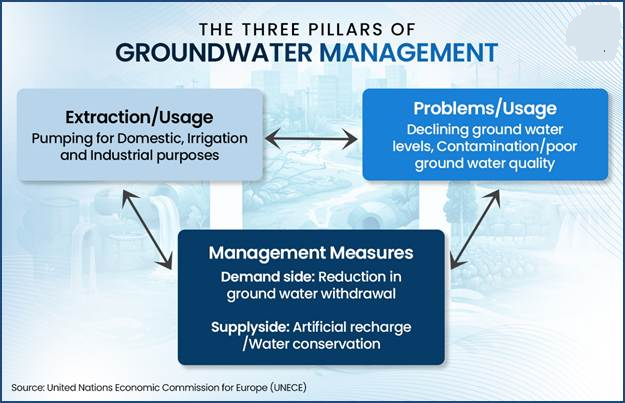
Groundwater management is an integral component of Integrated Water Resources Management (IWRM). It focuses on:
Understanding the functions and uses of aquifers
Identifying pressures and threats such as over-extraction and contamination
Assessing the impact of management interventions on sustainability
According to UNESCO, effective groundwater management rests on four key priorities:
1. Sound scientific knowledge of aquifers
2. Strong governance and regulatory frameworks
3. Stakeholder participation and community involvement
4. Sustainable abstraction and recharge practices
Why Groundwater Management is Necessary in India
India possesses extensive groundwater reserves, but their availability and quality vary widely across regions. In recent decades, these reserves have faced severe stress due to multiple factors:
1. Rising Pressure on Groundwater Systems: Largely unregulated extraction has led to alarming declines in water tables across many regions, especially in north-western and peninsular India.
2. Degradation of Groundwater Quality: Groundwater contamination from industrial effluents, mining activities, excessive fertiliser use, and naturally occurring arsenic and fluoride has emerged as a major public health and environmental concern.
3. Drivers of Uncontrolled Abstraction: Affordable drilling technologies and pumping equipment have enabled widespread construction of private tube wells, even among small farmers, leading to tragedy-of-the-commons type exploitation.
Recognising these challenges, effective groundwater management has become central to India’s commitments under COP-21, climate resilience strategies, and the achievement of Sustainable Development Goals (SDGs)—particularly SDG 6 (Clean Water and Sanitation), SDG 11 (Sustainable Cities), and SDG 12 (Responsible Consumption).
Government Initiatives Strengthening Groundwater Management
To address the escalating groundwater crisis, the Government of India has adopted a multi-pronged strategy combining regulation, scientific assessment, recharge, monitoring, and community participation.
Model Groundwater (Regulation and Control of Development and Management) Bill
To curb indiscriminate extraction and promote sustainable practices such as rainwater harvesting and artificial recharge, the Central Government prepared a Model Groundwater Bill.
The Bill has been adopted by 21 States and Union Territories, including Bihar, Punjab, Haryana, and Himachal Pradesh.
The Centre promotes adoption through State Water Ministers’ conferences, technical workshops, and deliberations under the National Interdepartmental Steering Committee (NISC) on Groundwater.
Jal Shakti Abhiyan: Catch the Rain (JSA: CTR)
Launched on World Water Day (22 March 2021), this nationwide campaign aims to transform water conservation into a people’s movement.
Its five key interventions include:
1. Water conservation and rainwater harvesting
2. Geo-tagging and inventory of water bodies
3. Establishment of Jal Shakti Kendras in all districts
4. Afforestation
5. Awareness generation
Jal Sanchay Jan Bhagidari (JSJB)
Launched in September 2024, JSJB operates under JSA: CTR and promotes community-led groundwater recharge through:
1. Rainwater harvesting
2. Recharge shafts
3. Borewell recharge
4. Aquifer recharge
As of 22 January 2026, over 39.6 lakh artificial recharge and storage works have been completed under JSJB 1.0 and 2.0.
National Aquifer Mapping and Management Programme (NAQUIM)
Implemented by the Central Ground Water Board (CGWB), NAQUIM aims to:
1. Characterise aquifers
2. Assess groundwater availability and quality
3. Prepare detailed aquifer maps
4. Develop area-specific management strategies
NAQUIM 2.0 (2023–present) enhances data granularity up to the Panchayat level, focusing on water-stressed, coastal, urban, industrial, mining, and poor-quality groundwater regions.
Master Plan for Artificial Recharge to Groundwater – 2020
| Scheme / Plan | Launch Year | Primary Focus | Key Features / Interventions | Scale / Financial Outlay | Expected / Observed Impact |
|---|---|---|---|---|---|
| Master Plan for Artificial Recharge to Groundwater | 2020 | Augmenting groundwater through region-specific recharge methods | • Surface spreading & subsurface recharge in rural areas • Rooftop rainwater harvesting in urban & hilly regions • Terrain-specific recharge techniques |
• 1.42 crore recharge structures proposed • Recharge potential of ~185 BCM |
• Large-scale enhancement of groundwater availability • Climate-resilient water management |
| Atal Bhujal Yojana (Atal Jal) | December 2019 | Community-led groundwater management in water-stressed areas | • Scientific aquifer-based planning • Institutional strengthening • Incentive-based performance outcomes • Promotion of sustainable agriculture |
• ₹6,000 crore outlay • Implemented in 7 water-stressed states |
• Reduced rate of groundwater decline • Improved water-use efficiency • Behavioural change at community level |
| Mission Amrit Sarovar | April 2022 | Creation & rejuvenation of water bodies | • Construction/revival of ponds (Amrit Sarovars) in every district • Convergence with MGNREGS & other schemes |
• Each pond ≥ 1 acre • Storage capacity ≥ 10,000 m³ |
• Enhanced surface water storage • Improved groundwater recharge • Local water security |
Conclusion
Groundwater is indispensable to India’s water security, food security, public health, and ecosystem stability. However, increasing pressures from over-extraction, contamination, and climate variability have made sustainable management unavoidable. Through a comprehensive and multi-layered approach—combining regulatory reforms, scientific assessment, infrastructure development, and community participation—India is transitioning towards participatory, evidence-based, and outcome-oriented groundwater governance. Initiatives led by the Ministry of Jal Shakti signal a decisive shift from exploitation to sustainability, laying a durable foundation for long-term resilience, inclusive growth, and national development goals.
Best ias coaching in delhi Best ias coaching in chandigarh
Prelims question:
Q. With reference to groundwater management in India, consider the following statements:
1. Groundwater contributes more than half of India’s irrigation requirements and drinking water supply.
2. Aquifers are underground geological formations that can store and transmit groundwater.
3. The National Aquifer Mapping and Management Programme (NAQUIM) is implemented by the Ministry of Environment, Forest and Climate Change.
Which of the statements given above is/are correct?
(a) 1 and 2 only
(b) 2 and 3 only
(c) 1 and 3 only
(d) 1, 2 and 3
Answer: A
Q. Groundwater has emerged as the backbone of India’s water security, yet it faces severe stress due to over-extraction and quality degradation. Discuss the need for sustainable groundwater management in India and evaluate the role of government initiatives in this regard.
(250 words)

- Europe’s AI Rules May Become India’s Opportunity - August 14, 2026
- Transparency as the Foundation of Trust in Medicine - August 14, 2026
- A Timely Reset for the Food Security Act: From Foodgrain Security to Nutrition Security - August 13, 2026

No Comments