


28 Jan International Data Privacy Day: Safeguarding Trust in India’s Population-Scale Digital Governance
This article covers “Daily Current Affairs” and From International Data Privacy Day: Safeguarding Trust in India’s Population-Scale Digital Governance
SYLLABUS MAPPING
GS- 3- Science & Technology / Internal Security- International Data Privacy Day: Safeguarding Trust in India’s Population-Scale Digital Governance
FOR PRELIMS
What rights are provided to citizens under India’s data protection framework?
FOR MAINS
What challenges does India face in ensuring data privacy at population scale?
Why in the News?
International Data Privacy Day, observed annually on 28 January, underscores the global importance of protecting personal data and privacy in an increasingly digital world. Also known as Data Protection Day, it commemorates the signing of Convention 108 in 1981 by the Council of Europe—the world’s first legally binding international treaty on data protection. In the digital age, where data has emerged as a critical economic and governance resource, privacy is no longer a peripheral concern but a foundational pillar of democratic and responsible digital governance.

India’s Expanding Digital Footprint and the Privacy Imperative
India’s rapid digitalisation has fundamentally transformed interactions between citizens and the State. Digital platforms today underpin service delivery, financial inclusion, healthcare access, participatory governance, and economic transactions at population scale. This transformation has generated immense efficiency and accessibility, but it has also amplified the privacy and cybersecurity imperative.
Scale and Reach of Digital Public Infrastructure (DPI)
1. UPI has revolutionised real-time digital payments, becoming a global benchmark for interoperable fintech systems.
2. Paperless governance platforms have streamlined public service delivery.
3. MyGov, with over 6 crore users, has strengthened participatory governance.
4. eSanjeevani has enabled more than 44 crore telemedicine consultations, expanding access to healthcare.
Digital Inclusion at Population Scale
1. India is now the world’s third-largest digitalised economy, supported by:
2. 101.7 crore broadband subscribers (as of September 2025),
3. An average of 1,000 minutes spent online per user, and
4. One of the world’s lowest data costs at $0.10 per GB (2025)
Strengthening Privacy and Cybersecurity
The scale that enables inclusion also increases vulnerability to data misuse, cyber fraud, and privacy breaches. Recognising this, the Government has significantly strengthened India’s cybersecurity and data protection ecosystem, including an allocation of ₹782 crore in the Union Budget 2025–26 for cybersecurity initiatives aimed at safeguarding digital public infrastructure. Observing International Data Privacy Day reinforces India’s commitment to privacy by design, institutional accountability, and public awareness, ensuring that digital growth remains secure and sustainable.
National Data Privacy and Security Readiness
Information Technology Act, 2000
The IT Act, 2000 remains the cornerstone of India’s cyber legal framework. It provides legal recognition to electronic records and digital signatures, enabling e-governance and digital commerce. The Act also establishes key cybersecurity institutions such as CERT-In, and empowers the State through provisions related to authentication, adjudication, content blocking, and cyber incident management (Sections 3, 3A, 6, 46, 69A, and 70B).
IT (Intermediary Guidelines and Digital Media Ethics Code) Rules, 2021
These Rules mandate due diligence, grievance redressal, and accountability for intermediaries such as social media platforms, search engines, online marketplaces, and internet service providers, thereby fostering a safer and more transparent online ecosystem.
Digital Personal Data Protection (DPDP) Framework
DPDP Act, 2023
Enacted in August 2023, the DPDP Act governs the processing of personal data collected digitally or digitised from offline sources. It adopts a SARAL approach—Simple, Accessible, Rational, and Actionable—to ensure ease of compliance while protecting individual privacy. A key institutional feature is the Data Protection Board of India, responsible for enforcement, inquiry into data breaches, and ensuring corrective action. At its core, the Act places citizens at the centre by recognising them as Data Principals, empowered with clearly defined rights and protections.
Rights of Citizens under the DPDP Act
1. Right to give or refuse consent
2. Right to know how data is collected and used
3. Right to access, correct, update, and erase personal data
4. Right to nominate a representative
5. Mandatory redressal within 90 days
6. Timely intimation during data breaches
7. Special protections for children and persons with disabilities
DPDP Rules, 2025
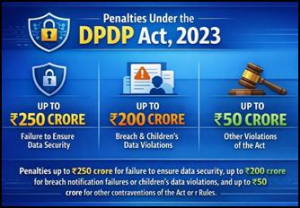
Notified in November 2025, the DPDP Rules, 2025 operationalise the Act by strengthening enforcement mechanisms, enhancing organisational accountability, and curbing misuse of personal data. Together, the Act and Rules provide regulatory clarity, balancing privacy protection with innovation and economic growth.
Additional National Measures for Data Security
1. CERT-In for proactive cybersecurity incident response
2. Indian Cyber Crime Coordination Centre (I4C) for national coordination against cybercrime
3. National Cyber Crime Reporting Portal (NCRP) and Helpline 1930 for citizen-centric reporting
4. Cyber Fraud Mitigation Centre (CFMC) for real-time inter-agency response
5. Platforms like Sahyog, Suspect Registry, and indigenous cybersecurity tools by C-DAC
6. National Cyber Forensic Laboratories for investigation and prosecution support
7. Capacity-building initiatives such as CyTrain, Cyber Commando Programme, ISEA, and CSPAI
8. Cyber Swachhta Kendra for citizen awareness and malware mitigation
Conclusion
International Data Privacy Day highlights a fundamental truth: trust is the cornerstone of digital governance. As India’s digital public infrastructure continues to shape governance, service delivery, and everyday life, protecting personal data is not merely a technical necessity but a democratic imperative. Through the DPDP framework, strengthened cybersecurity institutions, sustained budgetary support, and citizen-centric initiatives, India is steadily building a secure, ethical, and future-ready digital ecosystem. Observing Data Privacy Day reinforces the shared responsibility of the Government, digital platforms, and citizens in safeguarding digital rights and ensuring that India’s digital transformation remains inclusive, resilient, and citizen centric.
Best ias coaching in delhi Best ias coaching in chandigarh
Prelims question:
Q. With reference to data protection and cybersecurity in India, consider the following statements:
1. The Digital Personal Data Protection Act, 2023 applies only to data collected through online platforms.
2. The Data Protection Board of India is responsible for enforcement and inquiry into personal data breaches.
3. CERT-In is the national nodal agency for responding to cybersecurity incidents under the IT Act, 2000.
4. The DPDP Rules, 2025 aim to balance personal data protection with innovation and ease of compliance.
Which of the statements given above are correct?
(a) 2, 3 and 4 only
(b) 1, 2 and 3 only
(c) 2 and 3 only
(d) 1, 3 and 4 only
Answer: A
Q. Data privacy has emerged as a democratic imperative in India’s population-scale digital governance.” Discuss in the context of India’s expanding digital public infrastructure and the Digital Personal Data Protection framework.
(250 words)

- RBI’s Shrinking Real-Rate Cushion Amid Rising Inflation and Strong Demand - September 21, 2026
- India’s NGOs at a New Funding Crossroads - September 21, 2026
- Deep-Sea Discovery, Environmental Responsibility - September 19, 2026

No Comments