


31 Jan Balanced Fertilization: The Cornerstone of Sustainable Agricultural Growth in India
This article covers “Daily Current Affairs” and From Balanced Fertilization: The Cornerstone of Sustainable Agricultural Growth in India
SYLLABUS MAPPING
GS-3- Agriculture- Balanced Fertilization: The Cornerstone of Sustainable Agricultural Growth in India
FOR PRELIMS
What is balanced fertilization?
FOR MAINS
Why is the shift from NPK-centric fertilization to holistic nutrient management necessary in India?
Why in the News?
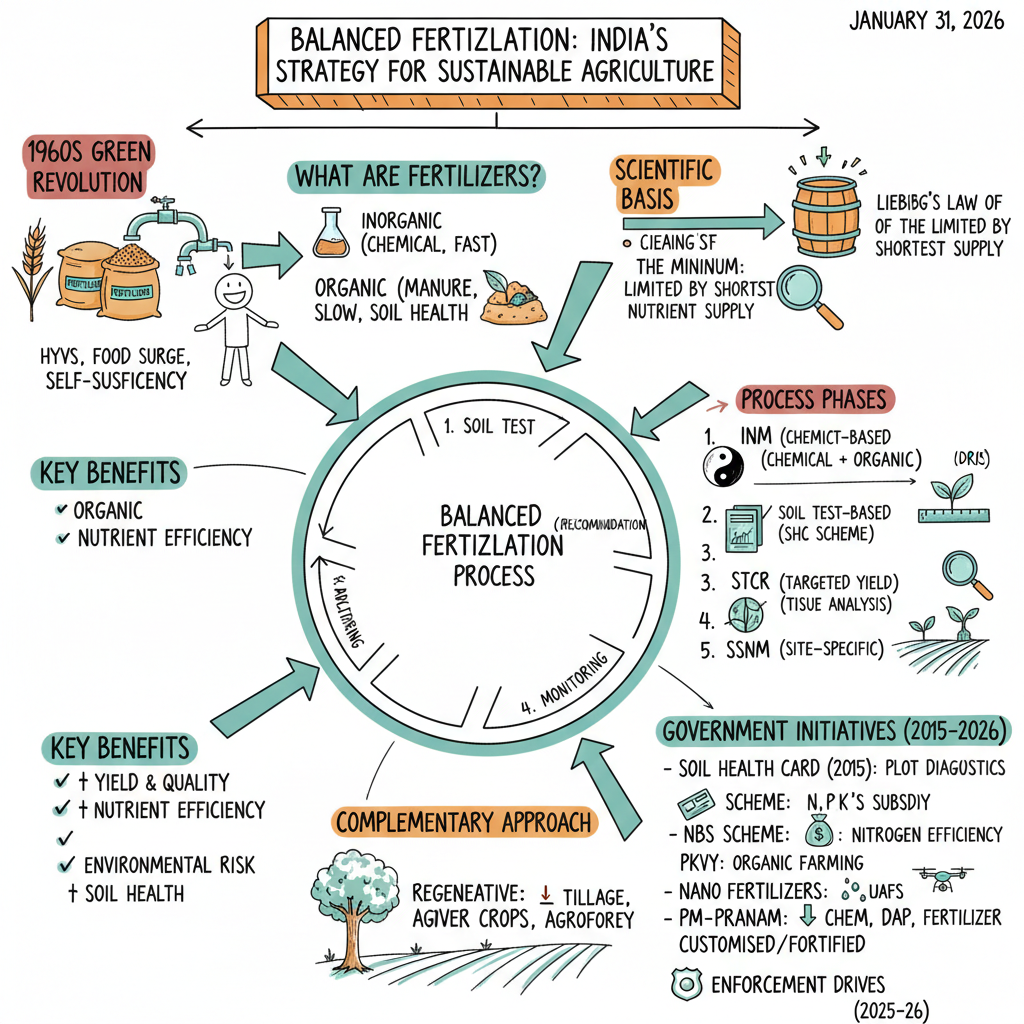
The Green Revolution marked a transformative phase in India’s agricultural history. The introduction of fertilizer-responsive high-yielding varieties (HYVs) of rice and wheat in the mid-1960s, supported by irrigation expansion and chemical fertilizers, enabled India to overcome chronic food shortages and achieve self-sufficiency. Foodgrain production surged, hunger declined, and rural livelihoods improved, positioning India as a global model for agricultural transformation.
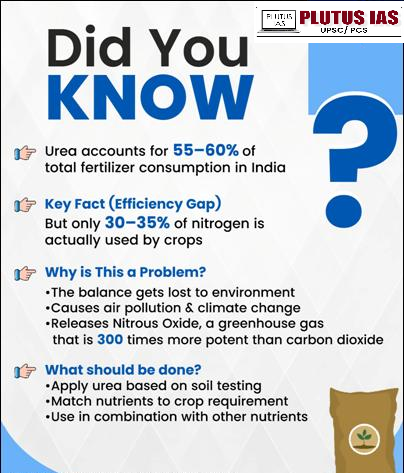
Understanding Fertilizers
Fertilizers are substances of natural or synthetic origin added to soil to supply essential plant nutrients. They are broadly classified into:
Inorganic fertilizers: Manufactured chemical compounds supplying nutrients in concentrated, readily available forms, allowing precise nutrient management.
Organic fertilizers: Derived from natural sources such as compost, farmyard manure, crop residues, seaweed, and animal by-products. They release nutrients gradually while improving soil structure, organic carbon, and biological activity.
Balanced Fertilization: Concept and Scientific Basis
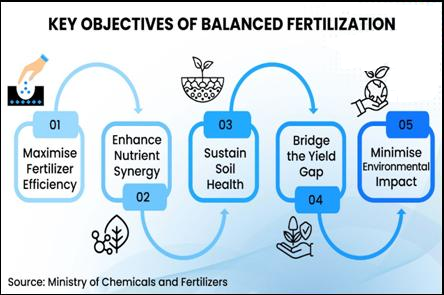
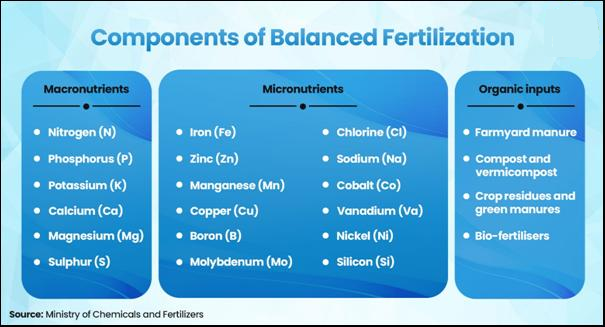
Balanced fertilization refers to the application of all essential plant nutrients—macronutrients and micronutrients—in appropriate proportions, quantities, timing, and methods, based on soil fertility, crop requirements, and climatic conditions. It goes beyond the conventional NPK-centric approach and adopts a holistic nutrient management framework. The scientific foundation of balanced fertilization lies in Justus von Liebig’s Law of the Minimum, which states that crop growth is limited by the nutrient in shortest supply, regardless of the abundance of others. Excessive application of a single nutrient, therefore, cannot compensate for deficiencies in others.
Benefits of Balanced Fertilization
1. Higher crop productivity through optimal nutrient availability
2. Improved performance of HYVs, maximising genetic potential
3. Enhanced nutrient-use efficiency, reducing wastage
4. Better crop quality and stress resistance
5. Improved soil health, including microbial activity and water-holding capacity
6. Reduced environmental risks such as leaching and water pollution
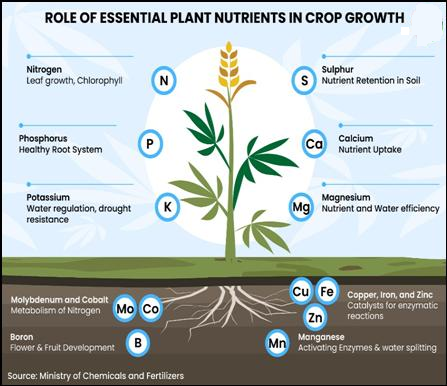
Process of Balanced Fertilization: From Soil to Solution
1. Integrated Nutrient Management (INM): INM combines chemical fertilizers, organic manures, and biological inputs to ensure efficient and sustainable nutrient use. It recognises that neither chemical nor organic inputs alone can meet crop nutrient demands.
2. Soil Test-Based Recommendations: Soil testing forms the backbone of balanced fertilization. Based on nutrient status (low, medium, high), fertilizer doses are adjusted accordingly. The Soil Health Card (SHC) Scheme operationalises this approach nationwide.
3. Soil Test Crop Response (STCR): STCR links fertilizer application to targeted yields by factoring in soil fertility, crop type, and climate, preventing over- or under-application.
4. Diagnosis and Recommendation Integrated System (DRIS): DRIS assesses nutrient balance using plant tissue analysis and nutrient ratios, enabling corrective measures during crop growth.
5. Site-Specific Nutrient Management (SSNM): SSNM tailors fertilizer application to field-level variability, applying nutrients only where deficits exist, thereby improving efficiency and reducing losses.
Regenerative Agriculture: A Complementary Approach
Regenerative agriculture strengthens balanced fertilization by restoring soil health through reduced tillage, crop rotation, cover cropping, mulching, and agroforestry. These practices enhance organic matter, improve nutrient retention, and reduce dependency on repeated fertilizer application. In India, regenerative approaches such as micro-irrigation, natural farming, and climate-resilient agriculture are gaining traction.

Government Initiatives Promoting Balanced Fertilization
1. Soil Health Card Scheme: Launched in 2015, SHCs provide plot-wise soil diagnostics covering macronutrients, micronutrients, and soil properties. Over 25.5 crore cards have been distributed, enabling informed fertilizer use.
2. Nutrient-Based Subsidy (NBS) Scheme: The NBS scheme promotes balanced use of N, P, K, and sulphur by linking subsidies to nutrient content. Between 2022–23 and 2024–25, over ₹2.04 lakh crore was allocated under the scheme.
3. Neem-Coated Urea: Mandatory neem coating improves nitrogen-use efficiency, reduces overuse, and lowers environmental losses.
4. Paramparagat Krishi Vikas Yojana (PKVY): PKVY supports organic farming and sustainable nutrient practices, covering 16.9 lakh hectares as of October 2025.
5. PM-PRANAM: This scheme incentivises States to reduce chemical fertilizer use, promoting eco-friendly alternatives. In FY 2023–24, 14 States reduced fertilizer consumption by 15.14 lakh MT.
6. Promotion of Nano Fertilizers: Nano urea and nano DAP enhance nutrient absorption efficiency. Government initiatives include field demonstrations, PMKSK availability, drone-based spraying, and industry scale-up.
7. Customised and Fortified Fertilizers: Subsidised fertilizers fortified with micronutrients such as zinc and boron are promoted under the NBS policy to address region-specific deficiencies.
Enforcement and Supply Chain Integrity
To prevent diversion and misuse, the Department of Fertilizers conducted extensive enforcement drives during Kharif and Rabi 2025–26, issuing over 14,000 notices, suspending licenses, and registering FIRs. These measures ensure timely availability and protect farmer interests.
Conclusion
Balanced fertilization has emerged as a strategic imperative for sustaining India’s agricultural productivity while addressing soil degradation, nutrient imbalance, and environmental stress. Through science-based interventions, farmer-centric schemes, and regulatory oversight, India is transitioning from input-intensive to efficiency-oriented nutrient management. Initiatives such as Soil Health Cards, Nutrient-Based Subsidy, INM, nano fertilizers, and PM-PRANAM collectively underscore the Government’s commitment to restoring soil health, optimising input use, and enhancing long-term agricultural resilience. Balanced fertilization thus forms the foundation of a productive, sustainable, and environmentally responsible agricultural future for India.
Best ias coaching in delhi Best ias coaching in chandigar
Prelims question:
Q. With reference to balanced fertilization in Indian agriculture, consider the following statements:
1. Balanced fertilization involves the application of only N, P and K fertilizers in fixed proportions.
2. Liebig’s Law of the Minimum provides the scientific basis for balanced fertilization.
3. Soil Health Card Scheme aims to promote soil test–based fertilizer application.
4. Neem-coated urea improves nitrogen-use efficiency and reduces fertilizer diversion.
Which of the statements given above are correct?
(a) 2, 3 and 4 only
(b) 1, 2 and 3 only
(c) 2 and 4 only
(d) 1, 3 and 4 only
Answer: A
Q. Balanced fertilization is critical for sustaining agricultural productivity while addressing soil degradation and environmental stress in India. Discuss the concept, benefits, and government initiatives promoting balanced fertilization in India. (250 words)

- Europe’s AI Rules May Become India’s Opportunity - August 14, 2026
- Transparency as the Foundation of Trust in Medicine - August 14, 2026
- A Timely Reset for the Food Security Act: From Foodgrain Security to Nutrition Security - August 13, 2026

No Comments