


10 Feb India–US Trade Deal and the Indian Rupee: Navigating Currency Dynamics Amid Global Uncertainty
This article covers “Daily Current Affairs” and the topic India–US Trade Deal and the Indian Rupee: Navigating Currency Dynamics Amid Global Uncertainty
SYLLABUS MAPPING:
GS- 2- International Relations- India–US Trade Deal and the Indian Rupee: Navigating Currency Dynamics Amid Global Uncertainty
FOR PRELIMS
Why did the Indian Rupee strengthen after the India–US trade deal?
FOR MAINS
What is the impact of trade agreements on the Indian economy?
Why in the News?
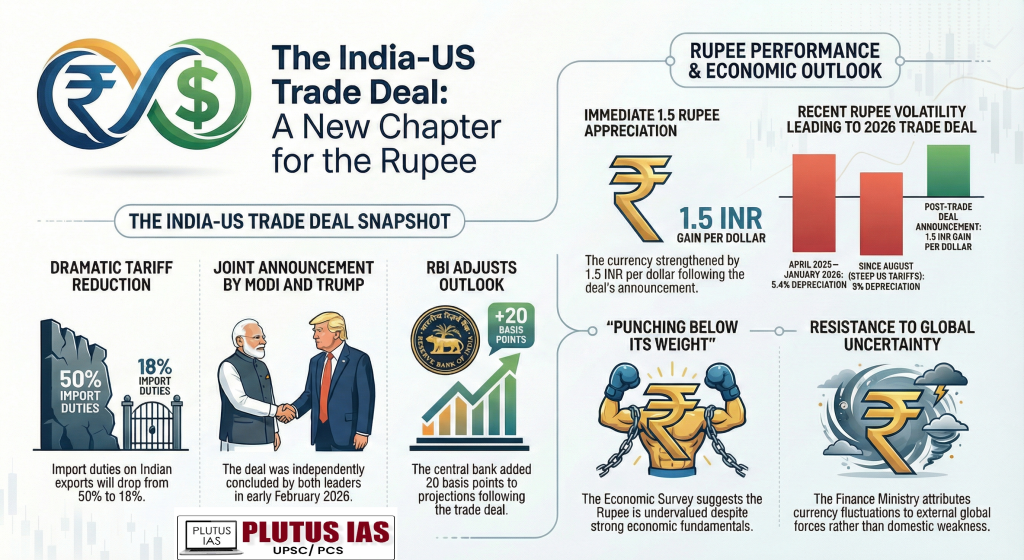
The global economic landscape witnessed a significant shift with the independent announcements by Prime Minister Narendra Modi and US President Donald Trump regarding the conclusion of a landmark India-US trade deal. Following this announcement, Reserve Bank of India (RBI) Governor Sanjay Malhotra observed that the Indian currency appreciated by approximately 1.5 Rupees per dollar, highlighting the immediate market sensitivity to bilateral trade breakthroughs. The Governor further emphasized that while the deal is a positive catalyst, the precise long-term impact on the Rupee will be dictated by the “specific details of the pact”.
Defining the Concept: Currency Dynamics in Trade
In macroeconomics, the exchange rate of the Indian Rupee (INR) against the US Dollar (USD) is not merely a number but a reflection of India’s trade competitiveness, capital flows, and economic health. This trade-currency nexus is defined by how changes in trade barriers—such as tariffs—alter the demand for domestic currency. A trade deal that lowers tariffs essentially reduces the cost of Indian goods in the US, potentially increasing export volumes and, consequently, the demand for the Rupee. Currently, the discourse centers on “managed volatility,” where the RBI intervenes to prevent erratic swings while allowing market forces to determine the currency’s fundamental value.
Significance / Importance
• Drastic Tariff Rationalization: The deal facilitates a massive reduction in tariffs on Indian exports, bringing them down to 18% from a staggering 50% (which included a 25% punitive levy previously imposed).
• Export Competitiveness: Lower tariffs act as a direct stimulus for merchandise exports, which Governor Malhotra identifies as a key driver to “sustain growth momentum”.
• Sentiment and Speculation Control: The announcement has already led to a reduction in intraday short bets, as traders recalibrate their positions in favor of a stronger Rupee supported by expected trade inflows.
• Macroeconomic Signaling: The RBI’s proactive addition of 20 basis points to certain metrics following the deal signals institutional confidence in the deal’s ability to bolster India’s external account.
Key Issues / Challenges
• Persistent Depreciation: Between April 1, 2025, and mid-January 2026, the Rupee depreciated by approximately 5.4% against the US Dollar.
• The “External Forces” Factor: Finance Minister Nirmala Sitharaman has pointed out that while domestic “fundamentals are fine,” the Rupee is being disproportionately affected by “global uncertainty”.
• Corporate Dollar Demand: High and persistent demand for US Dollars from corporate India for imports and debt servicing continues to put downward pressure on the domestic currency.
• Tariff Sensitivity: The Rupee is highly sensitive to US trade policy; it fell nearly 5% specifically after the US imposed steep tariffs on Indian merchandise in August 2025.
Economic / Social / Environmental Impact
• Strategic Undervaluation: The latest Economic Survey notes that the Rupee is currently “punching below its weight”. While this suggests the currency doesn’t reflect India’s “stellar economic fundamentals,” an undervalued Rupee is currently serving as a strategic “offset” against remaining American tariffs.
• Inflationary Buffer: Usually, a weak Rupee leads to “imported inflation” (especially via oil). However, the sources indicate there is currently no threat of higher inflation from crude oil imports, providing the RBI more room to manage the currency without immediate price stability concerns.
• Growth Linkage: By boosting merchandise exports through the trade deal and Free Trade Agreements (FTAs), the economy can maintain its high-growth trajectory, which is essential for job creation and poverty reduction.
Governance and Institutional Aspects
• RBI’s Interventionist Philosophy: The RBI maintains that it does not target a specific level or band for the Rupee. Its mandate is strictly to “curb excessive volatility” to ensure market stability.
• Market Support Mechanisms: The Rupee’s recent stability near the Rs 91.97 mark has been largely supported by foreign banks’ dollar sales and the central bank’s tactical presence in the forex market.
• Fiscal-Monetary Coordination: The Finance Ministry’s focus on maintaining strong “fundamentals” (as noted in Budget 2026) provides the necessary backdrop for the RBI to manage external shocks effectively.
Ethical / Democratic Concerns
• Equitable Growth: A volatile currency can disproportionately hurt small-scale exporters and consumers if it leads to inflation.
• Transparency in Trade: The Governor’s remark that the impact “depends on the details” underscores the need for transparency in bilateral pacts to allow domestic industries to prepare for the transition.
Way Forward
1. Diversification of the Export Basket: Beyond simply benefiting from lower tariffs, India must use the 18% tariff window to move into high-value manufacturing and technology exports, ensuring that dollar inflows are diverse and resilient to sector-specific shocks.
2. Strengthening Hedging Mechanisms: To manage the “high corporate dollar demand,” the government and RBI should facilitate easier and more cost-effective currency hedging for Indian firms, reducing sudden spikes in dollar demand that destabilize the Rupee.
3. Active FTA Outreach: Following the India-US model, India should fast-track other Free Trade Agreements (FTAs). As Governor Malhotra noted, these are essential to “sustain growth momentum” and provide a buffer against the volatility of any single trading partner.
4. Calibrated Forex Intervention: The RBI should continue its policy of curbing “excessive volatility” while gradually allowing the Rupee to move toward its fair value as global uncertainties (like those cited by the Finance Minister) subside.
5. Leveraging the Energy Shield: Since stable crude oil prices are currently preventing “imported inflation,” India should accelerate its energy transition and strategic petroleum reserves to ensure this shield remains permanent, even if global oil prices rise in the future.
6. Enhancing “Viksit Bharat” Fundamentals: Focus must remain on the domestic fundamentals—fiscal discipline, infrastructure, and ease of doing business—so that the Rupee’s “stellar economic fundamentals” eventually outweigh external speculative forces.
Conclusion
The India-US trade deal marks a strategic victory in navigating an era of global protectionism. By reducing tariffs and boosting export prospects, the deal provides a vital anchor for the Indian Rupee in turbulent waters. While the currency may currently be “punching below its weight” due to external shocks, the path forward lies in utilizing this period of “strategic undervaluation” to build a robust, export-led economy.
Ultimately, a stable and resilient Rupee is fundamental to the vision of Viksit Bharat 2047. By aligning trade diplomacy with sound monetary governance and inclusive growth, India can ensure that its currency becomes a global symbol of its Atmanirbhar (self-reliant) and stellar economic strength. This transition will be pivotal in achieving sustainable development and maintaining India’s leadership in the democratic global order.
Q. With reference to the impact of trade agreements on currency valuation, consider the following statements:
1. Reduction in tariffs on exports can increase demand for the domestic currency by boosting export volumes.
2. A policy of “managed volatility” implies that the central bank targets a fixed exchange rate band.
3. An undervalued currency can sometimes act as a buffer against external trade shocks.
Which of the statements given above are correct?
(a) 1 and 2 only
(b) 1 and 3 only
(c) 2 and 3 only
(d) 1, 2 and 3
Answer: B
Mains Questions
Q. Discuss how trade liberalisation influences the valuation of the Indian Rupee. In this context, examine the role of the RBI in managing exchange rate volatility and suggest measures to ensure that the Rupee reflects India’s economic fundamentals.
(250 words, 15 marks)

- Europe’s AI Rules May Become India’s Opportunity - August 14, 2026
- Transparency as the Foundation of Trust in Medicine - August 14, 2026
- A Timely Reset for the Food Security Act: From Foodgrain Security to Nutrition Security - August 13, 2026

No Comments