


11 Feb SCALP Missile Deal: Strengthening India’s Stand-Off Strike Capability and Strategic Deterrence
This article covers “Daily Current Affairs” and the topic SCALP Missile Deal: Strengthening India’s Stand-Off Strike Capability and Strategic Deterrence
SYLLABUS MAPPING:
GS- 3- Science & Technology- SCALP Missile Deal: Strengthening India’s Stand-Off Strike Capability and Strategic Deterrence
FOR PRELIMS
What is a cruise missile? Explain with reference to SCALP.
FOR MAINS
What are the challenges associated with India’s dependence on imported defence technology?
Why in the News?
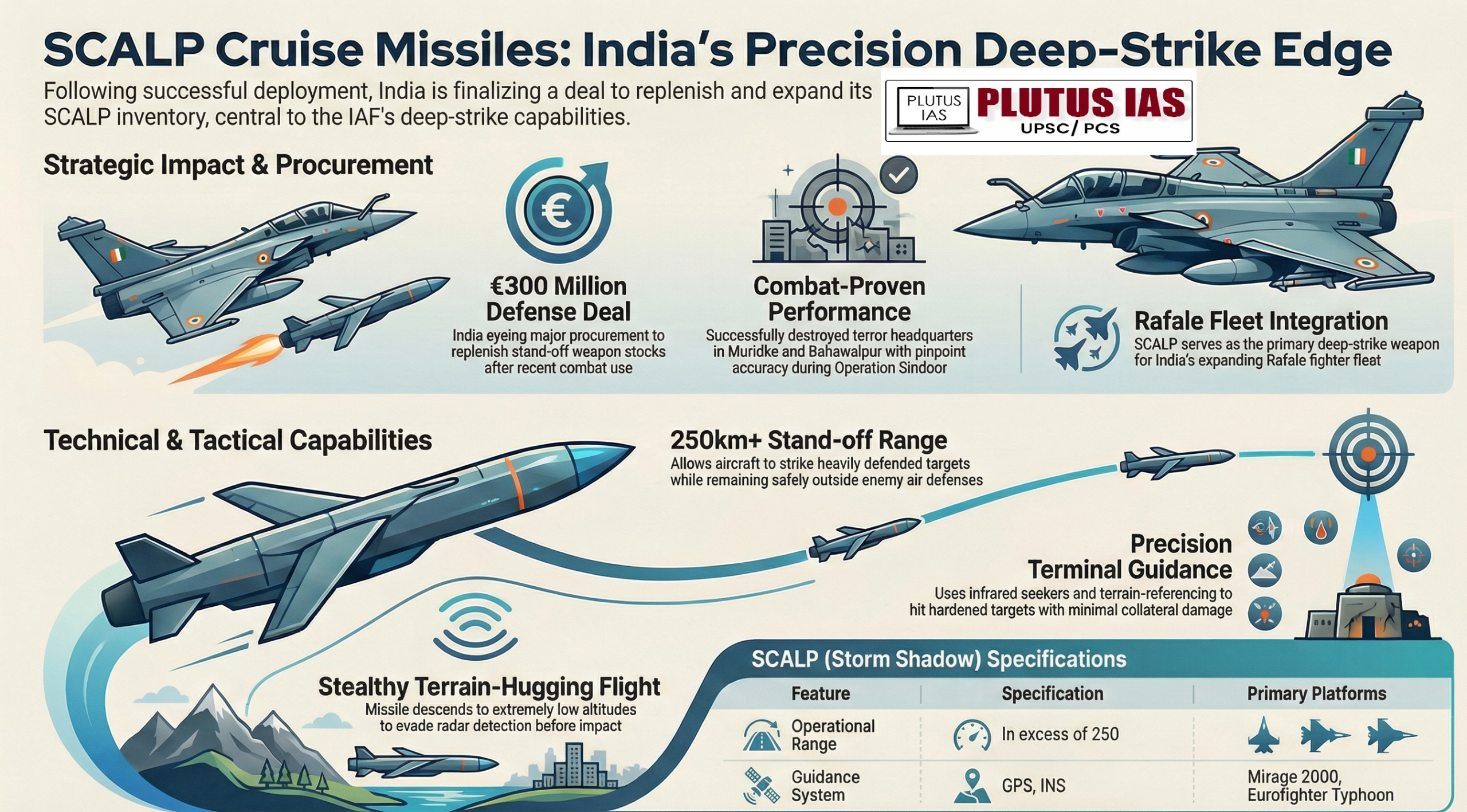
India is currently in advanced negotiations with France for a major defense deal estimated at €300 million (approximately ₹2,700 crore) to procure additional SCALP cruise missiles for the Indian Air Force (IAF). This procurement follows the successful combat validation of the weapon system during Operation Sindoor, where it was utilized to dismantle terror infrastructure across the border. For the UPSC Civil Services Examination, this topic is highly relevant under General Studies Paper III (Security Challenges and their Management; Science and Technology- Developments and their Applications) and General Studies Paper II (Bilateral Relations involving India and/or affecting India’s interests).
Definition and Conceptual Background
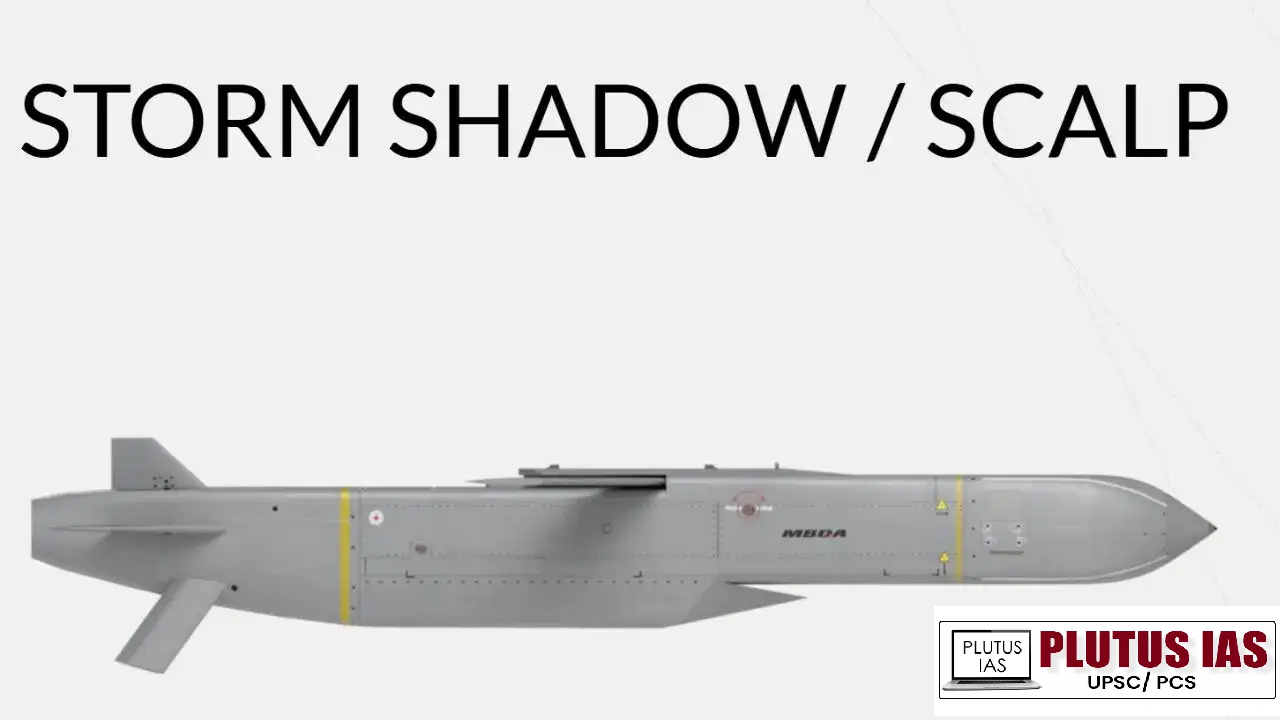
The SCALP (Système de Croisière Autonome à Longue Portée), also known as Storm Shadow in the United Kingdom, is an air-launched, long-range, conventionally armed cruise missile.
• Concept of Stand-off Weaponry: A “stand-off” weapon allows the launching platform (in this case, the Rafale fighter jet) to remain well outside the enemy’s air defense envelope—in excess of 250 kilometers—while delivering a high-precision strike.
• Cruise Missile Characteristics: Unlike ballistic missiles, cruise missiles like SCALP fly at low altitudes and are self-propelled throughout their flight, making them harder to detect by traditional radar.
Historical Background: Operation Sindoor and Combat Validation
• Counter-Terrorism Operations: The IAF deployed these missiles to destroy the headquarters of banned terror organizations, specifically Jaish-e-Mohammed and Lashkar-e-Toiba, in Pakistan’s Muridke and Bahawalpur regions.
• Expansion of Role: Following these initial strikes, the missiles were reportedly used to target Pakistan Air Force (PAF) bases, damaging runways, hangars, and high-value assets on the ground.
• A Shift in Strategy: This combat usage shifted the IAF’s assessment from viewing the SCALP as a mere “paper capability” to a core pillar of its future combat doctrine.
Key Features, Components, and Technical Data
• Navigation Suite: It utilizes a combination of Inertial Navigation Systems (INS), GPS, and terrain-referencing technology.
• Terminal Guidance: In its final phase, an onboard infrared seeker compares the physical target with pre-loaded reference imagery, ensuring a high-confidence hit with pinpoint accuracy.
• Layered Strike Capability: During operations, SCALPs were deployed alongside BrahMos supersonic cruise missiles, creating a “layered precision strike package” that effectively overwhelmed enemy defenses.
• Compatibility: While primarily integrated with the Rafale, it is also compatible with the Mirage 2000, Eurofighter Typhoon, and Tornado jets.
Significance for India
• Strategic & Military: It firmly establishes the Rafale as the central pillar of India’s air combat strength. With plans under consideration to induct 114 more Rafale aircraft, the Indian Air Force’s fleet strength could expand to around 200 jets, substantially boosting its deep-strike capability as well as its role in maintaining credible nuclear deterrence.
• Naval Dimension: The integration of similar advanced weaponry (like the Meteor missile) into the 26 Rafale Marine fighters ordered for the Indian Navy ensures a standardized and potent strike capability across the armed forces.
• Security Dimension: As threat perceptions rise along India’s western front, the ability to strike heavily defended targets without entering hostile airspace provides a vital security buffer.
Challenges, Criticism, and Limitations
1. High Fiscal Cost: The €300 million replenishment cost reflects the heavy financial burden of precision-guided munitions, straining the defence capital budget amid competing modernization priorities.
2. Technological Dependency: SCALP remains proprietary to MBDA (France/UK), limiting India’s access to source codes, upgrades, and critical subsystems — constraining strategic autonomy.
3. Limited Indigenous Value Addition: As a largely imported system, it offers minimal technology transfer (ToT), slowing domestic capability development in long-range cruise missile technology.
4. Supply Chain Vulnerability: In prolonged conflicts or geopolitical tensions, dependence on foreign OEMs may create logistical and replenishment uncertainties.
5. Escalation Risks: Deployment of advanced deep-strike capabilities may trigger counter-procurement by adversaries (e.g., enhanced air defense systems), intensifying the regional arms race.
6. Operational Integration Challenges: Integration with multiple platforms, maintenance infrastructure, and training requirements adds to lifecycle and operational complexity.
Constitutional, Legal, and Institutional Provisions
1. Union List (Seventh Schedule): Defence, armed forces, and war-related matters fall exclusively under the Union List, granting Parliament and the Central Government full authority over such procurements.
2. Executive Power under Article 73: The Union executive exercises power in defence and foreign affairs, enabling international defence agreements.
3. Defence Acquisition Council (DAC): The apex body chaired by the Defence Minister approves major capital acquisitions and ensures strategic alignment.
4. Defence Acquisition Procedure (DAP) 2020: Provides the regulatory framework for capital procurement, emphasizing transparency, indigenization, and “combat-proven” systems.
5. Parliamentary Oversight: The Standing Committee on Defence reviews procurement policies and expenditure to ensure accountability.
6. CAG Audit Mechanism: Defence deals remain subject to audit scrutiny, ensuring financial propriety and procedural compliance.
Government Initiatives and Policies
1. Atmanirbhar Bharat in Defence: While categorized as “Buy Global,” such procurements aim to bridge immediate capability gaps until indigenous systems mature.
2. Modernization of IAF Fleet: The proposed induction of 114 additional Rafales reflects a long-term vision for air superiority and deep-strike readiness.
3. Integrated Theatre Commands (ITCs): Standardized missile systems across services enhance interoperability and joint operational capability.
4. Defence Indigenisation Lists: Parallel policy efforts restrict import of certain defence items, encouraging domestic R&D and production.
5. Make in India & Strategic Partnerships Model: Encourages private sector participation in advanced defence manufacturing.
6. DRDO Indigenous Missile Programs: Continued development of systems like Nirbhay and BrahMos variants complements imported deep-strike platforms.
International Comparison and Global Perspective
1. NATO Deployment Standard: SCALP/Storm Shadow is widely used by France, UK, and Italy, establishing its credibility in NATO operations.
2. Combat-Proven Record: Successfully deployed in conflicts such as Iraq, Libya, and Syria, enhancing its global reputation.
3. Advanced Terminal Guidance: Infrared imaging seeker provides higher resistance to GPS jamming compared to GPS-dependent systems.
4. Comparison with Tomahawk: While Tomahawk is sea-launched and longer-ranged, SCALP offers superior air-launched precision in certain tactical scenarios.
5. Comparison with Kalibr: Russian Kalibr provides multi-platform launch capability, but SCALP’s stealth profile enhances survivability in contested airspace.
6. Global Trend toward Precision Warfare: Modern militaries increasingly rely on stand-off, low-collateral precision strikes, making systems like SCALP central to 21st-century warfare doctrine.
Way Forward
1. Indigenous Development: Parallel to this procurement, India must expedite the development of indigenous long-range cruise missiles by DRDO to reduce long-term dependency on foreign OEMs.
2. Strategic Autonomy: Future contracts should explore the possibility of domestic maintenance, repair, and overhaul (MRO) for these missiles to ensure operational readiness during prolonged conflicts.
3. Integration with AMCA: The lessons learned from SCALP integration on Rafales should be applied to India’s indigenous Advanced Medium Combat Aircraft (AMCA) project.
4. Diplomatic Balancing: Continued collaboration with France serves as a strategic counter-weight, ensuring a diversified supply chain for high-tech weaponry.
Conclusion
The proposed €300 million SCALP deal represents a transition from “capability acquisition” to “combat consolidation”. By investing in combat-proven technology, India is not only safeguarding its sovereign borders but also upholding the Constitutional value of national security as a foundation for peace. In the era of Amrit Kaal, as India marches toward becoming a Viksit Bharat by 2047, a potent and self-assured defense posture is essential. This procurement aligns with Sustainable Development Goal 16 (Peace, Justice, and Strong Institutions) by providing the state with the tools necessary to deter aggression and protect its citizens. Ultimately, the SCALP missile is a testament to India’s evolving “credible deterrence” posture, ensuring that the nation’s growth remains inclusive and undisturbed by external threats.
Q. With reference to the SCALP (Storm Shadow) cruise missile, consider the following statements:
1. It is an air-launched, long-range cruise missile.
2. It follows a ballistic trajectory during most of its flight.
3. It uses an infrared imaging seeker for terminal guidance.
4. It is integrated with the Rafale aircraft operated by the Indian Air Force.
Which of the statements given above are correct?
(a) 1, 3 and 4 only
(b) 1 and 2 only
(c) 2 and 4 only
(d) 1, 2, 3 and 4
Answer: A
Mains Questions
Q. India’s proposed procurement of additional SCALP cruise missiles reflects a shift from capability acquisition to combat consolidation. Discuss the strategic significance of stand-off precision weapon systems for India’s national security. Also examine the associated challenges
(250 words, 15 marks)

- RBI’s Shrinking Real-Rate Cushion Amid Rising Inflation and Strong Demand - September 21, 2026
- India’s NGOs at a New Funding Crossroads - September 21, 2026
- Deep-Sea Discovery, Environmental Responsibility - September 19, 2026

No Comments