


16 Mar The Golden Decade of Metro Rail: Transformative Urban Mobility and Financial Resilience in India
This article covers “Daily Current Affairs” and From The Golden Decade of Metro Rail: Transformative Urban Mobility and Financial Resilience in India
SYLLABUS MAPPING
GS- 3 – Infrastructure – The Golden Decade of Metro Rail: Transformative Urban Mobility and Financial Resilience in India
FOR PRELIMS
What are the major challenges in the expansion of metro rail networks in India?
FOR MAINS
What are the major challenges in the expansion of metro rail networks in India?
Why in the News?
In January 2026, the Economic Advisory Council to the Prime Minister (EAC-PM) released a landmark study titled “Golden Decade of Infrastructure Development in India with Special Reference to Metro Rail Network”. The report highlights how India’s aggressive expansion of metro rail—now the third-largest operational network globally—is transcending its primary role as a transport system to become a catalyst for household financial stability and sustainable urban growth
Definition and Scope
Metro Rail in India represents a high-capacity, rapid transit urban system designed to provide faster, cleaner, and more reliable journeys. Beyond traditional rail, the current landscape includes diversified systems such as Regional Rapid Transit Systems (RRTS) for inter-city connectivity (e.g., Namo Bharat RRTS), Underwater Metros, and Water Metros for unique geographical terrains.
Background and Context
India’s metro journey has seen an unprecedented acceleration in the last decade.
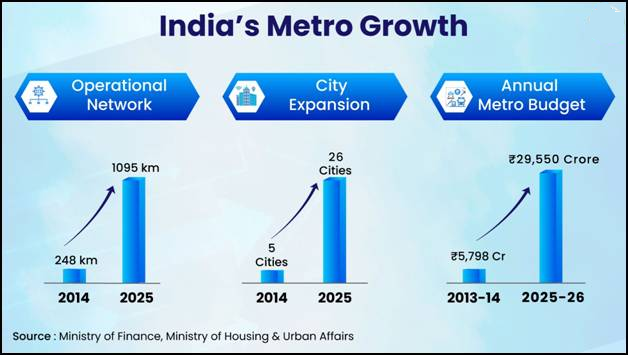
1. Expansion Metrics: The network grew from 248 km across 5 cities in 2014 to 1,095 km across 26 cities by 2025.
2. Investment Surge: Annual budget allocations for metro projects rose from ₹5,798 crore (2013–14) to ₹29,550 crore (2025–26).
3. Strategic Alignment: This growth is integrated with the National Infrastructure Pipeline (NIP) and the PM GatiShakti National Master Plan to ensure multi-modal connectivity and seamless urban planning.
Significance / Importance
1. Urban Mobility & Decongestion: Metros reduce dependence on private vehicles, lowering household transport costs and easing road congestion.
2. Economic Multiplier: Large-scale investments (e.g., ₹3.44 lakh crore sanctioned for 38 projects since 2014) act as engines of growth, supporting jobs and enhancing productivity.
3. Technological Sovereignty: Innovations like the Indigenous Automatic Train Supervision (i-ATS) and Platform Screen Doors (PSD) developed by Bharat Electronics Limited and National Capital Region Transport Corporation showcase India’s advancing technological strength.
Economic, Social, and Environmental Impact
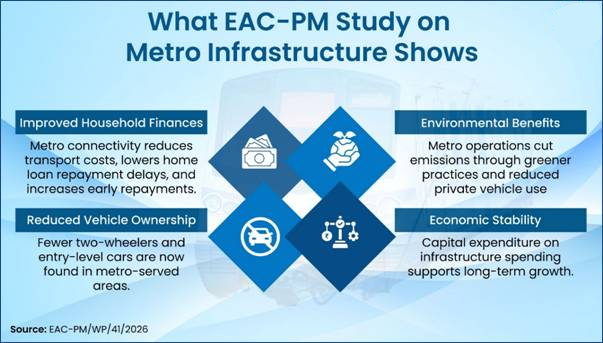
1. Improved Household Financial Discipline: Access to metro rail reduces recurring transport expenses, leading to better loan management.
2. Delhi: Missed payments on home loans dropped by 4.42%.
3. Bengaluru: Loan repayment delays declined by 2.4%, while early repayments rose by 3.5%.
4. Hyderabad: Early home loan repayments increased by 1.8%.
5. Reduced Indebtedness: By lowering transport costs, households carry lighter debt burdens and manage liquidity more effectively.
6. Environmental Sustainability: The integration of regenerative braking, solar panels, and green stations supports India’s climate goals by reducing carbon emissions.
Governance and Institutional Aspects
1. Integrated Planning: The Network Planning Group (NPG) reviews metro and aviation projects together to ensure a unified approach to transport.
2. Digital Integration: The National Common Mobility Card (NCMC), or “One Nation–One Card,” is now functional across 11 metro projects, promoting ease of travel.
3. Safety and Efficiency: Deployment of the European Train Control System (ETCS) on LTE backbone and Unmanned Train Operations (UTO) (on **Delhi Metro’s Pink and Magenta lines) are setting global benchmarks for smart operations.
Key Issues / Challenges
1. High Capital Intensity: Despite the budget surge, metro projects remain capital-intensive, requiring a delicate balance between fiscal prudence and expansion.
2. Last-Mile Connectivity: While the Kochi Water Metro addresses specific terrain, ensuring seamless last-mile connectivity across all 26 cities remains a governance priority.
Global Comparison
India has firmly established itself as a global leader in urban transit, now possessing the world’s third-largest operational metro network. The adoption of world-class technologies like Hybrid Level-III radio-based signaling systems places Indian metros on par with, or ahead of, many advanced global counterparts.
Way Forward
1. Enhancing Financial Resilience: Policy should continue to leverage metro expansion to reduce urban financial stress, as evidenced by the EAC-PM study.
2. Technological Deepening: Further indigenization of components (similar to i-ATS) can drive down costs and support Atmanirbhar Bharat.
3. Sustainable Urbanism: Expanding the “Water Metro” model to other coastal/riverine cities and scaling solar integration will be vital for meeting climate targets.
4. Integrated Mobility: Expanding the National Common Mobility Card (NCMC) to all public transport modes nationally to achieve a truly “One Nation–One Card” ecosystem.
Conclusion
The evolution of India’s metro rail network from a localized transit solution to a nationwide catalyst for economic resilience reflects a commitment to inclusive and sustainable growth. By strengthening household finances, enhancing ease of living, and leveraging cutting-edge technology, the metro system has become a cornerstone of India’s long-term vision for Viksit Bharat 2047. It embodies the constitutional values of equitable access and progress, ensuring that as India urbanizes, it does so with resilience, stability, and global competitiveness.
Best ias coaching in delhi Best ias coaching in chandigar
Prelims question:
Q. Consider the following statements regarding the metro rail expansion in India:
I. India currently possesses the world’s third-largest operational metro rail network.
II. The Economic Advisory Council to the Prime Minister report highlighted that metro connectivity has improved household financial discipline by reducing transport expenses.
III. The National Common Mobility Card enables seamless travel across multiple public transport systems under the “One Nation–One Card” initiative.
IV. The Kochi Water Metro is an example of a metro system designed for riverine or coastal terrains.
Which of the statements given above are correct?
A. I and II only
B. I, II and III only
C. II, III and IV only
D. I, II, III and IV
Answer: D
Q. The rapid expansion of metro rail networks in India has gone beyond improving urban transport and has begun influencing household financial stability and sustainable urban development. Discuss in the light of the findings of the Economic Advisory Council to the Prime Minister report on the “Golden Decade of Infrastructure Development in India.
(250 words)

- Europe’s AI Rules May Become India’s Opportunity - August 14, 2026
- Transparency as the Foundation of Trust in Medicine - August 14, 2026
- A Timely Reset for the Food Security Act: From Foodgrain Security to Nutrition Security - August 13, 2026

No Comments