


13 Feb Cybercrime as a National Security Crisis: The Rise of India’s Digital Shadow Industry
This article covers “Daily Current Affairs” and From Cybercrime as a National Security Crisis: The Rise of India’s Digital Shadow Industry
SYLLABUS MAPPING
GS-3- Internal Security – Cybercrime as a National Security Crisis: The Rise of India’s Digital Shadow Industry
FOR PRELIMS
What is cybercrime? Why is it increasing in India?
FOR MAINS
Why is cybercrime becoming a major problem in India?
Why in the News?
Union Home Minister Amit Shah, while addressing a conference titled “Tackling Cyber-Enabled Frauds & Dismantling the Ecosystem,” warned that cybercrime in India has escalated into a “national crisis.” He described it as a rapidly expanding “shadow industry” posing a serious threat to national security, emphasizing that the exponential growth in digital transactions has been accompanied by proportionate risks.
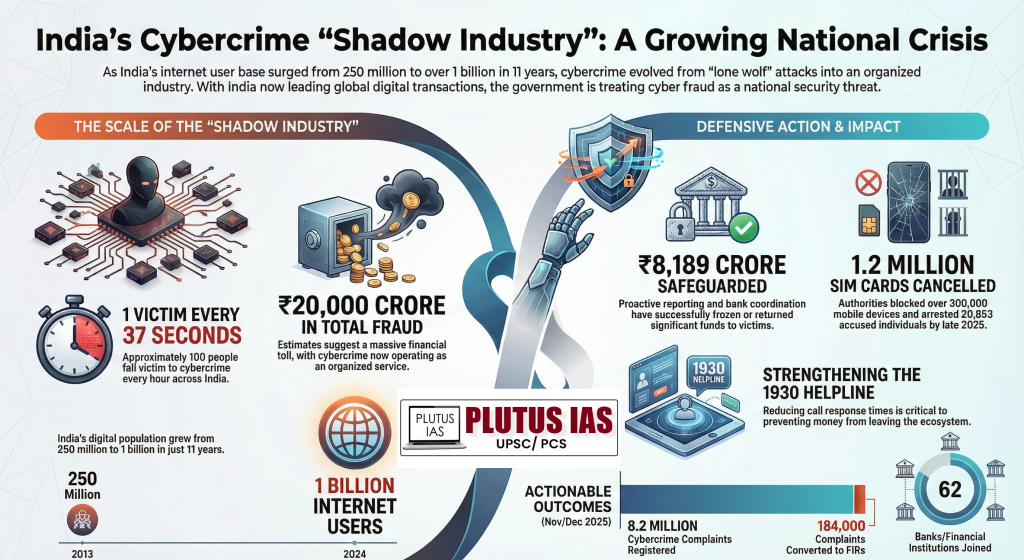
Key Facts & Data
1. One person in India falls victim to cybercrime every 37 seconds, averaging nearly 100 victims per hour.
2. India has crossed 1 billion internet users, compared to 250 million users 11 years ago.
3. Every second digital transaction in the world now takes place in India.
4. Cybercrimes increased by over 30% as per the NCRB report (2023).
5. Estimated total cyber fraud amount: approximately ₹20,000 crore, of which ₹8,189 crore has been safeguarded or returned.
Institutional Mechanisms:
Indian Cyber Crime Coordination Centre (I4C): The central nodal agency for coordinating action against cybercrime.
Central Bureau of Investigation (CBI): Co-organised the national conference along with I4C.
Schemes/Helplines/Portals
1930 Helpline: Dedicated emergency helpline for immediate reporting and financial freezing in cyber fraud cases.
I4C Reporting Portal: Accessed over 230 million times between January 2020 and November 2025, registering over 8.2 million complaints.
Cybercrime in India
| Dimension | Details | Implications for National Security & Governance |
|---|---|---|
| Nature of the Problem | Cybercrime has evolved from sporadic digital offences into a structured and organised national security threat. | Threat extends beyond financial fraud to systemic instability, trust deficit in digital economy, and economic security risks. |
| Massive financial implications and widespread victimisation across states. | Undermines digital confidence, affects fintech growth, and impacts vulnerable sections disproportionately. | |
| Structural Causes | Rapid digital expansion and fintech penetration. | Increased digital footprint without corresponding security architecture. |
| Massive growth in internet penetration creating a large attack surface. | More entry points for fraud, phishing, ransomware, and data breaches. | |
| Rise in digital payment volumes without proportionate digital literacy. | Citizens become soft targets for social engineering and OTP-based fraud. | |
| Technological sophistication of criminals using automated and AI-enabled fraud mechanisms. | Harder detection, scalable fraud models, deepfake-based scams emerging. | |
| Trends & Patterns | Shift from isolated “lone wolf” attacks to organised cyber syndicates. | Indicates criminal institutionalisation and professionalisation. |
| Complaints increased from 52,000 (2021) to 86,000 (recent data). | Rising incidence despite better reporting and awareness mechanisms. | |
| Investigations becoming faster, yet crime volume rising simultaneously. | Enforcement improvements insufficient against scale and speed of crime. | |
| Organised Crime Dimension | Cybercrime now functions like a structured industry. | Institutional threat requiring coordinated multi-agency response. |
| Bank accounts “bought and sold as a service.” | Emergence of financial crime marketplaces in dark web ecosystems. | |
| SIM cards and mule accounts systematically exploited. | Weak KYC compliance and identity misuse concerns. | |
| Fraud networks operate across jurisdictions, often internationally. | Necessitates international cooperation, MLATs, and cyber diplomacy. |
Government Measures Taken
• Institutional Framework: Establishment of I4C as a specialised coordination centre under MHA. Integration of 62 banks and financial institutions with I4C mechanisms.
• Technological & Operational Measures: Establishment of the 1930 emergency helpline to enable prompt reporting of cyber fraud and immediate freezing of suspicious financial transactions.
• Achievements: ₹8,189 crore safeguarded or returned to victims. Over 12 lakh suspicious SIM cards cancelled. More than 3 lakh IMEI numbers blocked. 20,853 accused persons arrested in cybercrime cases.
Way Forward
• Institutional Strengthening: Expand and professionalise 1930 helpline infrastructure. Create specialised cybercrime courts for faster adjudication. Enhance state-level cyber police stations.
• Awareness & Digital Literacy: Launch of nationwide campaigns to promote safe digital practices and responsible online behaviour. Focused outreach programmes for vulnerable groups such as senior citizens and rural populations, who are more susceptible to online fraud.
• Technological Modernisation: AI-based fraud detection systems. Predictive analytics for suspicious transaction monitoring. Real-time inter-bank alert systems.
• International Cooperation: Bilateral and multilateral cybercrime treaties. Strengthening INTERPOL and global cyber coordination frameworks. Extradition agreements for cyber offenders.
Challenges / Gaps
• Coordination Issues:
Need for seamless coordination between: Banks, Telecom operators, State police units, Central agencies Identification and dismantling of domestic and foreign call centres remains complex.
• Capacity Constraints: Delays in answering 1930 helpline calls reduce recovery chances. Shortage of trained cyber forensic personnel. Variations in cyber policing capabilities across states.
• International Dimension: Cross-border cyber fraud networks. Jurisdictional limitations in investigation. Need for global intelligence-sharing frameworks.
Conclusion
As India leads the world in digital transaction volume, securing the digital ecosystem has become a matter of national security priority. The transformation of cybercrime into a structured industry demands coordinated, technology-driven, and citizen-centric responses. Ensuring robust cyber security is indispensable for sustaining trust in the Digital India ecosystem and preventing the escalation of cyber fraud into a systemic national crisis.
Best ias coaching in delhi Best ias coaching in chandigar
Prelims question:
Q. With reference to India’s cybercrime response mechanism, consider the following statements:
1. The Indian Cyber Crime Coordination Centre (I4C) functions under the Ministry of Home Affairs.
2. The 1930 helpline is used for immediate reporting and freezing of funds in cyber fraud cases.
3. Cybercrime investigation is exclusively the responsibility of the Central Bureau of Investigation (CBI).
Which of the statements given above is/are correct?
(a) 1 and 2 only
(b) 2 and 3 only
(c) 1 only
(d) 1, 2 and 3
Answer: A
Q. Cybercrime is emerging as a serious internal security challenge in India. Discuss the causes, consequences, and measures required to address this issue
(250 words)

- RBI’s Shrinking Real-Rate Cushion Amid Rising Inflation and Strong Demand - September 21, 2026
- India’s NGOs at a New Funding Crossroads - September 21, 2026
- Deep-Sea Discovery, Environmental Responsibility - September 19, 2026

No Comments