


14 Feb Viksit Bharat @2047 and Net Zero 2070: India’s Roadmap for Green Growth and Sustainable Development
This article covers “Daily Current Affairs” and From Viksit Bharat @2047 and Net Zero 2070: India’s Roadmap for Green Growth and Sustainable Development
SYLLABUS MAPPING
GS- 3- Environment & Climate Change- Viksit Bharat @2047 and Net Zero 2070: India’s Roadmap for Green Growth and Sustainable Development
FOR PRELIMS
What is meant by Viksit Bharat @2047 and Net Zero 2070?
FOR MAINS
Why is it important for India to balance development with environmental sustainability?
Why in the News?
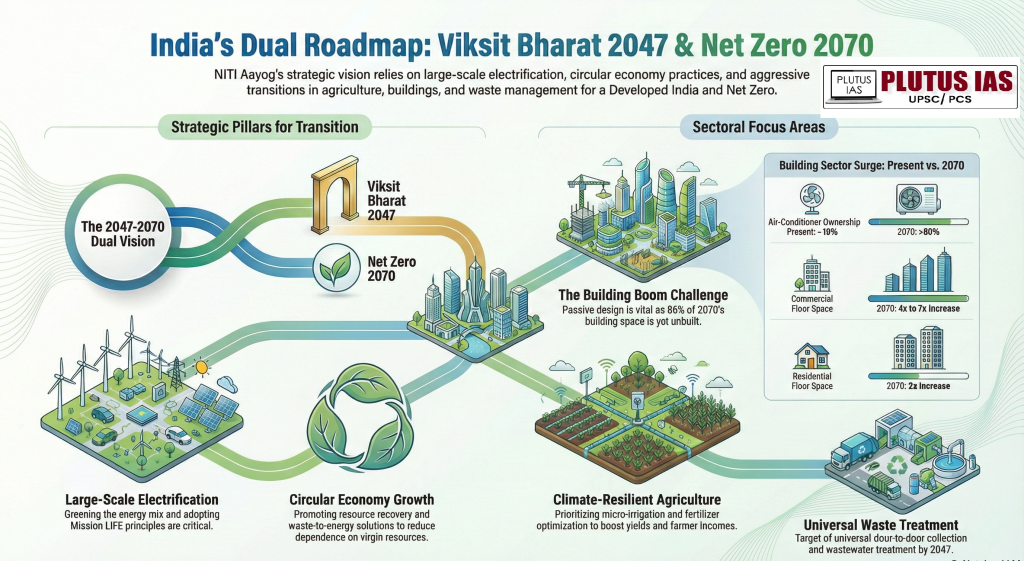
NITI Aayog, the premier policy think tank of the Government of India, has recently unveiled a series of pivotal sectoral study reports. These reports outline various development scenarios aimed at achieving the dual objective of transforming India into a developed nation (Viksit Bharat) by 2047 while ensuring a steady progression toward Net Zero emissions by 2070.
Defining the Concept: Viksit Bharat and Net Zero
Viksit Bharat @2047
This vision represents the culmination of India’s journey toward becoming a developed economy by the 100th year of its independence. It encompasses not just economic growth, but also high standards of living, technological advancement, and social inclusivity.
Net Zero 2070
This is India’s commitment to achieving a balance between the greenhouse gases (GHG) emitted into the atmosphere and those removed from it. This goal was formally announced as part of the “Panchamrit” strategy at COP26.
Background and Context
India stands at a unique historical juncture where it must pursue rapid industrialization and urbanization—processes that historically have been carbon-intensive—within the constraints of a global climate emergency.
The NITI Aayog reports emphasize that achieving the goal of a developed India by 2047 is feasible across all projected scenarios, provided the nation undertakes significant structural and behavioral transitions.
This represents a shift from “growth at all costs” to a “Green Growth” model that integrates climate commitments into the very fabric of economic planning.
Significance and Importance of the Dual Transition
1. Decoupling Growth from Emissions: The strategy seeks to ensure that economic expansion does not lead to a proportional increase in environmental degradation.
2. Energy Security: By focusing on large-scale electrification and greening the energy mix, India aims to reduce its reliance on volatile global fossil fuel markets.
3. Global Leadership: By charting a path to development that respects planetary boundaries, India serves as a model for other Global South nations.
4. Resource Independence: The promotion of circular economy practices ensures that the nation can sustain growth despite global resource scarcities.
Sectoral Priorities for Transformation (NITI Aayog Framework)
| Sector | Why Critical? | Key Challenges | Strategic Approach | Major Interventions | Expected Outcomes |
|---|---|---|---|---|---|
| Agriculture | Largest employer; backbone of rural economy; climate-vulnerable sector | Water stress, soil degradation, methane emissions, declining productivity | Focus on climate resilience; mitigation treated as co-benefit of efficiency | • Micro-irrigation (water-use efficiency) • Fertilizer optimization • Climate-resilient crop practices • Improved farm management |
• Higher crop yields • Increased farmer income • Reduced chemical runoff • Lower methane & N₂O emissions |
| Buildings Sector | Rapid urbanization; 86% of 2070 building stock yet to be constructed | Risk of long-term energy lock-in; rising cooling demand | Prevent carbon lock-in through efficient design & materials | • Passive cooling design (natural ventilation, daylight) • Super-efficient appliances • Low-carbon construction materials • Sustainable urban planning |
• Reduced long-term energy demand • Lower electricity consumption • Reduced emissions from cooling • Sustainable urban growth |
| Waste Management | Though ~2.5% of GHG share, high methane impact; urban sustainability challenge | Poor segregation, landfill methane, untreated wastewater | Promote Circular Economy model | • Universal door-to-door waste collection by 2047 • 100% wastewater treatment • Bio-methanation for Bio-CNG • Composting & material recovery |
Constitutional and Legal Dimensions
1. Directive Principles (Article 48A): The Constitution mandates that the State shall endeavor to protect and improve the environment.
2. Fundamental Duties (Article 51A(g)): It is the duty of every citizen to protect the natural environment.
3. Right to Life (Article 21): The Supreme Court has repeatedly held that the right to a clean environment is a fundamental right.
Economic, Social, and Environmental Impact
1. Economic: Transitioning to a circular economy and green energy mix can create new industries and “green jobs,” enhancing India’s Atmanirbhar (Self-reliance) in energy.
2. Social: Improving farmer incomes through resilient agriculture directly addresses rural poverty and migration.
3. Environmental: The transition directly contributes to global efforts to limit temperature rise while reducing local pollution through better waste management.
Governance and Institutional Aspects
The NITI Aayog reports stress the need for coordinated sectoral strategies. This implies that climate goals cannot be the responsibility of the Ministry of Environment alone; they must be integrated into the planning of the Ministries of Agriculture, Urban Affairs, Power, and Finance.
This “whole-of-government” approach is essential for achieving the 2047 and 2070 targets.
Global Comparison
Unlike developed Western nations that reached high-income status before focusing on decarbonization, India is attempting to “leapfrog.” By adopting Mission LiFE and circular economy principles early in its development peak, India is attempting to avoid the high-pollution path taken by industrialized nations.
Way Forward: A Policy Roadmap
1. Accelerate Mission LiFE: Institutionalize behavioral changes that promote sustainable consumption and production.
2. Strict Building Codes: Implement and enforce stringent energy-efficiency standards for all new constructions to avoid cooling-related energy surges.
3. Scale Bio-methanation: Invest in waste-to-energy infrastructure in urban centers to create a self-sustaining resource loop.
4. Agri-Tech Integration: Focus on digitizing and scaling micro-irrigation and soil-health monitoring to ensure agricultural sustainability.
5. Green Finance: Develop robust mechanisms to fund the transition of the energy mix toward renewable sources.
Conclusion
The dual path toward Viksit Bharat @2047 and Net Zero 2070 is not a choice between development and the environment, but a necessity for long-term survival and prosperity. As the NITI Aayog reports conclude, the integration of economic growth with climate commitments through coordinated sectoral strategies is the only way forward. This journey is deeply rooted in constitutional values of equity and stewardship and is essential for achieving Sustainable Development Goals (SDGs). By transforming its energy, agriculture, and urban systems today, India is securing an inclusive, resilient, and developed future for the generations of 2047 and beyond.
Best ias coaching in delhi Best ias coaching in chandigar
Prelims question:
Q. With reference to the recent sectoral study reports released by NITI Aayog, consider the following statements:
1. India has committed to achieving Net Zero emissions by 2050 as part of the Panchamrit strategy.
2. The Buildings sector is critical because a large proportion of India’s future building stock is yet to be constructed.
3. Waste management contributes a relatively small share of India’s total GHG emissions but has a disproportionately high methane impact.
Which of the statements given above is/are correct?
(a) 2 and 3 only
(b) 1 and 2 only
(c) 1 and 3 only
(d) 1, 2 and 3
Answer: A
Mains Question:
Q. NITI Aayog’s recent sectoral studies emphasize that India’s transition to a developed nation by 2047 must be aligned with its Net Zero commitment by 2070. Discuss the significance of this dual transition and examine the role of agriculture, buildings, and waste management sectors in achieving sustainable and inclusive growth.
(250 words)
(250 words)

- RBI’s Shrinking Real-Rate Cushion Amid Rising Inflation and Strong Demand - September 21, 2026
- India’s NGOs at a New Funding Crossroads - September 21, 2026
- Deep-Sea Discovery, Environmental Responsibility - September 19, 2026

No Comments