


17 Feb India’s Drone Revolution: Navigating the Flight Path to Viksit Bharat 2047
This article covers “Daily Current Affairs” and From India’s Drone Revolution: Navigating the Flight Path to Viksit Bharat 2047
SYLLABUS MAPPING
GS- 3-Science & Technology- India’s Drone Revolution: Navigating the Flight Path to Viksit Bharat 2047
FOR PRELIMS
What is a drone ecosystem?
FOR MAINS
What are the main challenges in the use of drones in India?
Why in the News?
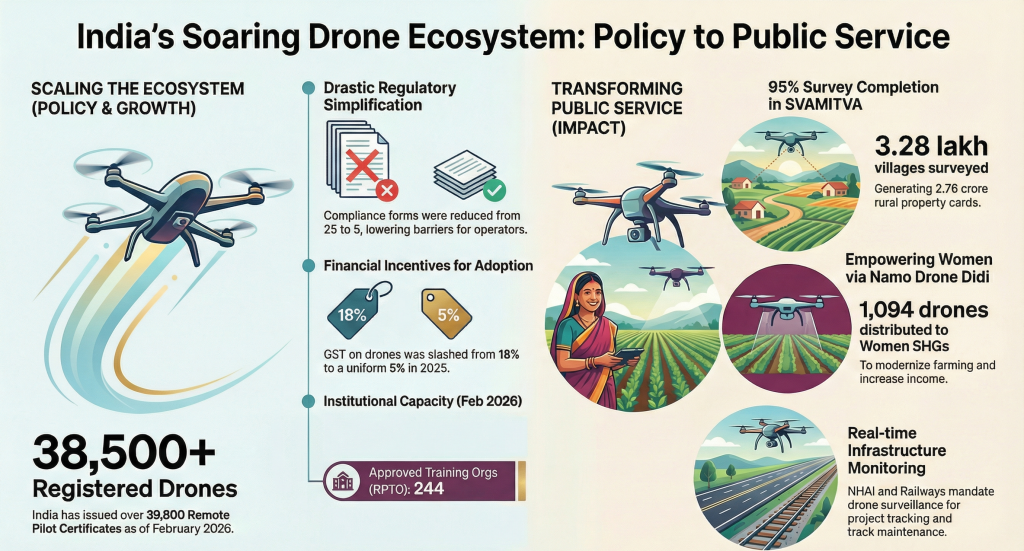
As of February 2026, India has successfully transitioned from a nascent stage of experimental drone deployment to a mainstream, innovation-driven ecosystem. Recent data indicates a robust expansion with over 38,500 registered drones (UIN), nearly 40,000 DGCA-certified remote pilots, and 244 approved training organizations, signaling the maturation of “Drone-as-a-Service” (DaaS) as a pillar of modern governance.
Defining the Concept
A Drone Ecosystem in the Indian context is a comprehensive, multi-sectoral framework comprising Unmanned Aerial Systems (UAS) manufacturers, software developers, service providers, and certified training institutions. It operates within a unified regulatory environment (Digital Sky/eGCA) and leverages technology to optimize public service delivery, infrastructure management, and national security.
Background and Context
Historically, drones were limited to defense applications and experimental research. However, the last two decades have witnessed an evolution where drones have become central to the “Minimum Government, Maximum Governance” philosophy. The shift was accelerated by the Drone Rules, 2021 and subsequent amendments, which liberalized the sector by removing stringent licensing requirements and simplifying compliance to foster domestic manufacturing and grassroots adoption.
Significance and Importance
1. Precision Governance and Rural Empowerment: Through the SVAMITVA Scheme, drones have revolutionized land records by surveying 3.28 lakh villages (95% of the target) and facilitating the creation of 2.76 crore property cards. This reduces land disputes and enhances the creditworthiness of rural citizens.
2. Infrastructure Transparency: The National Highways Authority of India (NHAI) now mandates monthly drone-video recordings for all projects. This creates a “Data Lake” of permanent records that serve as evidence in dispute resolutions and ensure project accountability.
3. Modernizing Logistics and Railways: The Railway Protection Force (RPF) utilizes drones for security surveillance in yards and stations, while the Ministry of Railways has directed zones to use UAVs for inspecting hard-to-reach tracks and bridges, significantly improving maintenance efficiency.
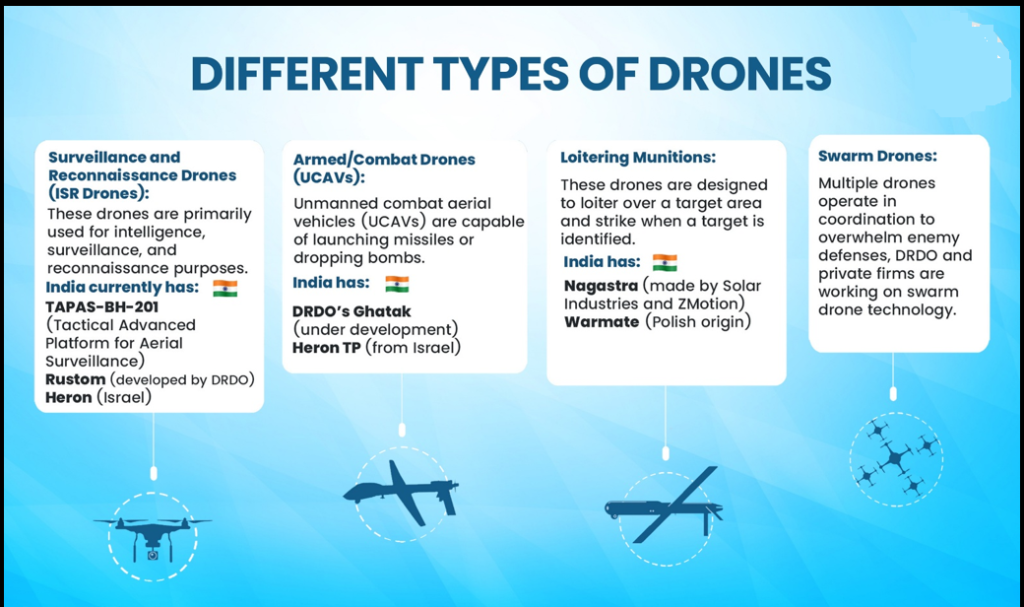
4. National Security: In defense, drones provide real-time intelligence and strike capabilities, as demonstrated in Operation SINDOOR, where loitering munitions and Indian drones were used to destroy targets with high precision.
Key Issues and Challenges
1. Privacy and Data Security: While drones provide real-time surveillance for the RPF and NHAI, the lack of a specific, stringent data protection protocol for aerial surveillance data remains a concern regarding individual privacy rights.
2. Airspace Management: With nearly 90% of Indian airspace designated as “Green Zones,” the challenge lies in managing the increasing traffic to avoid collisions while strictly enforcing “No-Fly Zones” around critical infrastructure.
3. Import Dependency: Despite the PLI scheme, India is still in the process of achieving full technological self-reliance for high-end components like flight controllers and sensors.
4. Skill Gap: While there are 244 RPTOs, the rapid demand for certified pilots across 31 States and UTs requires even more decentralized training facilities to cater to the agriculture sector.
Constitutional and Legal Dimensions
The drone ecosystem is underpinned by the Drone Rules, 2021 (Amended 2022 & 2023).
1. Simplified Regulatory Architecture: Compliance forms were reduced from 25 to 5, and approvals dropped from 72 to 4, embodying the spirit of Ease of Doing Business.
2. Decentralization: The replacement of a traditional pilot license with a Remote Pilot Certificate issued by the DGCA has democratized access to the technology.
3. Digital Governance: The migration to eGCA for registration and certification ensures a paperless, transparent interface between the citizen and the regulator.
Economic, Social, and Environmental Impact
1. Economic Impact: The ₹120 crore PLI scheme for drones and components encourages MSMEs and startups to scale production. Furthermore, reducing GST on drones to a uniform 5% in 2025 significantly lowered the cost of entry for commercial and personal use.
2. Social Impact (Namo Drone Didi): This flagship initiative has distributed 1,094 drones to Women Self Help Groups (SHGs). By training women as “Drone Didis,” the government is shifting rural labor from hazardous manual chemical spraying to high-tech precision agriculture, thereby enhancing income and social status.
3. Environmental Resilience: The North East Centre for Technology Application and Reach (NECTAR) uses drones for flood and landslide monitoring. These drones provide live visuals that allow for faster, better-coordinated search and rescue operations, minimizing human and environmental loss during disasters.
Governance and Institutional Aspects
1. Digital Sky Platform: Serves as the single-window interface for flight plans and airspace maps, ensuring that the 38,575 registered drones operate within authorized limits.
2. Skill Development (SwaYaan): This capacity-building program has benefited 26,000+ participants, creating a talent pool necessary for the burgeoning sector.
3. Innovation Incentives (NIDAR): The National Innovation Challenge encourages students and researchers with a ₹40 lakh prize pool to develop autonomous drones for disaster management and agriculture.
Way Forward
1. Strengthening Atmanirbharta: To move beyond the current ₹120 crore PLI, the government should encourage the domestic manufacture of high-value sensors and motors to reduce dependency on foreign supply chains.
2. Harmonizing Data Standards: Establishing a national protocol for drone-captured data, especially those used as legal evidence in NHAI disputes, will ensure judicial consistency.
3. Scaling Rural Infrastructure: Expanding the number of Remote Pilot Training Organisations (RPTOs) specifically in the North East and hilly regions will support disaster management initiatives like NECTAR.
4. Integration with PMFBY: Fully automating crop assessment for the Pradhan Mantri Fasal Bima Yojana via drones will ensure faster and more accurate insurance payouts for farmers.
Conclusion
The evolution of India’s drone ecosystem is a testament to the transformative power of technology-led governance. By prioritizing inclusive development through the Namo Drone Didi initiative and enhancing transparency via the SVAMITVA Scheme, India is aligning its technological prowess with Constitutional values of social and economic justice. As the nation marches toward Viksit Bharat 2047, the drone sector will remain a critical catalyst for Atmanirbhar Bharat, ensuring that the benefits of the digital revolution reach the “last mile” and contribute to a more resilient and sustainable India.
Best ias coaching in delhi Best ias coaching in chandigar
Prelims question:
Q. With reference to the Drone Rules, 2021, consider the following statements:
1. The Rules replaced multiple approval layers with a simplified digital single-window system.
2. Remote Pilot Certificates are issued by the DGCA instead of requiring a traditional pilot license.
3. The Rules prohibit the use of drones for agricultural purposes.
Which of the statements given above is/are correct?
(a) 1 and 2 only
(b) 2 and 3 only
(c) 1 only
(d) 1, 2 and 3
Answer: A
Mains Question:
Q. India’s drone ecosystem represents a convergence of technology, governance reform, and rural transformation.” Discuss the significance of drones in achieving Viksit Bharat 2047 while highlighting the associated regulatory and ethical challenges
(250 words)

- RBI’s Shrinking Real-Rate Cushion Amid Rising Inflation and Strong Demand - September 21, 2026
- India’s NGOs at a New Funding Crossroads - September 21, 2026
- Deep-Sea Discovery, Environmental Responsibility - September 19, 2026

No Comments