


21 Feb India’s AI-Driven Youth Dividend: Skilling, Innovation and Inclusive Growth
This article covers “Daily Current Affairs” and From India’s AI-Driven Youth Dividend: Skilling, Innovation and Inclusive Growth
SYLLABUS MAPPING
GS- 3 – Science & Technology and Economy- India’s AI-Driven Youth Dividend: Skilling, Innovation and Inclusive Growth
FOR PRELIMS
What is meant by youth dividend in the AI era?
FOR MAINS
What challenges does AI create for young workers?
Why in the News?
India’s demographic advantage and AI ambitions gained prominence following the India‑AI Impact Summit 2026, which highlighted youth-led innovation, large-scale AI skilling initiatives, and infrastructure expansion under the IndiaAI Mission. The Union Budget 2026-27 further emphasised AI skilling, the creative digital economy, and education-to-employment transitions.
Definition / Concept
Youth dividend in the AI era refers to India’s ability to convert its large young population into a productive, innovation-driven workforce through Artificial Intelligence (AI) skilling, infrastructure access, and ecosystem development.
Key elements:
Demographic advantage
AI-enabled employability and entrepreneurship
Digital public infrastructure and compute access
Responsible and inclusive AI innovation
Significance
1. Economic growth: AI can significantly enhance productivity, innovation, and startup ecosystem growth. Creative digital sectors projected to generate ~2 million jobs by 2030
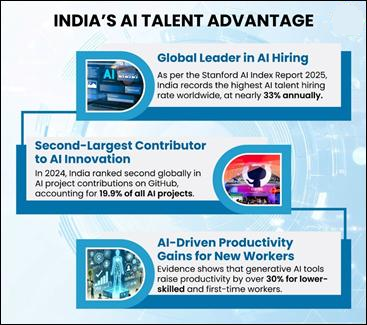
2. Employment transformation: AI job demand rising faster than non-AI roles. Emergence of interdisciplinary careers combining tech with domain expertise
3. Innovation leadership: Youth-led startups and research are positioning India as a use-case capital in AI
4. Inclusive development: Democratised compute infrastructure reduces urban-rural digital divides
5. Strategic autonomy: Indigenous AI models strengthen technological sovereignty
Key Issues / Challenges
1. Skill mismatch between education and industry needs
2. Risk of job displacement in routine tasks
3. Digital divide across regions and socio-economic groups
4. Inadequate research ecosystem compared to global leaders
5. Ethical concerns including bias, privacy, and misinformation
6. Funding and infrastructure constraints for deep-tech startups
Constitutional / Legal Dimensions
1. Fundamental Rights
1. Article 14 — equality in access to opportunities
2. Article 19 — freedom of expression in digital spaces
3. Article 21 — privacy and data protection concerns
2. Directive Principles
1. Article 39 — equitable distribution of resources
2. Article 41 — right to work and education
3. Article 46 — promotion of educational and economic interests of weaker sections
3. Judicial dimension: Data privacy jurisprudence emphasises balancing innovation with rights protection.
Economic / Social / Environmental Impact
1. Economic Impact: Enterprise AI adoption (87%) driving labour demand. Growth of startups beyond metropolitan regions. Enhanced global competitiveness
2. Social Impact: Expanded access to education and skill developmen. Women and youth entrepreneurship in AI ecosystem. Improved public service delivery through AI applications
3. Environmental Impact: AI enabling climate monitoring, smart agriculture, and energy optimisation. Need to manage energy consumption of AI infrastructure
Governance and Institutional Aspects
1. Multi-tier skilling ecosystem: Foundational AI literacy in schools,Vocational training through Skill India and FutureSkills Prime. Advanced research via fellowships and AI labs
2. Infrastructure expansion: Subsidised compute and GPU access under IndiaAI Mission. Data and AI labs in Tier-2/3 cities.
3. Industry-academia collaboration: Partnerships with technology firms and startups, Innovation challenges and incubation platforms
4. Labour market governance: Education-to-Employment Standing Committee to align skills with jobs
Global Comparison
| Dimension | India | US | China | EU |
|---|---|---|---|---|
| Talent scale | Large youth pool | High research intensity | Massive investment | Strong regulation |
| Infrastructure | Expanding compute access | Advanced tech ecosystem | State-driven AI push | Ethical AI focus |
| Policy approach | Inclusive and use-case driven | Innovation-led | Strategic dominance | Rights-centric governance |
Government Initiatives and Policy Response
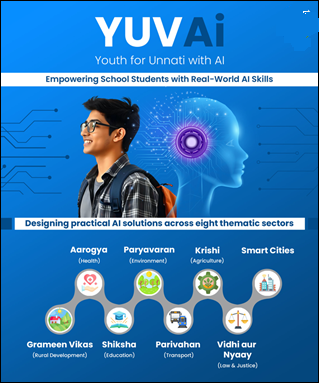
1. School-level AI literacy: AI and Computational Thinking curriculum. YUVAi and AI literacy programmes
3. Vocational and professional upskilling: Skill India Mission and SOAR initiative. FutureSkills Prime and Skill India Digital Hub
4. Advanced research ecosystem: Fellowships and AI labs under IndiaAI Mission. Expansion of compute infrastructure
5. Innovation ecosystem: Global youth challenges and startup platforms, Women-led AI entrepreneurship initiatives
Way Forward
1. Education reforms: Embed AI across disciplines. Strengthen STEM and interdisciplinary learning
2. Labour market transition: Reskilling and lifelong learning frameworks. Social security for displaced workers
3. Research and innovation: Increase R&D investment. Promote academia-industry collaboration
4. Infrastructure expansion: Expand affordable compute and data ecosystems. Strengthen rural digital connectivity
5. Ethical AI governance: Develop comprehensive AI regulation. Promote transparency and accountability frameworks
6. Inclusive ecosystem: Focus on women, rural youth, and disadvantaged groups. Encourage regional innovation clusters
7. Global partnerships: Collaboration in AI research, standards, and governance
Conclusion
India stands at a decisive juncture where its demographic dividend can evolve into a youth dividend in the AI era. The momentum generated by initiatives such as the IndiaAI Mission and policy emphasis in the Union Budget 2026-27 reflects a strategic effort to transform the country’s vast young population into a globally competitive AI workforce. However, realising this potential requires bridging skill gaps, strengthening research capacity, expanding digital infrastructure, and ensuring ethical AI governance. A balanced approach that combines innovation with inclusivity, productivity with employment security, and technological advancement with constitutional safeguards will be essential.
Prelims question:
Q. With reference to India’s youth dividend in the Artificial Intelligence (AI) era, consider the following statements:
1. The youth dividend refers to converting India’s large young population into an innovation-driven workforce through AI skilling and infrastructure access.
2. The IndiaAI Mission focuses only on AI research and does not address compute infrastructure or skilling.
3. AI adoption can contribute to productivity growth and create interdisciplinary employment opportunities.
Which of the statements given above is/are correct?
(a) 1 and 2 only
(b) 1 and 3 only
(c) 2 and 3 only
(d) 1, 2 and 3
Answer: B
Mains Question:
Q. India’s demographic dividend can transform into a youth dividend in the Artificial Intelligence era.
Discuss the opportunities, challenges, and policy measures required to harness AI-driven youth potential in India. (250 words)

- Before New Taxes, Make Every Rupee Count: Fiscal Discipline and Outcome-Based Governance in Tamil Nadu - August 20, 2026
- A Palestinian State as the Foundation for Regional Peace - August 20, 2026
- A Vision for an Inclusive Bangladesh: Democracy, Minority Rights and India’s Neighbourhood - August 19, 2026

No Comments