


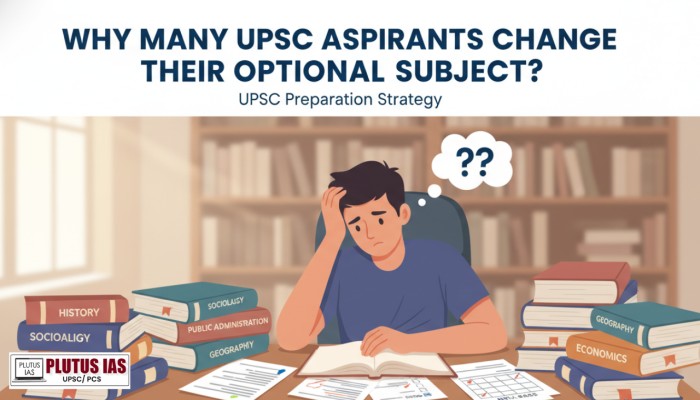
24 Feb Why Many UPSC Aspirants Change Their Optional Subject?
The Civil Services Examination conducted by UPSC is one of the toughest competitive exams in India. Every year thousands of aspirants start their preparation with great enthusiasm. One of the most important decisions in this journey is choosing the right optional subject for the UPSC Mains examination. However, many aspirants later decide to change their optional subject after spending months or sometimes even years studying it.
This situation is very common among UPSC aspirants. While some students benefit from changing their optional subject, others regret the decision because it leads to a loss of time and momentum. Understanding why aspirants change their optional subject can help future candidates make a more informed and stable decision during their preparation.
Importance of Optional Subject in UPSC
The optional subject plays a significant role in the UPSC Mains examination. It consists of two papers and carries a total of 500 marks. These marks often make a decisive difference in the final ranking of candidates.
Unlike General Studies papers, the optional subject allows aspirants to specialize in one particular area. A well-chosen optional subject can significantly boost overall marks if the candidate has a strong understanding of the subject and is able to write analytical answers.
Because of this importance, selecting the right optional subject becomes a critical step in UPSC preparation. However, many aspirants realize later that the subject they initially selected may not be suitable for them.
Lack of Proper Research Before Choosing Optional
One of the most common reasons aspirants change their optional subject is that they do not research enough before selecting it. Many candidates choose their optional subject based on trends, popularity, or advice from friends without understanding the syllabus or the level of depth required.
Must Check :- Best IAS Coaching in Delhi
Some aspirants pick a subject simply because they heard that it has a high success rate. Others select it because coaching institutes promote certain optionals more than others. When students start studying the subject seriously, they realize that the syllabus is vast or difficult to understand.
This realization often leads them to reconsider their choice and switch to another optional subject.
Difficulty in Understanding the Subject
Another major reason aspirants change their optional subject is the difficulty they face in understanding the concepts. Some subjects require strong conceptual clarity, analytical thinking, or technical knowledge.
For example, subjects like mathematics or engineering optionals require problem solving skills and consistent practice. On the other hand, humanities subjects demand analytical writing and conceptual interpretation.
If an aspirant struggles to understand the subject even after months of preparation, they may feel that continuing with it will affect their chances in the examination. As a result, they decide to shift to another optional that feels more manageable.
Mismatch Between Interest and Subject
Interest plays a very important role in long term UPSC preparation. The preparation journey is long and requires studying the same subject repeatedly for many months.
Many aspirants initially choose an optional subject without considering whether they actually enjoy studying it. Over time, they realize that they do not feel motivated or interested in reading the subject.
This lack of interest makes it difficult to maintain consistency in preparation. Eventually, aspirants begin to lose confidence in their optional subject and decide to change it to something they find more engaging.
Influence of Peer Pressure
Peer pressure is another reason why many UPSC aspirants change their optional subject. When aspirants interact with other candidates in libraries, coaching institutes, or online communities, they often hear different opinions about optional subjects.
Sometimes they hear statements such as a particular optional is scoring or another optional has low success rates. Listening to these opinions repeatedly can create confusion and self doubt.
As a result, aspirants start believing that their chosen optional may not be the right one and decide to switch subjects, even if their original choice was reasonable.
Low Marks in Mock Tests
Mock tests are an important part of UPSC preparation. They help aspirants evaluate their understanding of the subject and improve answer writing skills.
However, some aspirants become discouraged when they receive low marks in optional subject mock tests. Instead of analyzing their mistakes and improving their answers, they assume that the subject itself is not suitable for them.
This misunderstanding often leads them to change their optional subject prematurely. In many cases, the issue is not the subject but the lack of proper preparation or answer writing practice.
Vast Syllabus of Certain Optionals
Some optional subjects in the UPSC exam have very extensive syllabi. When aspirants first see the syllabus, it may appear manageable. But as preparation progresses, they realize that covering the entire syllabus requires a significant amount of time and effort.
Balancing optional subject preparation with General Studies, current affairs, and answer writing becomes challenging. Due to this pressure, some aspirants decide to switch to an optional subject with a relatively smaller syllabus.
This decision is often taken when aspirants feel that managing their current optional along with other subjects is becoming overwhelming.
Lack of Proper Guidance
Guidance plays a crucial role in UPSC preparation. When aspirants do not receive proper guidance about study materials, answer writing techniques, or syllabus coverage, they may feel lost.
Without the right strategy, even a good optional subject can become difficult to handle. Aspirants who lack mentorship or structured preparation sometimes blame the subject itself for their difficulties.
As a result, they believe that changing the optional subject will solve their problems, although the real issue might be the absence of effective guidance.
Availability of Study Material
The availability of quality study material also influences the decision to change optional subjects. Some subjects have abundant resources such as books, notes, test series, and online lectures.
However, other optionals may have limited or scattered resources. When aspirants struggle to find reliable study material or previous year answer guidance, they may feel disadvantaged compared to candidates preparing other optionals.
This resource gap sometimes pushes aspirants to shift toward subjects that have more structured and accessible preparation material.
Changing Trends in Optional Subjects
Every year aspirants observe trends related to optional subjects, such as the number of candidates selecting certain subjects or the performance of specific optionals in the final results.
These trends often influence aspirants’ decisions. If a particular optional subject appears to perform well in a given year, many candidates start considering it as a better option.
However, such trends can be misleading. Success in UPSC depends more on the candidate’s understanding and preparation rather than the optional subject itself. Still, changing trends often create uncertainty and cause aspirants to switch their optionals.
Fear of Low Scoring Optional
Some aspirants believe that certain optional subjects are inherently low scoring. This belief may come from past result analyses or discussions in aspirant communities.
When candidates start feeling that their optional subject may not yield high marks, they may lose confidence. Even if they have already studied a significant portion of the syllabus, fear of low marks can motivate them to choose another subject.
This psychological factor plays a strong role in the decision to change optional subjects.
When Changing Optional Can Be a Good Decision
Although changing optional subjects can sometimes lead to wasted effort, there are situations where it may be the right decision.
- If an aspirant genuinely struggles to understand the subject even after sincere effort.
- If the subject does not match the aspirant’s academic background or interest.
- If the candidate realizes early in the preparation that another subject suits them better.
- If the aspirant has reliable guidance and resources for the new optional subject.
In such cases, changing the optional subject early in the preparation phase may actually improve performance in the UPSC Mains examination.
How to Choose the Right Optional Subject
To avoid the need to change optional subjects later, aspirants should take a thoughtful and strategic approach when making their initial choice.
- Carefully read the complete syllabus of the optional subject.
- Analyze previous year question papers.
- Check the availability of study material and guidance.
- Consider your interest and academic background.
- Evaluate how comfortable you feel writing answers on the subject.
Spending a few days researching these aspects can prevent months of confusion later in the preparation journey.
Must Check :- Best IAS Coaching in Delhi
Conclusion
Changing an optional subject during UPSC preparation is a common experience for many aspirants. It usually happens due to reasons such as lack of research, difficulty in understanding the subject, peer influence, vast syllabus, or low confidence.
However, aspirants should remember that no optional subject guarantees success or failure in the UPSC examination. What truly matters is clarity of concepts, consistent revision, and strong answer writing skills.
Before deciding to change an optional subject, aspirants should carefully analyze the real problem. If the issue is related to strategy or preparation methods, improving the study approach may be a better solution than switching subjects.
Choosing the right optional subject with patience, research, and self awareness can make the UPSC preparation journey more stable and productive.

- Best AI Tool for UPSC Preparation - July 27, 2026
- Best UPSC + Diploma Coaching - April 28, 2026
- Best UPSC + MBA Coaching - April 28, 2026

No Comments