


25 Feb Strengthening Grassroots Democracy: Towards Synergy Between the ECI and State Election Commissions
This article covers “Daily Current Affairs” and From Strengthening Grassroots Democracy: Towards Synergy Between the ECI and State Election Commissions
SYLLABUS MAPPING
GS-2 – Polity & Governance- Strengthening Grassroots Democracy: Towards Synergy Between the ECI and State Election Commissions
FOR PRELIMS
What are the challenges in maintaining accurate electoral rolls in India?
FOR MAINS
Why is coordination between the Election Commission of India and State Election Commissions important for democracy in India?
Why in the News?
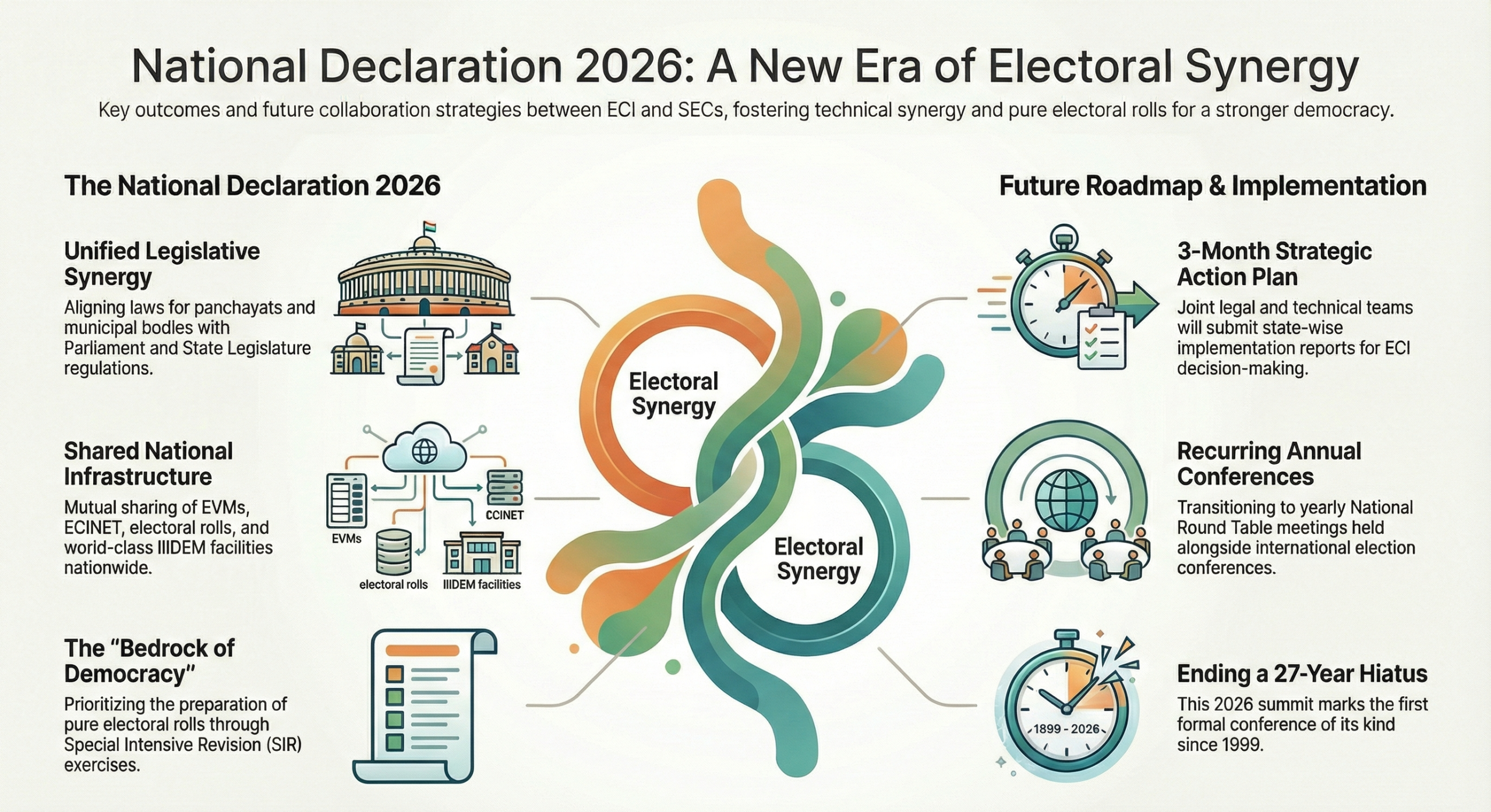
A National Round Table Conference between the Election Commission of India (ECI) and State Election Commissioners was held in New Delhi on 24 February 2026, culminating in the adoption of the National Declaration 2026.
The conference took place after a gap of 27 years, with the last such interaction occurring in 1999, signalling renewed efforts to strengthen electoral federalism and institutional coordination.
Defining the Concept: Electoral Synergy and Integrity
Electoral synergy refers to collaborative coordination between the ECI and State Election Commissions (SECs) to ensure:
1. Preparation of pure electoral rolls
2. Transparent conduct of elections
3. Strengthening democratic legitimacy
A pure electoral roll includes all eligible voters while excluding ineligible names, thereby reflecting the genuine will of citizens.
Background and Constitutional Context: Dual Election Structure
India follows a dual institutional election management framework:
1. Article 324: Empowers the ECI to supervise elections to Parliament, State Legislatures, and offices of President and Vice-President.
2. Articles 243K & 243ZA: Establish SECs to conduct Panchayat and Municipal elections under the 73rd and 74th Amendments.
3. Institutional Gap: Limited structured dialogue between these bodies for nearly three decades, resulting in operational silos.
Significance of the National Declaration 2026
1. Strengthening Democratic Legitimacy: The declaration emphasises pure and updated electoral rolls as the foundation of democracy, ensuring inclusion of all eligible voters and safeguarding the constitutional right to vote.
2. Administrative and Fiscal Efficiency: Resource sharing—such as EVMs, digital platforms like ECINET, and training infrastructure—reduces duplication of efforts, lowers election costs, and improves operational efficiency.
3. Deepening Electoral Federalism: Enhanced coordination between the Election Commission of India and State Election Commissions promotes cooperative federalism while respecting institutional autonomy.
4. Technological Modernisation and Capacity Building: Technology transfer, digital roll management, and joint training initiatives help bridge capability gaps among states and improve transparency in local body elections.
5. Enhancing India’s Global Democratic Leadership: A unified and coordinated election management framework strengthens India’s standing as a global model for large-scale democratic governance and electoral integrity.
Key Issues and Challenges
1. Duplication of Electoral Rolls: Separate voter lists for local and general elections create inconsistencies, confusion among voters, and risks of exclusion or duplication.
2. Technological Asymmetry: While the Election Commission of India uses advanced digital platforms and EVM infrastructure, many State Election Commissions lack adequate technological capacity.
3. Legal Fragmentation: Diverse state laws governing local body elections often diverge from the Representation of the People Acts, leading to regulatory inconsistency.
4. Institutional Coordination Deficit: The absence of a structured, periodic platform for dialogue between election bodies has historically limited collaboration and knowledge sharing.
5. Capacity and Resource Constraints: Limited financial and human resources at the state level hinder adoption of best practices and modern election management tools.
Constitutional and Legal Dimensions
1. Preservation of Institutional Autonomy: Any collaboration must respect the constitutional independence of SECs under Articles 243K and 243ZA.
2. Functional Parity Principle: Judicial pronouncements (e.g., Kishansing Tomar case, 2006) affirm that SECs enjoy powers analogous to the ECI within their respective jurisdictions.
3. Legal Harmonisation with Federal Balance: Efforts to align election laws must ensure administrative efficiency while safeguarding state legislative autonomy.
4. Scope for Cooperative Federalism: The Constitution does not prohibit resource sharing, enabling synergy within a legally viable framework.
5. Need for Clarified Institutional Protocols: Clear guidelines on collaboration can prevent jurisdictional conflicts and enhance accountability.
Governance and Institutional Aspects
1. Special Intensive Revision (SIR): Targeted electoral roll cleansing exercises aim to enhance accuracy and eliminate ineligible entries.
2. Formation of Joint Technical Teams: Legal and technical experts are tasked with translating policy ideas into operational reforms.
3. Infrastructure and Capacity Sharing: Training and research facilities, including advanced election management institutions, can strengthen SEC capabilities.
4. Digital Integration and Data Synchronisation: Adoption of digital platforms enables real-time voter roll updates and improves transparency.
5. Institutionalised Dialogue Mechanisms: Regular conferences and review platforms can ensure sustained coordination and policy continuity.
Way Forward
1. Institutionalise Structured Inter-Institutional Dialogue: Regular annual round table conferences and thematic workshops should be formalised to ensure continuous coordination between the Election Commission of India and State Election Commissions.
2. Move Towards a Unified and Dynamic Electoral Roll: Adoption of a single, synchronised voter database (“One Nation, One Voters’ List”) can eliminate duplication, reduce errors, and enhance voter convenience.
3. Accelerate Digital Integration and Technological Modernisation: Expansion of platforms such as ECINET, GIS mapping, and digital Special Intensive Revision tools will enable real-time updates and improve transparency.
4. Promote Legal Harmonisation with Federal Sensitivity: States should gradually align local election laws with national electoral standards while preserving constitutional autonomy and federal balance.
5. Strengthen Capacity Building and Infrastructure Sharing: Training, research collaboration, and shared infrastructure—including EVM logistics and election management institutes—can bridge capability gaps among states.
6. Establish Robust Monitoring, Audit, and Accountability Mechanisms: Periodic performance reviews, joint audit frameworks, and data-driven monitoring can ensure effective implementation and sustained electoral integrity.
Conclusion
The National Round Table Conference 2026 marks a significant step toward ending institutional fragmentation between the ECI and SECs. By prioritising electoral roll purity, technological collaboration, and legal harmonisation, India is strengthening the foundations of its multi-tier democratic system. Sustained synergy between these constitutional bodies will enhance transparency, efficiency, and inclusive participation, positioning India as a global exemplar of electoral federalism.
Prelims question:
Q. With reference to electoral governance in India, consider the following statements:
1. The Election Commission of India is responsible for conducting elections to Panchayats and Municipalities.
2. State Election Commissions derive their constitutional status from the 73rd and 74th Constitutional Amendments.
3. The Constitution prohibits any form of coordination or resource sharing between the Election Commission of India and State Election Commissions.
Which of the statements given above is/are correct?
(a) 1 only
(b) 2 only
(c) 1 and 3 only
(d) 2 and 3 only
Answer: B
Mains Question:
Q. Discuss the need for enhanced coordination between the Election Commission of India and State Election Commissions in strengthening electoral federalism and democratic governance in India (250 words)

- RBI’s Shrinking Real-Rate Cushion Amid Rising Inflation and Strong Demand - September 21, 2026
- India’s NGOs at a New Funding Crossroads - September 21, 2026
- Deep-Sea Discovery, Environmental Responsibility - September 19, 2026

No Comments