


27 Feb Countervailing Duties on Solar Imports: Trade Protectionism vs Climate Goals
This article covers “Daily Current Affairs” and From Countervailing Duties on Solar Imports: Trade Protectionism vs Climate Goals
SYLLABUS MAPPING
GS-3-Economy- Countervailing Duties on Solar Imports: Trade Protectionism vs Climate Goals
FOR PRELIMS
What are Countervailing Duties (CVD)?
FOR MAINS
What challenges do high tariffs create for developing countries’ renewable energy exports?
Why in the News?
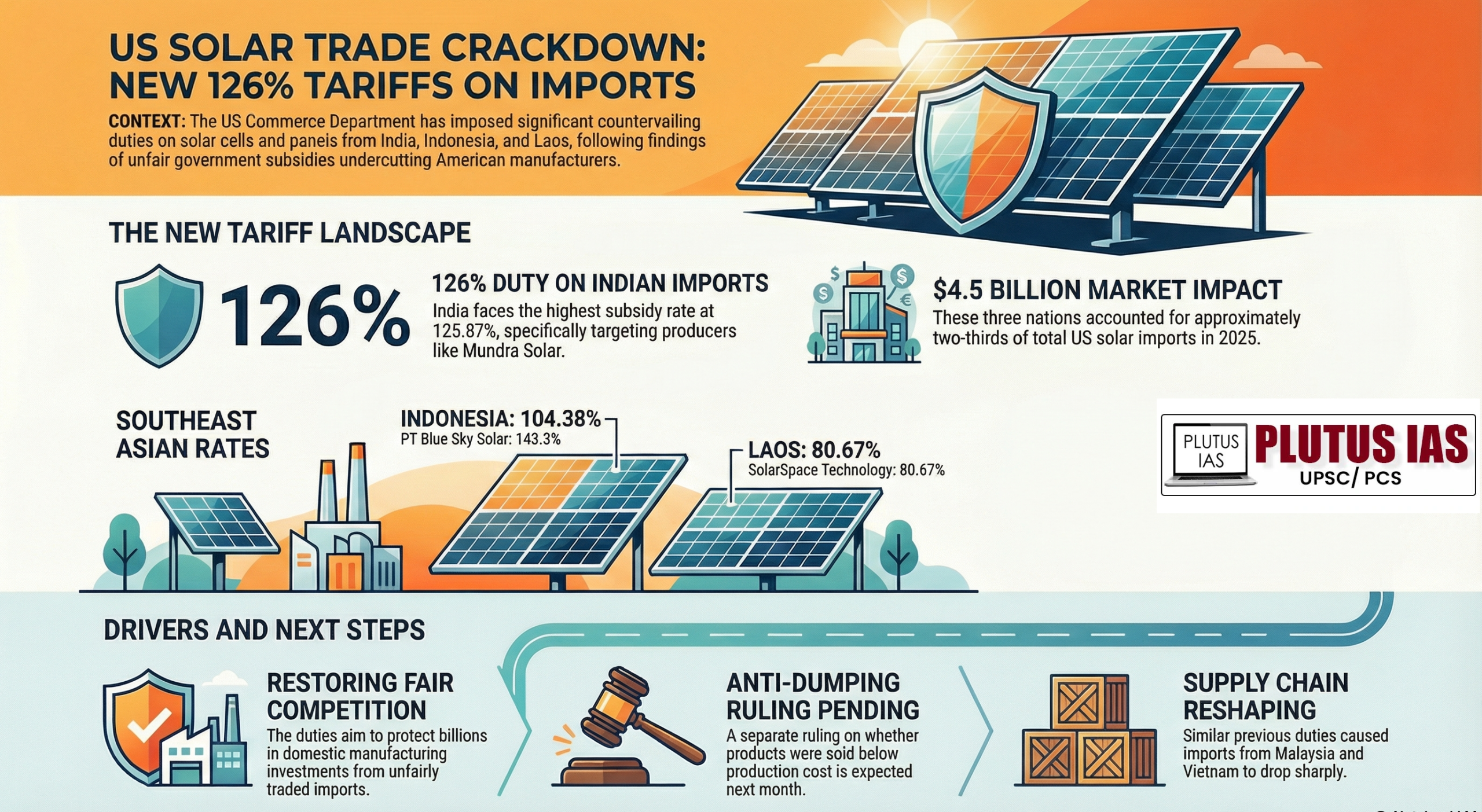
In February 2026, the United States Department of Commerce issued a landmark determination to levy Countervailing Duties (CVD) on solar cells and panels imported from India (126%), Indonesia (104%), and Laos (81%). This decision marks a significant escalation in trade tensions within the renewable energy sector, as the US seeks to shield its domestic manufacturers from what it characterizes as unfairly subsidized foreign competition.
Conceptual Definition: Countervailing Duties (CVD)
Countervailing Duties are specific trade barriers imposed under the framework of the World Trade Organization to offset the price advantage gained by exporters through government subsidies.
The Mechanism: When an importing country determines that an exporting nation’s government is providing financial assistance to its industries—thereby allowing them to sell goods below market value—it imposes a duty equivalent to the subsidy margin to “level the playing field”.
The Distinction: Unlike Anti-Dumping Duties (ADD), which target companies selling below production costs, CVDs specifically target government-led distortions in the market.
Background and Context
The Petitioners: The move was catalyzed by a petition from the Alliance for American Solar Manufacturing and Trade, a coalition including major players like First Solar (Arizona), Mission Solar Energy (Texas), and Hanwha Qcells (South Korea). They argue that foreign subsidies threaten billions of dollars in new US domestic manufacturing investments.
Shift in Supply Chains: Historically, the US market was dominated by solar imports from Malaysia, Vietnam, Thailand, and Cambodia. However, previous trade cases and high duties on those nations caused a sharp drop in their market share, leading US buyers to pivot toward India, Indonesia, and Laos.
Trade Volume: By 2025, these three countries accounted for approximately $4.5 billion in imports, representing nearly two-thirds of total US solar imports.
Significance and Importance
1. Geopolitical Strategy: Solar exports support India’s Make in India and Atmanirbhar Bharat goals, with the US being a key market for advanced solar modules.
2. Energy Security: The US is strengthening domestic manufacturing to reduce dependence on foreign suppliers in critical clean-energy supply chains.
3. Industrial Policy Shift: The move reflects growing green protectionism, where countries protect domestic renewable industries through trade measures and subsidies.
4. Trade Impact: Extremely high duties (over 100%) may disrupt global solar supply chains and alter international trade flows.
5. Climate Implications: Restricting low-cost imports could raise solar installation costs in the US, potentially slowing the global clean-energy transition.
Key Issues and Challenges
1. The Magnitude of Tariffs: A 126% duty effectively triples the cost of Indian modules in the US, making them uncompetitive against domestic or other non-affected foreign products.
2. Company-Specific Disparities: The duties are not uniform. For instance, Adani Mundra Solar (India) faces a specific rate of 125.87%, while some Indonesian firms face up to 143.3%.
3. Technical Disagreement: Representatives for the exporters, such as attorney Matthew Nicely, argue that these rates are unrealistic and do not reflect the actual financial experiences or subsidy levels of the companies involved.4.
4. Upcoming Legal Hurdle: This is only the first of two determinations. A separate ruling on Anti-Dumping is expected next month, which could further increase the total duty burden.
Constitutional and Legal Dimensions
Article 51 of the Indian Constitution: Promotion of international peace and security includes fostering “just and honourable relations between nations” and “respect for international law and treaty obligations.” India may view these duties as a violation of the spirit of the WTO SCM Agreement.
WTO Agreement on Subsidies and Countervailing Measures (SCM): This international treaty governs the use of CVDs. India must investigate if the US has met the “material injury” threshold required to justify such high duties.
Economic and Environmental Impact
Economic Impact on India:
Export Disruption: Manufacturers like Mundra Solar may face immediate revenue losses as US orders stall.
Investment Chill: High trade risks may deter future FDI into India’s solar manufacturing sector if the US market remains inaccessible.
Environmental/Climate Impact:
Increased Transition Costs: By blocking affordable imports, the US may inadvertently increase the cost of its own solar installations, potentially slowing the pace of its Net Zero transition.
SDG Linkage: This trade friction complicates the achievement of SDG 7 (Affordable and Clean Energy) and SDG 13 (Climate Action).
Governance and Institutional Aspects
US Commerce Department Autonomy: The department acts as a quasi-judicial body in trade disputes, often balancing domestic industrial lobbying with international trade commitments.
India’s Policy Response: The Indian government will likely need to engage via the Ministry of Commerce and Industry to provide counter-evidence against the “unfair subsidy” claims, particularly regarding schemes like the PLI (Production Linked Incentive).
Global Comparison
The US approach mirrors a broader trend of “Green Protectionism” seen globally. While the EU uses mechanisms like the Carbon Border Adjustment Mechanism (CBAM) to ensure fair competition, the US is increasingly relying on traditional trade remedies (CVD/ADD) and direct subsidies (via the Inflation Reduction Act) to reclaim manufacturing dominance from Asian competitors.
Way Forward
1. Domestic Market Absorption: India must accelerate domestic solar deployment through the PM-Surya Ghar: Muft Bijli Yojana to ensure that manufacturers have a robust internal market to fall back on.
2. Legal Challenge at the WTO: If the subsidy calculations are deemed arbitrary, India should join Indonesia and Laos in a collective dispute at the WTO’s Dispute Settlement Body.
3. Standardization and Transparency: Indian firms must maintain rigorous financial transparency regarding government incentives to better defend against future “unfair subsidy” allegations in international audits.
4. Strategic Diversification: Expanding export footprints into the Global South, the Middle East, and Africa can mitigate the risk of over-reliance on the US market.
Conclusion
The imposition of 126% countervailing duties is a watershed moment in the intersection of international trade and climate policy. While the US seeks to protect its “good-paying jobs” and “billions of dollars in investments,” it creates a friction point for India’s manufacturing ambitions.
Prelims question:
Q.With reference to Countervailing Duties (CVD), consider the following statements:
1. They are imposed to neutralize subsidies provided by exporting countries.
2. They are governed by the WTO Agreement on Subsidies and Countervailing Measures.
3. They are imposed when goods are sold below production cost by firms.
Which of the statements given above is/are correct?
A) 1 and 2 only
B) 2 and 3 only
C) 1 and 3 only
D) 1, 2 and 3
Answer: A
Mains Question:
Q. The recent imposition of countervailing duties on solar imports highlights the growing intersection between trade policy and climate transition. Discuss the implications of such protectionist measures for India’s solar manufacturing sector and global clean-energy supply chains (250 words)

- RBI’s Shrinking Real-Rate Cushion Amid Rising Inflation and Strong Demand - September 21, 2026
- India’s NGOs at a New Funding Crossroads - September 21, 2026
- Deep-Sea Discovery, Environmental Responsibility - September 19, 2026

No Comments