


28 Feb India-Israel Relations: A Strategic and Civilisational Convergence in a Changing Global Order
This article covers “Daily Current Affairs” and From India-Israel Relations: A Strategic and Civilisational Convergence in a Changing Global Order
SYLLABUS MAPPING
GS-2-International Relations – India-Israel Relations: A Strategic and Civilisational Convergence in a Changing Global Order
FOR PRELIMS
Why are India–Israel relations important for India?
FOR MAINS
What are the main challenges in India’s relations with Israel?
Why in the News?
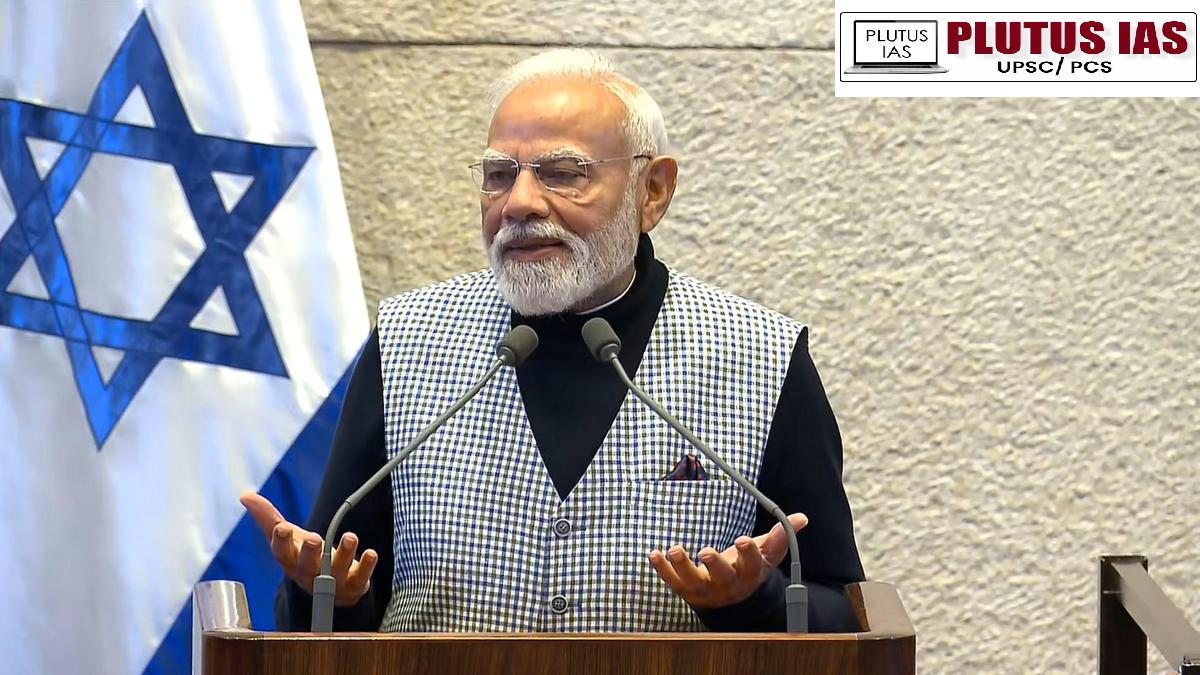
On February 25, 2026, the Prime Minister of India delivered a historic and unprecedented address to the Knesset (the Israeli Parliament). This marked the first time an Indian Head of Government has addressed this legislative body. The visit commemorated the deepening of the Strategic Partnership established in 2017 and highlighted India’s evolving role as a mediator and key security partner in the Middle East.
Defining the India–Israel Partnership
The relationship between India and Israel is a multifaceted alliance rooted in ancient civilisational ties and strengthened by modern strategic, economic, and technological cooperation. It reflects a transition from a buyer–seller defence relationship to a broad-based strategic partnership encompassing agriculture, water security, innovation, and regional stability. As the world’s fastest-growing major economy and a globally recognized “start-up nation,” respectively, India and Israel share a natural foundation for a forward-looking technological alliance.
Background and Contextual Evolution
Historical and Civilisational Ties
The relationship spans over two millennia. References to India as “Hodu” in the Book of Esther and trade records in the Talmud reflect deep-rooted ancient connectivity.
The Jewish Diaspora in India
India is among the few nations where Jewish communities—including Bene Israel (Maharashtra), Cochini Jews (Kerala), Baghdadi Jews (Mumbai and Kolkata), and Bnei Menashe (North East)—lived for centuries without persecution.
Diplomatic Milestones
India formally recognized Israel on September 17, 1950. However, relations remained limited for decades. A major shift occurred in 2017 when ties were elevated to a Strategic Partnership, expanding cooperation across multiple sectors.
Military Heritage
Shared history includes the 1918 Cavalry Charge at Haifa, where over 4,000 Indian soldiers sacrificed their lives. The memory of Major Thakur Dalpat Singh (“Hero of Haifa”) and Lt. General J.F.R. Jacob (key figure in the 1971 War) symbolize this enduring military bond.
Significance and Strategic Importance
1. Defense and Security: The bilateral MoU on Defence Cooperation (November 2025) underscores the importance of a trusted security partnership in a volatile global environment.
2. Agricultural and Water Security: Israel’s desert agriculture model has inspired India’s “Per Drop, More Crop” initiative. Precision irrigation and advanced water management technologies are crucial for India’s food security.
3. Technological Synergy: Cooperation in Quantum technologies, semiconductors, and Artificial Intelligence (AI) is central to the bilateral agenda, combining Israel’s innovation ecosystem with India’s large-scale implementation capacity.
4. Regional Architecture
India and Israel are key members of:
I2U2
India–Middle East–Europe Economic Corridor (IMEC)
Economic and Social Dimensions
1. Trade and Investment: Bilateral trade has expanded but remains below potential. The Bilateral Investment Treaty (2025) provides legal certainty, while negotiations for a Free Trade Agreement (FTA) seek to unlock greater trade opportunities.
2. Digital Public Infrastructure (DPI): Both nations are exploring cross-border financial linkages using India’s Digital Public Infrastructure model to facilitate seamless economic transactions.
3. The Human Pillar: Nearly half a million Indian farmers have been trained through 43 Centres of Excellence. Indian caregivers and skilled workers in Israel demonstrated resilience and dedication during crises such as the October 7 attacks.
Key Issues and Geopolitical Challenges
1. Terrorism: Both countries face cross-border terrorism. India maintains a consistent zero-tolerance approach, drawing parallels between the 26/11 Mumbai attacks and the October 7 attacks by Hamas.
2. Regional Instability: The Gaza conflict remains a major challenge. India has supported peace initiatives endorsed by the UN Security Council, advocating a just and durable solution to the Palestine issue.
3. Maintaining Momentum: Following the promise of the Abraham Accords, regional dynamics have become complex, requiring sustained diplomatic engagement and strategic vision.
Governance and Institutional Aspects
Legislative Cooperation
The formation of a Parliamentary Friendship Group for Israel in the Indian Parliament institutionalizes legislative exchanges and strengthens democratic cooperation.
Innovation Ecosystems
The iCreate Technology Business Incubator, inaugurated in 2018 by both Prime Ministers, has supported nearly 900 start-ups, showcasing successful youth-led innovation collaboration.
Ethical and Democratic Foundations
The partnership rests on shared democratic values and philosophical parallels:
1. Tikkun Olam (healing the world)
2. Vasudhaiva Kutumbakam (the world is one family)
3. Ethical traditions such as Halakha and Dharma
4. Cultural similarities in festivals like Hanukkah–Diwali and Purim–Holi
Way Forward
1. Expansion of Agricultural Cooperation: Increase the Centres of Excellence from 43 to 100 across India. Extend advanced Israeli techniques in drip irrigation, horticulture, and water management to more farmers and fishermen.
2. Early Conclusion of the Free Trade Agreement (FTA): Fast-track negotiations to unlock untapped trade potential. Strengthen supply chain integration and boost bilateral investments.
3. Deepening Technology & Manufacturing Collaboration: Promote joint manufacturing in semiconductors and Artificial Intelligence (AI). Combine Israel’s R&D strength with India’s large-scale production capacity.
4. Strengthening Digital Public Infrastructure (DPI) Linkages: Develop seamless cross-border financial systems. Facilitate smoother remittances, digital payments, and business transactions.
5. Enhancing People-to-People Engagement: Promote Yoga and Ayurveda in Israel. Encourage youth exchanges, academic collaboration, and tourism to build cultural understanding.
6. Sustained Diplomatic & Regional Engagement: Continue dialogue to ensure stability in West Asia. Support international efforts toward a just and durable peace in the region.
Conclusion
The India–Israel partnership has evolved from historical goodwill into a strategic imperative for the 21st century. Grounded in shared values and civilisational traditions, it advances national development while contributing to global stability. As India moves toward the vision of Viksit Bharat 2047, the synergy between India’s economic scale and Israel’s technological innovation will remain central to inclusive growth, sustainable development, and a peaceful regional order.
Prelims question:
Q. With reference to India–Israel relations, consider the following statements:
1. India recognized Israel in 1950 but upgraded the relationship to a Strategic Partnership only in 2017.
2. India and Israel are members of the I2U2 grouping along with the United Kingdom and France.
3. The India–Middle East–Europe Economic Corridor (IMEC) aims to enhance connectivity and economic integration across regions.
Which of the statements given above is/are correct?
A) 1 and 3 only
B) 2 and 3 only
C) 1 only
D) 1, 2 and 3
Answer: A
Mains Question:
Q. The India–Israel relationship has evolved from limited diplomatic engagement to a comprehensive strategic partnership. Discuss the key areas of cooperation between the two countries and examine the challenges in balancing strategic interests with regional stability in West Asia (250 words)

- RBI’s Shrinking Real-Rate Cushion Amid Rising Inflation and Strong Demand - September 21, 2026
- India’s NGOs at a New Funding Crossroads - September 21, 2026
- Deep-Sea Discovery, Environmental Responsibility - September 19, 2026

No Comments