


09 Mar Pradhan Mantri Bhartiya Janaushadhi Pariyojana (PMBJP): Towards Affordable and Equitable Healthcare
This article covers “Daily Current Affairs” and From Pradhan Mantri Bhartiya Janaushadhi Pariyojana (PMBJP): Towards Affordable and Equitable Healthcare
SYLLABUS MAPPING
GS-2– Governance- Pradhan Mantri Bhartiya Janaushadhi Pariyojana (PMBJP): Towards Affordable and Equitable Healthcare
FOR PRELIMS
What are the major challenges in the implementation of the Pradhan Mantri Bhartiya Janaushadhi Pariyojana?
FOR MAINS
What is the purpose of the Pradhan Mantri Bhartiya Janaushadhi Pariyojana?
Why in the news?
India observed Janaushadhi Saptah 2026 from March 1st to 7th, culminating in the 8th Janaushadhi Diwas on March 7, 2026.
This nationwide outreach initiative, themed “Janaushadhi Sasti Bhi, Bharosemand Bhi, Sehat Ki Baat, Bachat Ke Saath,” was organized by the Pharmaceuticals and Medical Devices Bureau of India (PMBI) to promote awareness regarding affordable, quality generic medicines.
Defining PMBJP
The Pradhan Mantri Bhartiya Janaushadhi Pariyojana (PMBJP) is a flagship campaign launched by the Department of Pharmaceuticals, Ministry of Chemicals and Fertilizers.
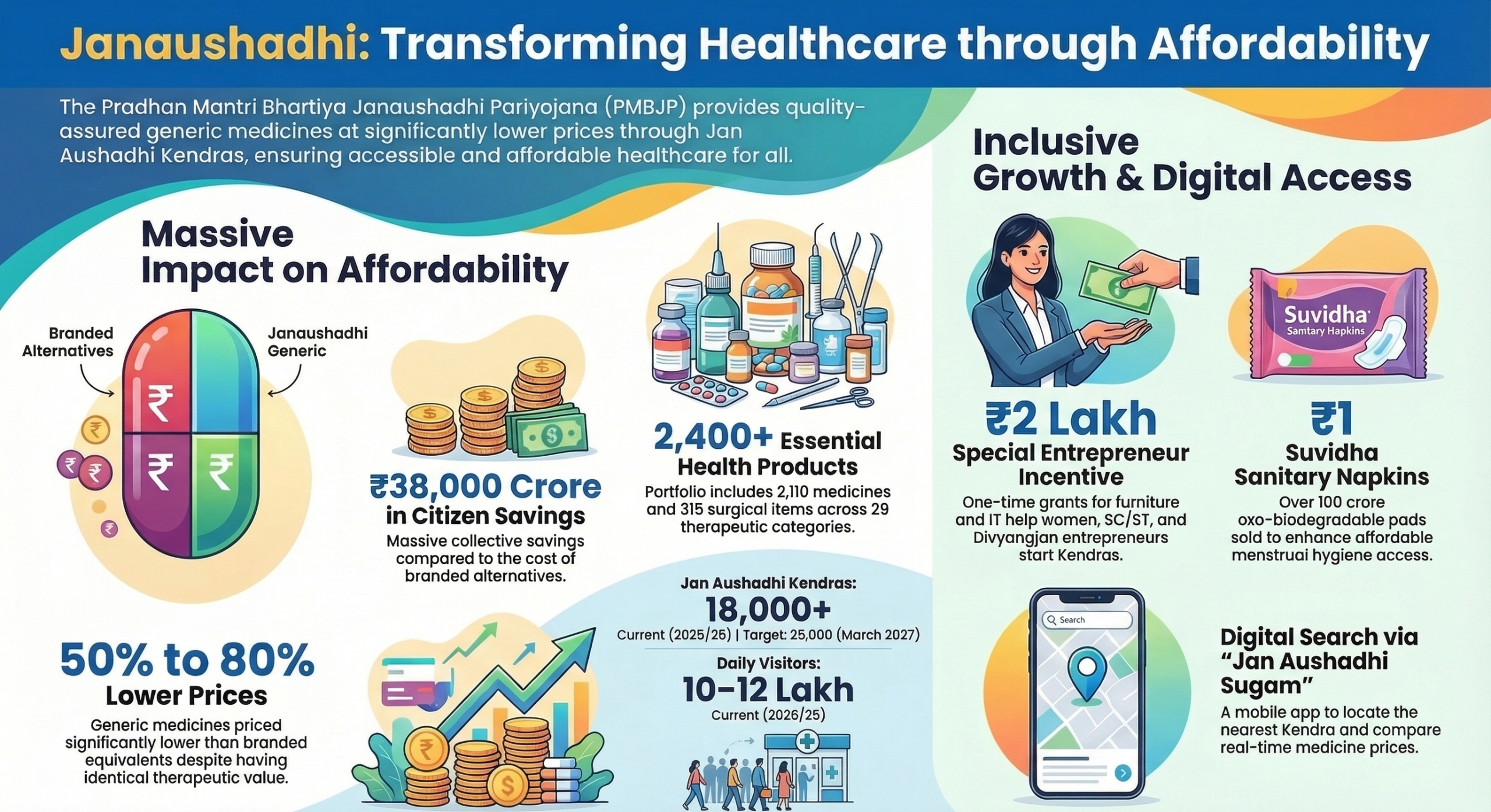
It aims to provide quality-assured generic medicines at significantly lower prices—typically 50% to 80% less than branded alternatives—through a dedicated network of outlets known as Jan Aushadhi Kendras (JAKs).
Background and Context
In India, medicines constitute a disproportionately high share of household out-of-pocket expenditure (OOPE), often acting as a barrier to essential treatment.
While branded generic medicines are sold at premium prices, their unbranded counterparts possess the same therapeutic value.
The PMBJP serves as a critical policy intervention to bridge this disparity, ensuring that financial vulnerability does not translate into a denial of healthcare.
Significance and Importance
1. Financial Protection: By offering medicines at a fraction of market costs, the scheme has generated estimated savings of approximately ₹38,000 crore for citizens as of June 2025.
2. Healthcare Accessibility: With over 18,000 functional Kendras and a target of 25,000 by March 2027, the scheme ensures the availability of over 2,100 medicines and 315 surgical items even in remote areas.
3. Inclusive Entrepreneurship: The franchise-based model empowers individual entrepreneurs, NGOs, and cooperatives, particularly those from marginalized groups.
Governance and Institutional Aspects
1. Regulatory Oversight: The Pharmaceuticals and Medical Devices Bureau of India (PMBI) is the implementing agency.
2. Quality Assurance: Medicines are sourced exclusively from WHO-GMP compliant manufacturers and undergo rigorous testing at NABL-accredited laboratories before distribution.
3. Digital Integration: The Jan Aushadhi Sugam mobile app facilitates transparency by allowing users to locate nearby shops, check real-time availability, and compare prices with branded drugs.
Economic and Social Impact
1. Menstrual Hygiene: The introduction of Suvidha Oxo-biodegradable Sanitary Napkins at ₹1 per pad has revolutionized access to menstrual health, with over 100 crore pads sold by January 2026.
2. Empowerment of Vulnerable Sections: Special financial incentives of up to ₹2 lakh are provided to women, SC/ST, Divyangjan, and entrepreneurs in Himalayan and North-Eastern regions to establish Kendras.
3. Rural Penetration: The integration of Primary Agricultural Credit Societies (PACS) allows the scheme to leverage a network of 13 crore farmers to serve as affordable medicine hubs in deep rural pockets.
Key Issues and Challenges
1. Supply Chain Resilience: Maintaining a consistent supply of fast-moving drugs across a massive national network remains a logistical challenge.
2. Perception Gaps: Despite quality certifications, overcoming the public and medical community’s bias toward expensive branded medicines requires continuous awareness efforts.
3. Operational Sustainability: Ensuring the long-term viability of individual Kendras requires maintaining a minimum stock of high-demand products and diversifying the product basket to include nutraceuticals.
Constitutional and Legal Dimensions
While the PMBJP is an executive scheme, it aligns with the Directive Principles of State Policy, specifically Article 47, which mandates the State to improve public health.
Furthermore, the Supreme Court of India has frequently interpreted the Right to Health as an integral part of the Right to Life under Article 21, making the provision of affordable medicine a constitutional imperative.
Way Forward
1. Strengthening Last-Mile Connectivity: Expanding the presence of JAKs at high-footfall transit hubs like Railway Stations (currently 116) and through the PACS network to ensure no citizen is left behind.
2. Technological Upgradation: Further digitizing demand forecasting and utilizing the end-to-end IT-enabled supply chain to prevent “out-of-stock” scenarios for the 400 fastest-moving products.
3. Behavioral Change Communication: Sustained outreach like Janaushadhi Saptah is essential to build trust in the efficacy of generic drugs among doctors and patients alike.
4. Enhancing Store Viability: Continually expanding the product basket to include medical devices and daily health supplements to increase footfall and revenue for store operators.
Conclusion
The Pradhan Mantri Bhartiya Janaushadhi Pariyojana has evolved from a price-control mechanism into a robust ecosystem for inclusive growth and democratic governance in healthcare. By intertwining affordable health with entrepreneurial opportunities, it aligns with India’s long-term vision of Viksit Bharat 2047 and Sustainable Development Goal 3 (Good Health and Well-being). Ultimately, the scheme reinforces the Government’s commitment to an Atmanirbhar Bharat, where quality healthcare is a right for all, regardless of socio-economic status.
Prelims question:
Q. With reference to the Pradhan Mantri Bhartiya Janaushadhi Pariyojana (PMBJP), consider the following statements:
1. It aims to provide quality generic medicines at affordable prices through Jan Aushadhi Kendras.
2. The scheme is implemented by the Pharmaceuticals and Medical Devices Bureau of India.
3. Medicines under the scheme are procured only from WHO-GMP compliant manufacturers and tested in NABL-accredited laboratories.
4.The scheme is implemented by the Ministry of Health and Family Welfare.
Which of the statements given above are correct?
A) 1 and 2 only
B) 1, 2 and 3 only
C) 2, 3 and 4 only
D) 1, 3 and 4 only
Answer: B
Mains Question:
Q. The Pradhan Mantri Bhartiya Janaushadhi Pariyojana (PMBJP) aims to make healthcare more affordable and accessible in India. Discuss its significance in reducing healthcare costs and improving public health. Also examine the challenges associated with its implementation. (250 words)

- RBI’s Shrinking Real-Rate Cushion Amid Rising Inflation and Strong Demand - September 21, 2026
- India’s NGOs at a New Funding Crossroads - September 21, 2026
- Deep-Sea Discovery, Environmental Responsibility - September 19, 2026

No Comments