


10 Mar The Essential Commodities Act (ECA), 1955: Navigating the Intersection of Market Liberalization and State Intervention
This article covers “Daily Current Affairs” and From The Essential Commodities Act (ECA), 1955: Navigating the Intersection of Market Liberalization and State Intervention
SYLLABUS MAPPING
GS-3-Indian Economy- The Essential Commodities Act (ECA), 1955: Navigating the Intersection of Market Liberalization and State Intervention
FOR PRELIMS
What is the Essential Commodities Act, 1955?
FOR MAINS
What are the main objectives of the Essential Commodities Act?
Why in the news?
On March 9, 2026, the Central Government invoked the Essential Commodities Act (ECA), 1955, in response to a global oil crisis triggered by Israel-U.S. strikes on Iran. This directive mandates that all oil refining companies maximize the production of Liquefied Petroleum Gas (LPG) and ensure its availability is prioritized exclusively for domestic consumers to prevent energy shortages.
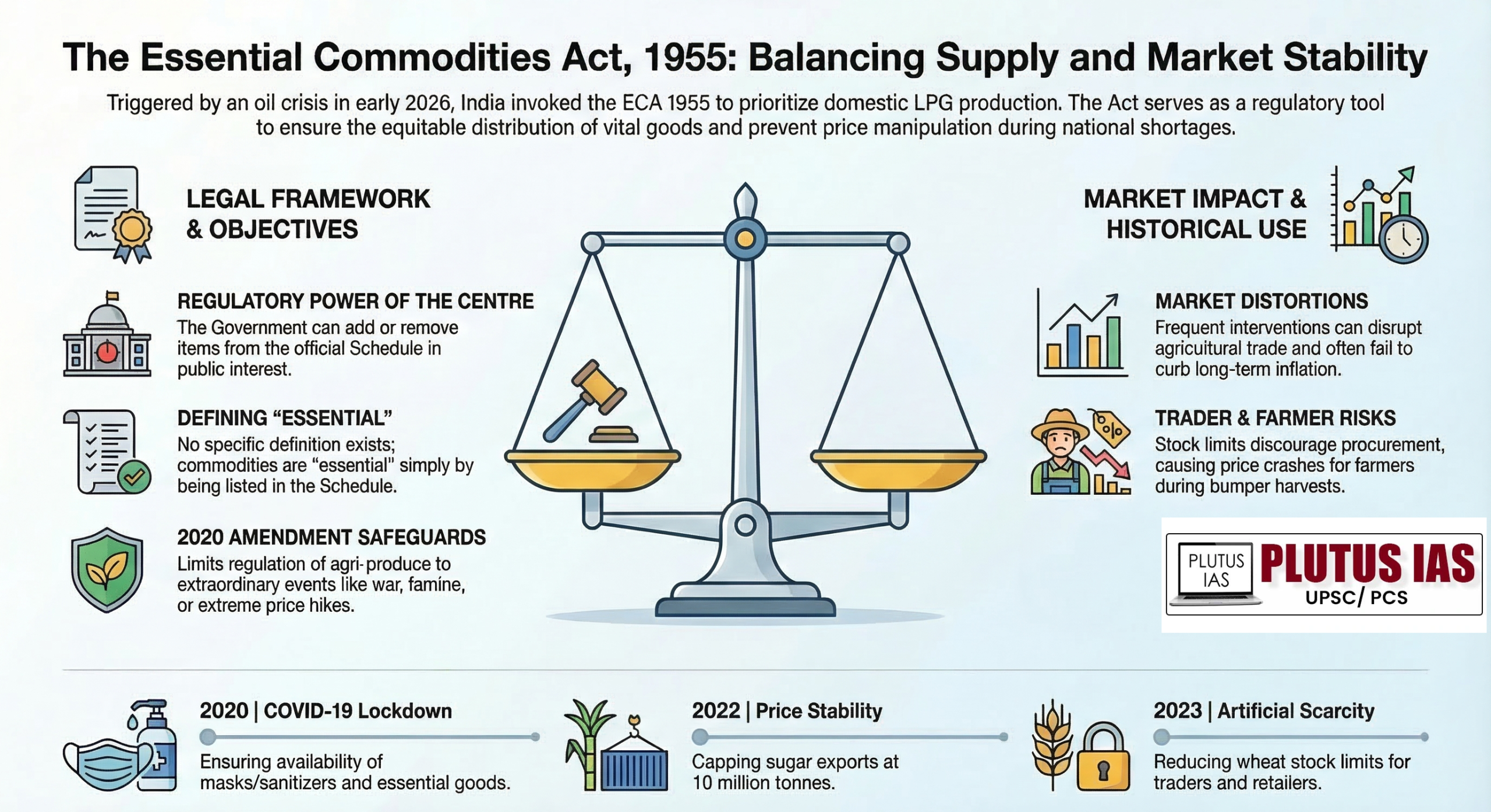
Defining the Essential Commodities Act (ECA), 1955
The ECA is a regulatory tool used by the state to control the production, supply, and distribution of commodities that are vital to the community.
1. Legal Precision: The Act does not provide a specific definition of what an “essential commodity” is.
2. Section 2(A): It clarifies that an “essential commodity” refers to any item currently specified in the “Schedule” of the Act.
3. Central Authority: The Centre holds the power to add or remove items from this Schedule in the public interest, typically in consultation with State Governments.
Historical and Economic Context: A Legacy of Scarcity
1. Genesis (1955): The Act was born out of a period of severe food shortages and low domestic foodgrain production in post-independence India.
2. External Dependence: During this era, India was heavily reliant on food aid, most notably wheat imports under the United States’ Public Law 480 (PL-480) Program.
3. Initial Intent: The primary goal was to ensure a fair distribution system and to curb the predatory practices of hoarding and black marketing.
The 2020 Amendment: A Paradigm Shift
Limited Regulatory Scope: The Centre’s power to regulate items like cereals, pulses, potatoes, onions, edible oilseeds, and oils was restricted to “extraordinary circumstances” such as war, famine, extraordinary price rises, or grave natural calamities.
Price-Triggered Stock Limits: Stock limits on agricultural produce can now only be imposed if there is a 100% retail price rise for horticultural produce or a 50% rise for non-perishables.
Critical Analysis: Challenges and Market Distortions
1. Distorting Agricultural Trade: Frequent and ad-hoc government interventions often disrupt the natural price discovery of the market and have been largely ineffective at controlling long-term inflation.
2. Deterring Infrastructure Investment: The fear of sudden stock limits discourages traders from investing in large-scale storage and warehousing, as they often purchase less than their actual capacity to avoid legal complications.
3. Impact on Farmers: During bumper harvests, the inability of traders to stock large quantities leads to price crashes, particularly for perishable goods, causing heavy financial losses for farmers.
4. Administrative Malpractice: The broad regulatory powers have occasionally led to rent-seeking, corruption, and harassment of legitimate market participants by enforcement agencies.
Governance and Institutional Aspects
1. Role of States: While the Centre notifies a commodity, it often urges State Governments to enforce stock limits and ensure fair pricing, as seen during the COVID-19 lockdown in April 2020.
2. Digital Monitoring: The government has increasingly moved toward transparency, such as the Wheat Stock Limit Portal (2023), which requires stocking entities to register and provide weekly updates.
3. Export Controls: The Directorate General of Foreign Trade (DGFT) often uses ECA-linked orders to cap exports, as seen with Sugar in May 2022, to prioritize domestic stability.
Way Forward: Policy-Oriented Solutions
1. Objective Trigger Mechanisms: Adhere strictly to the 2020 amendment’s price triggers to ensure regulatory predictability for investors.
2. Infrastructure Incentives: Provide “safe harbor” status for modern warehouses and cold-chain providers to encourage private investment in the agricultural value chain.
3. Market-Based Price Stabilization: Instead of restrictive stock limits, the government should strengthen the Price Stabilization Fund to intervene through open market operations.
4. Evidence-Based Implementation: Use real-time data from GSTN and digital stock portals to target only genuine hoarders rather than legitimate traders.
Conclusion
The Essential Commodities Act, 1955, serves as a vital safeguard for the socio-economic rights of Indian citizens, ensuring that the most vulnerable are protected from market volatility during crises. However, as India aims for Viksit Bharat 2047, the Act must evolve from a “control-based” regime to a “facilitative” framework. By balancing the constitutional value of social justice with the needs of a modern, efficient market, India can achieve inclusive growth and Atmanirbhar Bharat, ensuring that “essential” goods are accessible to all without stifling the economic engine of the nation.
Prelims question:
Q. With reference to the Essential Commodities Act (ECA), 1955, consider the following statements:
1. The Act clearly defines the term “essential commodity” in its provisions.
2. The Central Government has the power to add or remove commodities from the Schedule of the Act.
3. After the 2020 amendment, stock limits on agricultural produce can be imposed only under extraordinary circumstances.
Which of the statements given above is/are correct?
A) 1 and 2 only
B) 2 and 3 only
C) 1 and 3 only
D) 1, 2 and 3
Answer: B
Mains Question:
Q. The Essential Commodities Act, 1955 plays a crucial role in ensuring the availability and price stability of essential goods in India. However, frequent government interventions may distort market mechanisms. Critically examine the relevance of the Essential Commodities Act in the context of recent economic reforms and market liberalization
(250 words)

- Blockades in the Red Sea and Persian Gulf: Why Maritime Security Matters for India - September 16, 2026
- Iran War and the U.S. Munitions Shortfall: What It Reveals About Defence Industrial Capacity - September 16, 2026
- Let AI Safety Catch Up: Governing Frontier AI Before It Outruns Human Control - September 15, 2026

No Comments