


11 Mar The Brain Co-Processor Moonshot: Advancing Neurotechnology and Indigenous Innovation in India
This article covers “Daily Current Affairs” and From The Brain Co-Processor Moonshot: Advancing Neurotechnology and Indigenous Innovation in India
SYLLABUS MAPPING
GS- 3-Science and Technology- The Brain Co-Processor Moonshot: Advancing Neurotechnology and Indigenous Innovation in India
FOR PRELIMS
What are the main challenges in developing brain–machine interface technology?
FOR MAINS
What are brain co-processors?
Why in the news?
Recently, the Indian Institute of Science (IISc), Bangalore, in partnership with the Pratiksha Trust, launched an ambitious “Moonshot Project” to develop brain co-processors. This multidisciplinary initiative aims to position India at the global frontier of neuroscience and AI-driven medical technology.
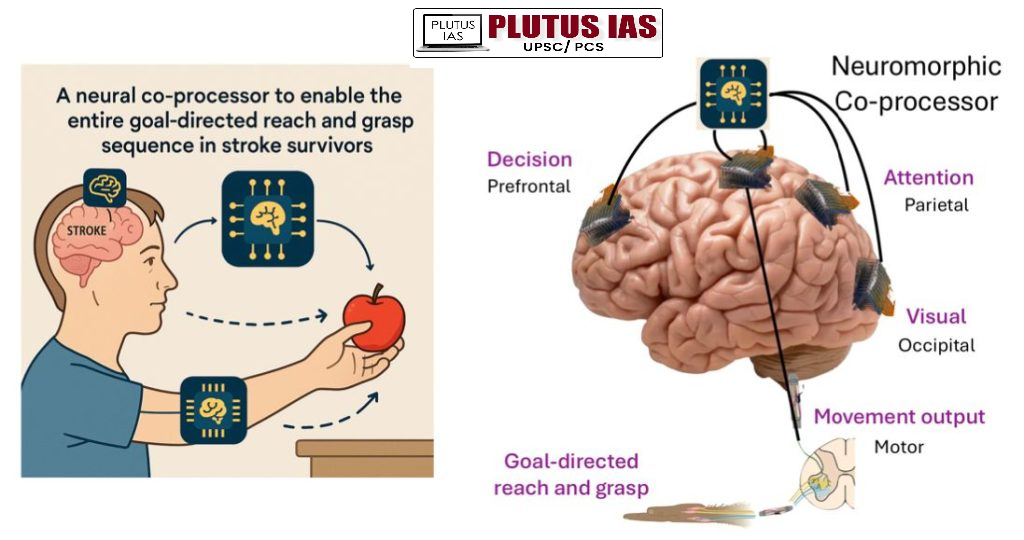 Defining Brain Co-Processors
Brain co-processors are advanced, AI-powered closed-loop devices designed to interact directly with the human brain. These systems function by decoding neural signals, processing them through artificial intelligence (AI) algorithms, and re-encoding the information back into the brain via neural stimulation or neurofeedback. Unlike traditional assistive devices, they aim to enhance or restore natural brain functions such as motor control, memory, and vision.
Background and Context
The project evolved from the Brain, Computation, and Data Science (BCD) initiative at IISc, an interdisciplinary cluster comprising over 20 faculty members from eight different departments. Supported by a generous endowment from the Pratiksha Trust (founded by Kris Gopalakrishnan and Sudha Gopalakrishnan), the initiative aligns with the vision of establishing an “Indian Brain Project”.
This effort comes at a critical time as traditional silicon electronics approach saturation, necessitating brain-inspired or neuromorphic computing accelerators to deliver faster, more energy-efficient AI.
Significance and Importance
1. Medical Rehabilitation: The primary focus is the cognitive and motor rehabilitation of stroke survivors, specifically restoring goal-directed reaching and grasping abilities.
2. Technological Breakthroughs: Researchers have already developed an analog computing platform capable of storing 16,500 conductance states—a massive leap over the binary (two-state) limit of traditional digital computers.
3. Strategic Autonomy: By indigenizing the development of implants, hardware, and AI stacks, India reduces its dependence on expensive imported neurotechnology.
4. Creation of Digital Public Goods: The project intends to release open-source AI tools, visualization platforms, and India-specific neural datasets (such as stereo EEG and ECoG) to foster global research.
Governance and Institutional Aspects
The project is a collaborative model involving IISc’s Foundation for Science, Innovation and Development (FSID), medical professionals, and international research institutions. It receives support from the Ministry of Electronics and Information Technology (MeitY) and aligns with the India Semiconductor Mission, focusing on developing a fully indigenous system-on-a-chip.
Key Issues and Challenges
1. Technical Complexity: The human brain’s 86 billion neurons present an immense challenge for accurate decoding and real-time interaction.
2. Regulatory Hurdles: Medical implants require rigorous clinical validation and must meet stringent national and international safety standards before deployment.
3. Data Privacy: Neural data is exceptionally sensitive; its collection and use raise significant neuro-privacy concerns regarding how thought-related data is stored and protected.
4. Cost and Accessibility: Initial stages of such high-end technology are often expensive, potentially limiting access to specialized healthcare centers.
Ethical and Democratic Concerns
The ability to “write” signals back into the brain via re-encoding raises ethical questions regarding human agency and cognitive liberty. Furthermore, ensuring that these life-altering technologies do not exacerbate the digital divide in healthcare is a vital democratic concern for inclusive growth.
Economic and Social Impact
1. Energy Efficiency: Neuromorphic accelerators can perform complex AI tasks (like training Large Language Models) on personal devices at a fraction of the energy required by traditional data centers.
2. Healthcare Savings: Developing affordable treatments suited for low-resource healthcare settings can significantly reduce the long-term economic burden of neurological disability in India.
Way Forward
1. Robust Regulatory Framework: India must develop specific clinical and ethical guidelines for Brain-Machine Interfaces (BMI) to ensure patient safety and data protection.
2. Interdisciplinary Talent Pipeline: Strengthening programs like IISc’s Interdisciplinary Ph.D. in Brain and Artificial Intelligence is essential to sustain a specialized workforce.
3. Public-Private Partnerships (PPP): Scaling the project from a “moonshot” to a mass-market reality will require deeper integration with India’s burgeoning medical device and semiconductor industries.
5. Clinical Integration: Continuous feedback loops involving neurologists, therapists, and caregivers are necessary to ensure the technology meets real-world patient needs.
Conclusion
The IISc Moonshot Project on Brain Co-processors represents more than a scientific milestone; it is a testament to India’s growing capacity for technological self-reliance (Atmanirbhar Bharat). By bridging the gap between foundational neuroscience and clinical application, this initiative supports United Nations Sustainable Development Goal 3 (Good Health and Well-being) and promotes inclusive growth by targeting affordable rehabilitation for stroke survivors. As India moves toward Viksit Bharat 2047, such pioneering efforts in neurotechnology will be pivotal in positioning the nation as a global leader in the Age of AI, grounded in the constitutional value of improving the quality of life for all its citizens.
Best ias coaching in delhi Best ias coaching in chandigar
Prelims question:
Q. With reference to Brain Co-Processors, consider the following statements:
I. Brain co-processors are AI-based closed-loop devices that decode neural signals and send processed signals back to the brain.
II. They can help restore or enhance brain functions such as motor control, memory, and vision.
III. They work only as external assistive devices and do not interact directly with neural activity.
Which of the statements given above is/are correct?
(a) I and II only
(b) II and III only
(c) I only
(d) I, II and III
Answer: A
Mains Question:
Q. The development of brain co-processors represents a major advancement in neurotechnology and artificial intelligence. Discuss the significance of the “Moonshot Project” launched by the Indian Institute of Science in advancing indigenous innovation in India. Also examine the challenges associated with brain-machine interface technologies.
(250 words)

- RBI’s Shrinking Real-Rate Cushion Amid Rising Inflation and Strong Demand - September 21, 2026
- India’s NGOs at a New Funding Crossroads - September 21, 2026
- Deep-Sea Discovery, Environmental Responsibility - September 19, 2026

No Comments