


21 Mar India’s Pharmaceutical Sector: From Global Generic Leader to Innovation Powerhouse
This article covers “Daily Current Affairs” and From India’s Pharmaceutical Sector: From Global Generic Leader to Innovation Powerhouse
SYLLABUS MAPPING
GS-3- Indian Economy- India’s Pharmaceutical Sector: From Global Generic Leader to Innovation Powerhouse
FOR PRELIMS
What is the role of government in the pharma sector?
FOR MAINS
What is the importance of India’s pharmaceutical sector?
Why in the News?
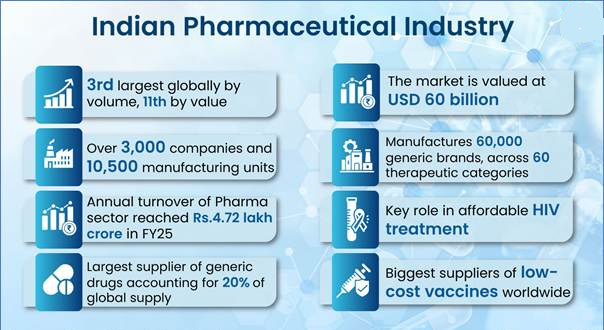
The release of the Economic Survey 2025-26 and the Union Budget 2026-27 have highlighted the Indian pharmaceutical sector’s robust growth, with annual turnover reaching Rs. 4.72 lakh crore in FY25. Furthermore, the sector’s strategic importance has been underscored by the conclusion of major trade agreements with the United Kingdom (July 2025) and New Zealand (December 2025), alongside ongoing negotiations with the European Union.
Definition and Context
The Indian pharmaceutical industry is a vital socio-economic sector that occupies a unique intersection between public health and economic development. It is defined by its ability to provide essential medicines and vaccines globally, driven by a combination of affordable pricing and assured quality. Historically, the sector has evolved from focusing on domestic production to becoming the world’s largest provider of generic medicines, accounting for approximately 20% of the global generic supply.
Significance
1. Global Leadership in Vaccines: India provides nearly 60% of vaccine supplies to UNICEF, meets 40-70% of global demand for DPT and BCG vaccines, and satisfies 90% of the WHO’s measles vaccine demand.
2. Market Scale: Ranked 3rd globally by volume and 11th by value, the industry comprises over 3,000 companies and 10,500 manufacturing units.
3. Strategic Exports: India exported to 191 countries in 2024-25, with 50% of exports directed to highly regulated markets like the U.S. and Europe.
4. Cost-Efficient Excellence: Cost-efficient manufacturing and a strong scientific workforce have enabled the production of 60,000 generic brands across 60 therapeutic categories.
Key Issues and Challenges
1. Import Dependence on Critical Inputs: Despite growth, there has been a historical reliance on single sources for Active Pharmaceutical Ingredients (APIs) and Key Starting Materials (KSMs).
2. Moving Up the Value Chain: While India leads in generics, there is a strategic need to move beyond generic manufacturing toward high-value biopharmaceuticals, biologics, and biosimilars.
3. Regulatory Harmonization: Ensuring continuous alignment of domestic standards with evolving international scientific and technological advancements remains a priority.
Economic and Social Impact
1. Economic Growth and FDI: The sector is a top-10 industry for foreign investment, attracting Rs. 13,193 crore in FDI up to September 2025. The domestic market is projected to grow from USD 60 billion to USD 130 billion by 2030.
2. Social Welfare and Affordability: The Pradhan Mantri Bhartiya Janaushadhi Pariyojana has established over 18,646 Jan Aushadhi Kendras, providing 2,110 medicines at reasonable prices and saving citizens approximately Rs. 8,000 crore in 2024-25.
3. Employment: Government schemes like the PLI for Pharmaceuticals have generated employment for approximately 97,000 persons as of late 2025.
Government Policy Interventions
1. Production Linked Incentive (PLI) Schemes: These schemes target pharmaceuticals, bulk drugs, and medical devices to reduce import dependency and boost domestic manufacturing.
2. Infrastructure Development: The government is supporting three Bulk Drug Parks (Andhra Pradesh, Gujarat, Himachal Pradesh) and three Medical Device Parks (UP, MP, Tamil Nadu) to provide common infrastructure and reduce manufacturing costs.
3. Innovation Focus: The Scheme for Promotion of Research and Innovation in Pharma MedTech (PRIP) and the new Biopharma SHAKTI initiative (with a Rs. 10,000 crore outlay) aim to foster a biopharmaceutical ecosystem.
Global Comparison and Trade Integration
1. India-EU FTA: Expected to provide market access valued at USD 572.3 billion.
2. India-UK CETA: Grants zero-duty access for 56 pharmaceutical tariff lines, enhancing the competitiveness of Indian generics in its largest European market.
3. India-NZ FTA: Provides zero-duty access across 90 tariff lines where duties previously ranged up to 5%.
Way Forward
1. Strengthening the API Ecosystem: Continue the momentum of the PLI for Bulk Drugs to further reduce the Rs. 3,591 crore worth of imports already avoided, ensuring supply chain resilience.
2. Focus on High-Value Innovation: Fully operationalize the Biopharma SHAKTI initiative by upgrading NIPERs and creating a network of 1,000+ accredited clinical trial sites to lead in biologics.
3. Enhancing Regulatory Diplomacy: Leverage the growing international acceptance of the Indian Pharmacopoeia to harmonize standards with more global partners.
4. Scaling Infrastructure: Accelerate the completion of common infrastructure in approved Bulk Drug and Medical Device Parks to support MSME participation.
Conclusion
India’s pharmaceutical sector has matured into a globally integrated system that effectively balances commercial scale with public health imperatives. By aligning with the vision of Atmanirbhar Bharat through reduced import dependence and pursuing inclusive growth via the PMBJP, the industry is a cornerstone of India’s journey toward Viksit Bharat 2047. Its continued focus on innovation-led growth and sustainable development in healthcare ensures that India remains a dependable and technologically advanced global leader in the pharmaceutical landscape.
Best ias coaching in delhi Best ias coaching in chandigarh
Prelims question:
Q. Consider the following statements regarding India’s pharmaceutical sector:
1. India is the largest provider of generic medicines globally.
2. India meets about 60% of UNICEF’s vaccine demand.
3. India is fully self-reliant in the production of Active Pharmaceutical Ingredients (APIs).
Which of the statements given above is/are correct?
(a) 1 and 2 only
(b) 2 and 3 only
(c) 1 and 3 only
(d) 1, 2 and 3
Answer: A
Q. India’s pharmaceutical sector is transitioning from a ‘Pharmacy of the World’ to a global innovation hub. Discuss the challenges and suggest measures to achieve this transformation.
(250 words)

- RBI’s Shrinking Real-Rate Cushion Amid Rising Inflation and Strong Demand - September 21, 2026
- India’s NGOs at a New Funding Crossroads - September 21, 2026
- Deep-Sea Discovery, Environmental Responsibility - September 19, 2026

No Comments